

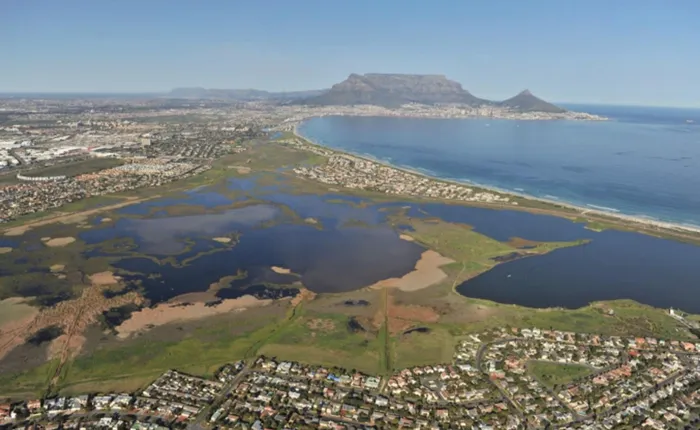
Diep River Estuary. Picture: City of Cape Town/Supplied
Cape Town – At its last meeting for 2022, the City of Cape Town’s council has adopted the Diep River estuary management plan that was published for public comment and input earlier this year.
This plan will now be submitted to provincial Environmental Affairs and Development Planning MEC Anton Bredell for approval in terms of section 9 of the national estuarine management protocol.
Deputy mayor and spatial planning and environment Mayco member Eddie Andrews said that this was a significant milestone in addressing pollution in the estuary, and the associated challenges and impact on surrounding communities.
“As a local government, our primary focus is to sustainably respond to the impact of rapid urbanisation.
“We are facing many pressures and the Diep River estuary management plan seeks to respond to the long-standing environmental pressures in Milnerton, Table View and surrounds.
“I trust that the affected communities will, over time, see and experience the benefits of the Diep River estuary management plan,” said Andrews.
The estuary covers an area of approximately 900 hectares and is the point at which the Diep River meets the ocean.
The river originates in the Riebeek Kasteel Mountains north-east of Malmesbury, and flows for about 65km south-west towards Cape Town, before entering the sea some 5km north of the Port of Cape Town.
As it flows towards the sea, the Diep River meanders through the Rietvlei Wetland Reserve and into Milnerton Lagoon.
Andrews said that the revised Diep River estuary management plan identifies pragmatic and realistic management interventions that will be undertaken against short, medium and long-term time horizons to address the current pressures on the estuary, and within the context of a heavily altered and urbanised environment.
“The plan includes new information and recommendations on how the City may manage the estuary more effectively.
“The plan was workshopped with a number of external experts and independent scientists in the field of coastal and estuarine science, and key City departments. We also gave the public an opportunity to comment and submit their proposals.
“The plan acknowledges the systemic pressures arising from multiple land uses within the wider catchment area of the Diep River and adopts a transversal approach towards addressing these pressures,” Andrews said.
The plan lists priorities and actions, among which:
A total of 47 high priority actions are indicated in the report and those priority actions are assigned to the responsible City departments, Andrews said.
“The Diep River estuary management plan is another example of our absolute commitment to, over time, improve the quality of our inland waterbodies so that in Milnerton in particular, we can get #outofthestink.”