Burial space crisis: families forced to abandon sacred traditions
Emotional toll
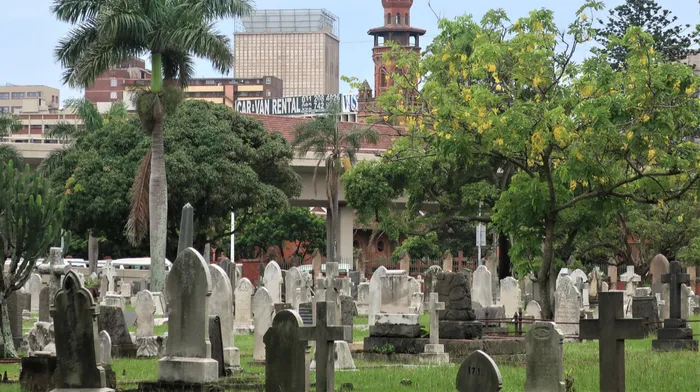
Brook Street Cemetery (formerly known as West Street Cemetery) next to the Emmanuel Cathedral in the city.
Image: Alison Chadwick
LOCAL cemeteries are rapidly running out of space, forcing families to abandon sacred burial traditions.
The SA Funeral Parlour Association (SAFPA) warned this crisis would only worsen without immediate intervention.
Nomfundo Mcoyi, President of SAFPA and CEO of Icebolethu Group said burial was a sacred tradition for many communities.
“We need to explore dignified alternatives such as cremation and green burials whilst working together to find sustainable solutions. We cannot afford to wait until families are turned away from cemeteries. The dignity of our final farewells must be preserved, even as our cities grow,” she said.
“For many families, burial is not merely a ritual, it is a sacred duty that connects the living with their ancestors. Cremation, though efficient, remains emotionally distant and culturally unfamiliar,” she added.
Dhayalan Moodley, of Moodley’s Funeral Services, said the shortage of graves was driven by several factors.
“We have observed a significant shortage of burial plots in all major cities, which is indeed a growing concern. The rapid urbanization, population growth and influx of migrants have put immense pressure on existing cemeteries, leading to severe space constraints. As more people move to urban areas, the demand for burial plots increases, straining the limited resources.
“This shortage has led to challenging situations such as reuse of graves. Because of deep-rooted cultural beliefs, people prefer traditional burial over cremation. Sadly, municipalities did not plan for the future,” said Moodley
He said the shortage was transforming the funeral industry and shifting cultural norms.
“We are seeing a significant shift in cultural attitudes around burial practices. Cremation, once considered taboo in some communities, is gaining traction due to space constraints. The reality of limited burial space is setting families towards considering alternatives like cremation.
“The demand for burial sites by Indians is low. However it is influenced by culture, religious and traditional factors. In our community cremation is being promoted by the undertakers due to grave shortages,” said Moodley.
However, the change comes with pain and resistance.
“When families discover their preferred burial option isn’t available, the reaction can range from distress to anger. The emotional toll is significant, especially when burial practices are tied to religion and heritage.
“Families are facing higher costs due to scarcity of burial plots. The shortage has led to increased prices for graves, coffins, tombstones, everything. The funeral industry is adapting, offering personalized and professional services, but the crisis remains,” said Moodley.
Clive Moodley, the deputy president of the National Funeral Practitioners Association of South Africa (Nufapa SA) said there had been a shortage of graves for the last 20 years.
“Our main issue is that people from the rural areas come to the city and use our cemeteries. We are now full and the people who live in the areas where the cemeteries are located have no space,” he said.
While most communities grapple with the burial space shortage, the Muslim community has been able to manage the crisis through the long-standing practice of grave recycling.
“We are blessed that we recycle graves. Five or more family members are buried in the same grave. We manage the grave shortage well. We did have an issue in Phoenix but we were given extra land with 3000 graves.
“We also maintain the graveyards, if not they would be unsafe for visiting families. If a family wants to bury because of customs, no-one should offer them different options. There should just be more grave sites made available,” said Salim Kazi, chairman of Islamic Burial Council.
Ahmed Paruk, a community activist, said Muslim graves were recycled every seven years.
“We are also acquiring private land and rezoning them as cemetery sites.”
In Chatsworth, community leader Rocky Naidoo said the situation has become dire.
“Many grave sites have become exhausted and there is no space for recycling. People are desperate to bury their loved ones quickly but cannot do so as there is no space available.”
In Tongaat, Harold Maistry, President of the Tongaat Civic Association, said the crisis had been long in the making.
“There is a general shortage of gravesites within the eThekwini Municipality, and Tongaat has not been spared. This issue was raised as early as 2005. The Town Planning Scheme has not been amended to factor in rapid urbanization and the demand for community facilities like cemeteries,” he said.
He warned that the lack of foresight has serious social and emotional consequences.
“The issue impacts the rights of bereaved families to practice their cultural beliefs. Families face the plight of delayed funerals, undignified practices like re-use of grave sites, and alternatives like cremation, which are not in line with their culture.
“Land that could have been reserved for cemeteries has been taken up by informal settlements. The city’s policy of reusing graves older than 10 years has also faced legal and cultural resistance, causing trauma for grieving families.”
In Phoenix, Sham Maharaj, a community leader said the shortage of burial sites and cemeteries had been a long standing issue in the eThekwini region.
“The management of the allocation of grave sites has become fraught with allegations of corruption that sites are being sold to the highest bidder. In addition, the number of people dying because of illnesses has risen sharply, putting enormous pressure on very limited grave sites.
“The reuse of existing graves as proposed by the municipality has not found favour with the religious sectors and traditional and conservative communities,” said Maharaj.
The city did not comment at the time of going to print.