

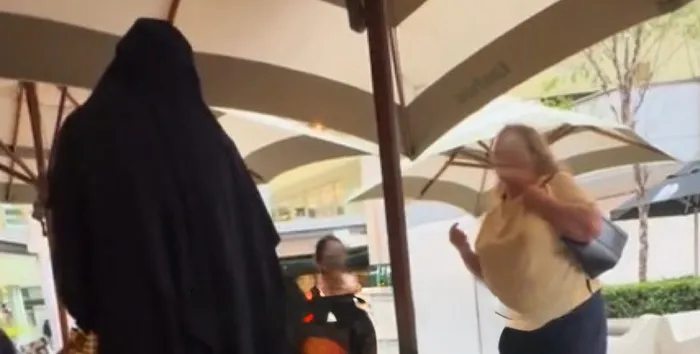
The video showing a white woman berating a Muslim woman for wearing a niqab at a Pretoria restaurant.
Image: TikTok/Screengrab
A VIDEO showing a white woman berating a Muslim woman for wearing a niqab at a Pretoria restaurant has sparked widespread condemnation from human rights activists and religious leaders.
Filmed by content creator @Kissmyabby, the video showed a woman approaching a table of Muslim women.
She then confronted the Muslim woman dressed in a niqab.
In her video, the creator said the confrontation was completely unprovoked.
“She just walked up to these women dressed in their niqab and started asking them, ‘Why are you wearing that?’
“And stated that ‘wearing those garments are disrespectful to people of South Africa',” the creator said.
As she walked away, the angry woman could be heard saying: “Western country this, okay. You need to respect the custom of the country that has given you a home. This is a very bad example for little girls to see.”
Throughout the confrontation, the Muslim woman remained calm despite the hostility directed at her.
The video has since gone viral, drawing widespread condemnation from human-rights activists, Muslim organisations, and civil society groups.
Human-rights, peace and interfaith activist Saydoon Nisa Sayed described the incident as an attack on dignity and religious freedom.
“Muslim women who wear the niqab are strong human-beings. They wear it because they love to keep themselves covered and protected and not because they are forced to. It is our beauty. Whether it is a face covering or not, we are proud of who we are,” Sayed said.
She added that such hostility was unnecessary and unjustified.
“From time to time, we find people jeering and staring. This type of intimidation must stop. In South Africa, we have people in government wearing niqab, right from the first sitting of Parliament in 1994.”
Black Sash’s Hoodah Abrahams Fayker said: “The Constitution provides for freedom of religion and in our constitutional democracy, a woman must have the right to wear what she wants.”
Activist, lawyer and Womandla founder Shabnam Palesa Mohamed said this incident reflected a deeper societal issue.
“It makes me feel profound sadness, but also righteous anger. The sadness comes from witnessing the deep human failure at the heart of Islamophobia: the inability to see a fellow human being beyond a piece of fabric.
“That woman in her niqab is someone's daughter, perhaps a mother, a professional, a contributor to our society, but in that moment of confrontation, she is reduced to a target of fear and hatred.”
Mohamed said confrontations like these were part of a global pattern.
“This is symptomatic of not only racism in South Africa but Donald Trump’s USA. The anger comes from knowing this is not an isolated act of ignorance, but a symptom of a systemic toxin. It’s a reminder that in decades after apartheid, Muslim women still navigate public spaces with a layer of anxiety that others do not.
“While not every Muslim woman will face a direct, public confrontation, virtually all navigate a landscape of micro-aggressions, the stares, the whispers, the 'well-meaning' questions that imply their choice is backward, or the more sinister assumption that they are a security threat.
“We need to enforce hate crime legislation and ensure employers, educational institutions, and service providers have clear policies protecting religious dress. This creates a framework of accountability that protects Muslims, habit-wearing nuns, Hindus, and everyone. Ultimately, it is about building a culture of Ubuntu - 'I am because we are.'
“Bodily autonomy is a universal right. A woman’s dress is her choice. When one woman is attacked for her hijab or doek, every woman's right to move through the world in peace is diminished,” said Mohamed
Dr Faisal Suliman, chairperson of the South African Muslim Network (Samnet), said harassment of niqab-wearing women was common.
“It is not uncommon for Muslim women to face harassment and discrimination. Women with niqabs often get a lot of road rage or negative looks directed at them.
“Still very pervasive, and fuelled more recently by cooperation between many of the Christian Zionists and Israel. Something that is being pursued very strongly by Zionist supporting community, both internally and externally, in trying to get more support for Israel. We have seen a very strong right wing presence and funding, coming from overseas to churches and this is a very dangerous precedent. It does not make for the future social cohesion and mutual respect,” said Suliman.
He described the attacker’s comments as reminiscent of colonial attitudes.
“A Muslim woman in niqab, telling her to be grateful for being allowed in this country, as she refers to it, and she should be respectful to the country and not wear the hijab. It smacks so much of the white Christian superiority and colonial mindset that is still extremely prevalent.
“In our country, and sadly growing rapidly in the Western world with a very strong right wing shift, evident in many countries in Europe, and clearly in the United States.”
Suliman said Samnet had worked to promote understanding through mosque open days, but warned of rising right-wing sentiment globally.
“This racist, Islamophobic diatribe by the woman, depicted in the video, frankly needs to be addressed by the human rights commission, and the commission for religious and language to get involved more actively, to raise more awareness about, not just Islamophobia, but derogatory, racism, bigotry and mindset,” said Suliman.
Dr Yusuf Patel, secretary general of the United Ulama Council of South Africa, said: “Being confronted for simply wearing the niqab leaves many feeling unsafe, exposed, and unfairly targeted.”
He emphasised that institutions must take stronger action.
“Protecting Muslim women requires more than condemning isolated incidents. We need broader public awareness and stronger stances against discrimination. No woman should ever feel she has to choose between her safety and her religious commitment. It is up to all of us to help ensure that South Africa remains a place where people of every belief can live openly and confidently, without fear of being singled out or shamed for who they are,” said Patel.