

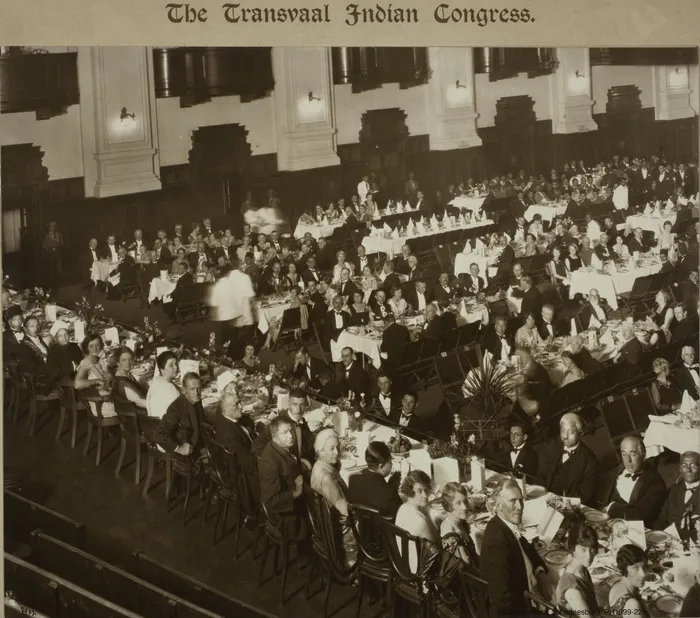
A farewell hosted by the Transvaal Indian Congress when Sastri ended his term as Agent General, January, 1929.
Image: Supplied
Valangaiman Sankaranarayana Srinivasa (VSS) Sastri arrived in South Africa in 1927 as India’s first Agent General. His term in office was trespassed with heightened anti-Indian sentiment. He rose to these challenges with erudition and engagement, forsaking dogma for diplomacy. Despite this, his South African sojourn has largely been written out of history, largely limited to his role in establishing Sastri College.
But as we researched for our book Belonging: A History of Indian South Africans reading Sastri’s speeches, following his interactions with the white ruling class, and his strategic use of Imperial connections, Sastri’s stature grew. Crucially we contend that Sastri’s ways of negotiating in a hostile terrain provides seminal lessons for contemporary challenges.
Sastri was a well-known figure in the British Empire’s global circuits long before his arrival in South Africa in 1927. This brought him into conflict with South African Prime Minister Jan Smuts. Both men, originating from the margins of Empire, were formidable in their own right. Much to Smuts’s chagrin, Sastri outmanoeuvred him at the 1921 Imperial Conference when he got the prime ministers of the Dominions (self-governing colonies) to "declare that in the interests of the British Commonwealth it was desirable that the rights of Indians should be recognised. The same resolution recorded South Africa’s dissent".
Sastri did not have Smuts’s deep association with the Empire, nor his command of the arsenal of state power, but he had India, the jewel in the British Crown. India gave the Empire an aura of grandeur and omnipotence but was also its Achilles heel. For by claiming equality as the Empire’s fellow subjects, Indian delegates could demand equal rights for Indians across the global expanse. Sastri exploited this skillfully.
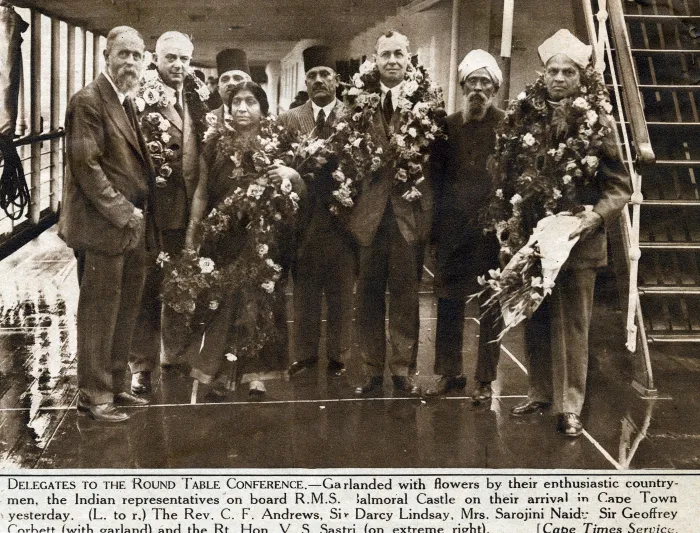
Delegates to the Round Table Conference garlanded by their enthusiastic countrymen.
Image: Supplied
It was Sastri’s eloquence as much as his ability to make use of the back-channels that became legendary. British Prime Minister Ramsay MacDonald reportedly said at a round-table conference, "After listening to the Rt. Hon. V.S. Srinivasa Sastri, I hesitate to speak my own language."
When Lord Balfour, British Foreign Secretary, heard Sastri speak at the League of Nations, he "said that he then realised the heights to which the English language could rise".
Sir Thomas Smartt, Cape Premier, leader of the Unionist Party and a minister in Smuts’s government, dubbed Sastri "Empire’s silver-tongued orator".
Sastri came from a humble background. Although a brilliant student, he could not afford to study law and instead completed an arts degree with the help of a bursary. He joined Gokhale’s Servants of India Society, formed in 1907 to provide secular training to individuals to serve India, and became its leader when Gokhale died in 1915. In 1913, Sastri was nominated to the Madras Legislative Council. He advocated the "Indianisation" of the public service, compulsory free education, and self-government along the lines of the white Dominions so that India would "no longer occupy a position of subordination but one of comradeship" in the Empire.
Until 1915, "moderate" and "liberal" politicians like Sastri controlled the Indian National Congress (INC). They were nationalists who aimed to emancipate India through a liberal parliamentary democracy in cooperation with the British. As Sastri told a meeting in Pietermaritzburg in 1927, the "British connection has been ordained for the good of both countries. We therefore take vow that we will not do anything which may have the remote effect of weakening this connection".
In time the liberal influence within the INC began to wane as a result of the death of the older generation of liberals and the increasing influence of those variously termed "radicals", "non-cooperationists" or "Home Rulers". Liberals like Sastri left the INC and formed the National Liberal Federation of India in December 1919.
The life of the British Empire was extended by the Dominions, which contributed to the defence of the federated structure. However, three-quarters of the Empire comprised one colony, India, which did not enjoy parity with the white-ruled Dominions. While Sastri advocated responsible government for India, he was against the non-violent mass struggles advocated by Gandhi’s as he feared the government may resort to violence. He believed that a circle of violence was inevitable in Gandhi’s politics. This did not mean a parting of the ways between Sastri and Gandhi. As Gandhi wrote in an obituary on Sastri’s death in 1946, "Though we differed in politics, our hearts were one" in seeking what was best for India and Indians.
Sastri first arrived in South Africa as part of a delegation to meet the South African government at a round-table conference which was held in Cape Town from December 17, 1926, to 11 January 1927. A deal was worked out that entered the history books as the Cape Town Agreement. It had three main clauses. The Indian government agreed to an assisted emigration scheme for Indians; the South African government promised to ‘uplift’ Indians who remained in the Union; and the Indian government was to appoint an Agent to monitor the workings of the agreement and "to secure continuous and effective cooperation between the two Governments".
Upliftment was to be achieved by increasing education opportunities, improving housing, allowing wives and children of Indian men into South Africa, and limiting the discretionary powers of local authorities by requiring licensing officers to provide written reasons when licence renewals were refused.
While there was opposition to the agreement from whites and Indians, Sastri’s appointment as the first Indian Agent General was crucial to the smooth implementation of the Agreement. He took up the position on June 27, 1927. His legacy includes the establishment of Sastri College, access for Indians to the University of Fort Hare, establishing Indo-European Councils to facilitate improved relations between Indians and liberal whites, and establishing the prestigious Orient Club to exert influence on white officials.
There were other parts to Sastri’s time in South Africa that are tantalising that Meg Samuelson tracks with sensitivity and care. It revolves around an epistolary exchange between him and Marie Kathleen Jeffreys. She first heard Sastri speak in November 1928 in Cape Town and was smitten. She wrote to Sastri and they met at the Mount Nelson Hotel. So began an inter-continental textual exchange of sheer literary power that takes in Tagore and Rudyard Kipling.
But over time Sastri begins to worry about the “relationship”. He wrote to Jeffreys in October 1930: “Another of your delightful letters gets a feeble and unworthy response from me. I can't help it. More is not in me. Side by side with a feeling of pride and joy, grows up one of debt that cannot be repaid. I am almost going to ask that you should not continue to crush me in this way."
She was upset, replying: “Fine phrases will be the ruin of our happiness. They kill the soul of truth, they cloud beauty in the shroud of flattery. Forgive me. (...) But I cannot dwell upon the snowy heights. I must come down to the valley and pluck the fruit ... I am not a poem or a play, to be forever a catastrophe, a climax or a gracious winding path of thought, leading to a loveliness unearthly and satisfying. Whatever shall I do with this immensity in my heart? ... You are a closed book to me."
Books are never closed. They open new imaginations. It is a subject of epistolary friendships that we hope to return to.
How do we evaluate Sastri’s legacy in South Africa? He was aware of the hatred and fear that Indians evoked among whites and sought to mitigate discriminatory legislation and expand access to education, employing a conciliarity approach and using his legendary charm, while appealing to Anglo-Saxon pretensions of fair play and the equality of all the Crown’s subjects. At the same time, Sastri stressed India’s importance to the Empire, hinting also at the risk of native Indian displeasure under the Raj. He also provided an assurance that Indians would do nothing to "disturb the political supremacy of whites".
In this approach he had his critics among Indian South Africans. One of them was MI Meer, editor of the Indian Views newspaper, who wrote that Sastri’s "homage to empire" was "the same thing as glorification of Indian subjugation". It was "a criminal betrayal" and "bound to degrade Indians in the eyes of the world".
Meer was probably upset about the way in which Sastri approached his task. As Manilal Gandhi put it in a letter to his father on July 14, 1928: "There seems to be no limit to Sastriji’s diplomacy."
Rather than simply condemning outright South African racism, he tried to exploit openings in the system and, where there were no openings, tried to create them by exploiting the importance of India to the Empire to prize the system open. He practiced a "visionary pragmatism".
British colonialism produced what the critical theorist Homi Bhabha has called the "mimic men", the brown sahibs who were considered compliant with Empire. Was Sastri one of Bhabha’s "mimic men"? In considering his work in South Africa one gets a sense that his biographer Vineet Thakur’s assessment is apposite: "In politics, he could compromise to the extent that the ideal, or the principle, was not entirely lost; so long as one could navigate the crevices along the way and find alternative, more possible ways of reaching the principle."
Sastri put this approach to work in South Africa. His position on incrementalism and critique of non-cooperation was disparaged as the Indian Congress rode the wave of dissent into power in India. But in South Africa, given the rampant nature of Afrikaner nationalism and the racial vindictiveness of the English settlers, the terrain was set for a Sastri who valued dialogue over outright dissent.
Sastri sought to make the most of the upliftment clause of the Cape Town Agreement, while subtly ignoring the clause about repatriation. His approach had to unfold in the hostile “Herrenvolk” ideological climate created by Malan and Hertzog, but arguably it bore fruit in the progress made in education in particular. He might have spoken the tongue of Empire, but his voice was important in a Dominion that was determined to heap discriminatory legislation on Indians while threatening them with mass repatriation.
At a time when racial nationalism is on the increase, a time when Indian South Africans’ place is once more questioned, one realises how resonant was Sastri’s stance of "visionary pragmatism".

Professor Ashwin Desai
Image: File

Professor Goolam Vahed
Image: File
Professor Ashwin Desai is Professor of Sociology at the University of Johannesburg. Professor Goolam Vahed teaches in the Department of History at the University of KwaZulu-Natal. This is an edited extract from their latest work, Belonging: A History of Indian South Africans, which is available at Ike’s Books in Florida Road, Durban.