Listen: Cultural commissioner's Pongal-inspired songs gain international acclaim
Culture
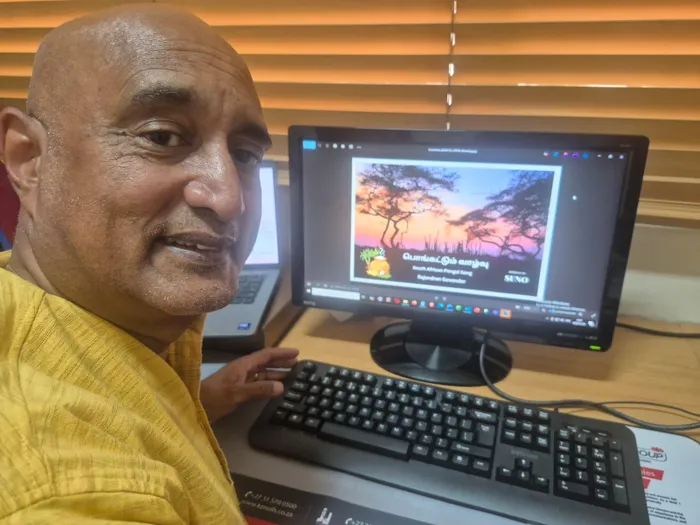
Dr Rajendran Govender.
Image: Supplied
ACADEMIC, cultural commissioner and researcher, Dr Rajendran Govender is receiving widespread acclaim following the release of two original songs inspired by the celebration of Pongal, a Hindu harvest festival.
The songs have attracted a positive response locally and internationally, with the accompanying music videos gaining traction online and being widely shared across social media platforms.
“What has been truly meaningful for me is the overwhelmingly positive response the songs have received. The videos have gained significant traction online and are being shared widely, which I deeply appreciate. The interest and support has been overwhelming and deeply humbling,” said Govender.
He explained that the creative inspiration for the songs emerged from the recent global celebration of Pongal.
Govender said as a researcher in cross-cultural studies, and a commissioner in the Cultural, Religious and Linguistic Rights Commission, he was also fascinated by how different communities worldwide shared similar values through cultural practices.
Drawing parallels between cultural traditions, Govender highlighted the strong resonance between Pongal and South Africa’s own indigenous ceremonies.
“For example, Pongal as a harvest thanksgiving festival resonates strongly with the Zulu annual first fruits ceremony, Umkhosi Wokweshwama, which is also grounded in appreciation, tradition, and respect for nature. I wanted to compose a song that reflected this unity in diversity, and that spoke to the South African reality; where different cultures live together, learn from each other, and build a shared national identity.”
To ensure inclusivity and broader reach, the songs were composed in Tamil and English.
“It took me about a week to write the lyrics. I revised the words several times because I wanted the message to be accurate, meaningful and respectful - both culturally and socially.”
He added that the lyrics were carefully crafted to balance accessibility and depth.
“For me, the words had to be simple enough for people to sing along, but deep enough to carry the spirit of Pongal and the South African context.”
The musical composition process was equally meticulous.
“It took about three days to put the music together and finalise the complete production. I used digital tools and AI-assisted music generation to support the recording process. However, the creative direction, the message, the lyrics and the final approvals were fully guided by me.”
Govender also clarified ownership of the work.
“I want to emphasise that I have full rights to the songs, and I am grateful that technology has made it possible for creators like myself to produce meaningful content more efficiently.”
At the heart of the songs lies a broader social message, he said.
“The song is about the importance of gratitude, especially towards nature; with particular emphasis on the sun, and the role of cows, both of which are revered during Pongal. More importantly, the song carries a wider social message: it encourages us to respect and understand one another’s cultural traditions so that we can live in peace, dignity, and harmony.”
He said the song promoted unity in diversity, and intentionally highlighted Pongal through a South African lens, celebrating how traditions could be preserved and shared positively within a multicultural society.
Interestingly, Govender does not perform vocally on the tracks himself.
“I do not sing myself. I leave the singing to my wife Nirmala and my daughter Nameshni, and in many ways, these songs were composed with them in mind.”
His deep connection to Tamil language and culture, he said, dated back to childhood.
“I have been exposed to the Tamil language, culture and music from a young age. I started learning Tamil at around the age of six, when I attended classes in Benoni (Gauteng), offered through the Benoni Tamil School Board, where my late mother, Pathma Vathiar, and my late mother-in-law, Lutchmee Vathiar, were Tamil teachers.”
Govender described growing up in a home rooted in cultural values and community involvement, which later expanded through his marriage.
“Through my wife Nirmala, who is a devotional singer, I developed a deeper appreciation for Indian music."
Pursuing a lifelong dream, Govender also took up the violin.
“My lifelong dream was always to play the violin. I began tuition with local violinist Leo Manickum, and last year I started online Carnatic violin classes with a tutor from Chennai, Guru Parvathy Navaneeth. I have thoroughly enjoyed this journey, and it has brought balance and joy to my very demanding professional schedule.”
Looking ahead, Govender confirmed that more music was on the way.
“I have already composed a lullaby for my two granddaughters, Thanika and Bhavia, and they were absolutely delighted because their names - and their Thata and Pati - were mentioned in the song. They now insist that I play it repeatedly.”
He has already started composing lyrics and music for Kavady and Maha Shivaratri.