

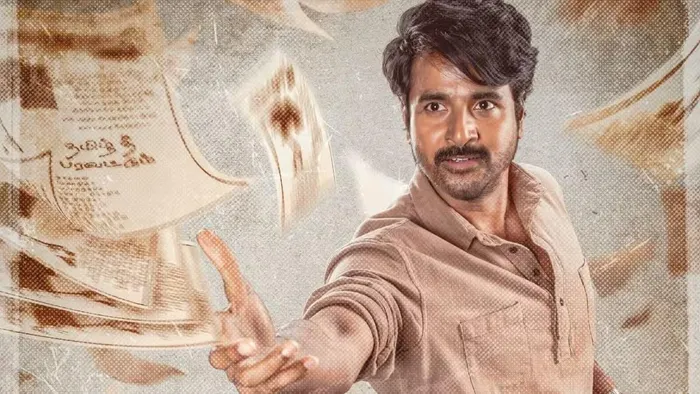
Sivakarthikeyan stars in the movie.
Image: Facebook
THE Tamil movie Parasakthi that ushered in 2026 is a bold, uncompromising cinematic statement that reaffirms the power of language as a vehicle of identity, resistance, and pride.
Directed by Sudha Kongara, and locally released by Kavin Media in time for Pongal, the movie set in the 1960s asserts, with urgency and clarity, that linguistic and cultural erasure is not a relic of the past but a present danger, and that reclaiming one’s mother tongue is an act of both personal and communitive liberation.
The film is based on the real-life 1965 Anti-Hindi Imposition Agitations primarily in Tamil Nadu. This was an important event in modern Indian history when hundreds of thousands protested against the compulsory teaching and promotion of Hindi, seen as cultural domination threatening Tamil identity and equality.
In the film, the story begins around 1959 and follows events up to 1965 when young people, mainly students, became active in the movement led by figures like Periyar and CN Annadurai, standing up for their language and culture. The film’s insistence that language carries culture and memory resonates far beyond Tamil Nadu; it echoes historical language struggles elsewhere, notably the Soweto uprising of 1976 when black South African students rose against the imposition of Afrikaans in schools, pointing out that control of language was control of freedom.
The lead actor in Parasakthi, Sivakarthikeyan, brings a commanding presence, reflecting his dedication to the role. However, there are moments where the intensity of his characterisation could have been delivered a bit more strongly and convincingly. Debutante Sreeleela, a Shruti Haasan look-alike, gave a splendid rendition of her role and excelled in creating an emotional space on screen, making her scenes particularly resonant.
The music for Parasakthi composed by GV Prakash Kumar, and marking his 100th film as a music director, features a mix of melodic romantic numbers alongside activist themed and narrative-driven songs. Popular artists such as Haricharan and Dhee are among the many playback singers who contributed to the album. The choice of music effectively enhances the film’s protest sequences and intense moments, elevating the emotional impact and complementing the story’s dramatic depth. Playing in repeat mode on my Apple music is the addictive number, Adi Alaye.
Madurai, where much of the story unfolds, is a character by itself, a city alive with history, injustice, and the possibility of awakening. The sets and locations – such as the Meenakshi Temple, Annamalai University and railway stations - reinforce the film’s insistence that the struggle for mother tongue is not abstract but intimately tied to everyday spaces and experiences.
Parasakthi resonates particularly strongly when placed in dialogue with global arguments for linguistic decolonisation. Ngũgĩ wa Thiong’o, the late Kenyan writer and academic widely regarded as the founding father of the decolonisation discourse, emphasised that: “African languages are not on a lower rung on a ladder to an English heaven… use English … but don’t let English use you. If you know all the languages of the world but not your mother tongue, that is enslavement."
Similarly, in his book Decolonising the Mind, wa Thiong’o argues that language carries culture and memory, shaping our perception of ourselves and our place in the world. This is precisely the argument Parasakthi makes about Tamil: to lose one’s language is to lose a part of oneself; to defend it is to reclaim dignity, history, and agency. The film also finds resonance with South Africa’s ongoing struggle to maintain mother tongues in the face of English dominance.
Decades after apartheid, English continues to be positioned as the “powerful” language, while African and Indian languages including isiZulu, Tamil, Hindi, and Telugu remain marginalised in schools and institutions. The gradual erasure of Indian languages from the University of KwaZulu-Natal curriculum in the early 2000s mirrors the cultural and linguistic neglect that Parasakthi critiques. Even after sustained advocacy, Indian languages are often relegated to after-school programmes or optional courses, a reminder that linguistic marginalisation is not merely historical, but structural and ongoing.
Here’s some work for Cultural Religious and Linguistic Rights Commissioner, Dr Rajendran Govender - he must lobby for the preservation and promotion of Indian languages in South Africa. After watching the opening day 8pm show at Cinecentre at Suncoast, I spoke with Lorraine and Erin Murugasen, who remarked that the movie provided valuable insight into the background and historical significance of the Tamil language. They also urged more people to make a conscious effort to support Tamil cinema in South Africa, especially given the strong demand for Bollywood films.
Sivakarthikeyan fan Thangam Rasen mentioned that she was glad her curiosity about the movie’s storyline brought her to the cinema. A maths professor, who wished to remain anonymous, was particularly intrigued by the hardships faced by the Tamil community in India and how these struggles resonate with South Africa’s own fight for linguistic freedom. While the cinema had about 25 seats occupied, it was heartening to see that many young people had come out.
For audiences in South Africa, and beyond, the film offers both mirror and challenge: to remember, to defend, and to speak. When a language thrives, a people endure. When it is silenced, an entire history risks being forgotten. Parasakthi is, in every sense, a cinematic call to arms for the preservation of cultural and linguistic identity; a reminder that words matter, and that mother tongues must be fought for with pride.
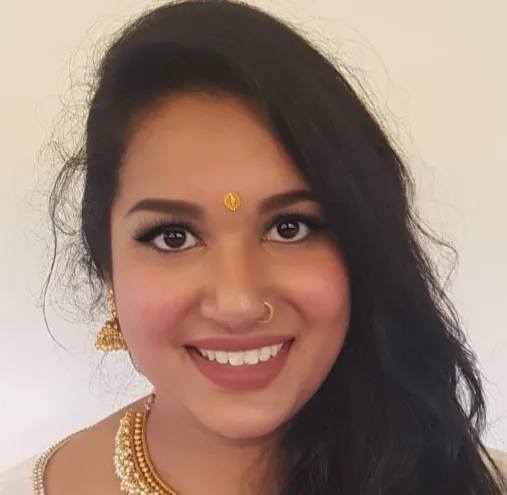
Saranya Devan.
Image: Supplied
Saranya Devan is a theatre-maker, dance performer, academic and proud Tamilian. She holds an MA in dance from UCT, and a MA in Bharatha Natyam from the University of Madras.