

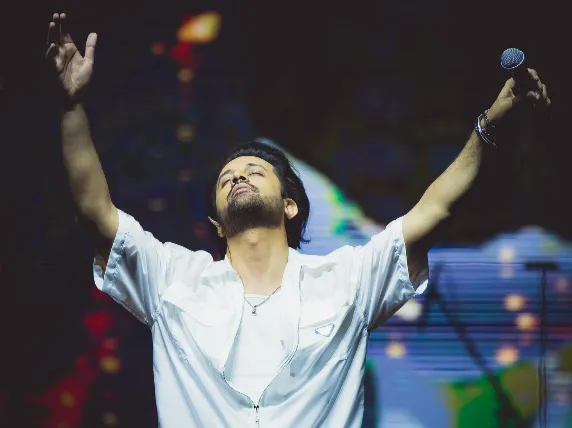
Atif Aslam
Image: Facebook
THE recent Atif Aslam show at Emperors Palace in Johannesburg was more than just a concert; it was a vibrant, sonic bridge across decades. As Aslam took to the stage for almost three hours, the atmosphere became a living vindication of two views I have held for several years. In a world of fleeting digital trends, the night proved that certain melodies possess a soul that refuses to age. My first long-held view is that the golden oldies of the 1950s and 1960s continue to resonate with young audiences two, or even three, generations down the line.
There is a common misconception that the works of Naushad, Shankar-Jaikishan, or the poetic depth of Sahir Ludhianvi are relics of a bygone era, regurgitated only by the nostalgia of our grandparents. However, as Aslam belted out medleys of these classics, the reality was starkly different. Thousands in the audience, many of whom were toddlers when these songs were first recorded, sang along with an enthusiasm that bordered on fanaticism.
This cross-generational appeal suggests that the golden age of Indian cinema was built on a melodic and lyrical foundation so sturdy that it transcends the evolution of technology and taste. The youth weren't just listening; they were participating in a cultural heritage that clearly still speaks to their modern sensibilities.
My second view is that the songs of the 1980s and 1990s, an era defined by a fresh wave of lyricists, music directors and playback singers, have officially ascended to the status of golden oldies for the millennial generation. This was the period of transition, where the lush orchestrations of the past met the synth-pop and experimental rhythms of a modernising India.
Aslam provided a masterclass in this transition. He gave the audience the opportunity to show just how deeply they remembered the favorites from a time when many of them were very young, or in some cases, not even born.
This observation was a fascinating experience. The very music that was once considered "new" and perhaps even "rebellious" by the purists of the 1970s has now become the nostalgic anchor for today’s middle-aged professionals. Seeing thirty-somethings get teary-eyed over a 1990s' ballad proves that the emotional weight of a song is determined not by its age, but by the memories it carries.
This latter observation is particularly heartwarming in a milieu where there is a constant, nagging fear that Indian culture is dying among today’s youth, especially within the diaspora. We often worry that globalism is a giant eraser, smoothing over the unique textures of our heritage. I am reminded of the mid-1980s, during my tenure as station manager of the then Radio Lotus. We shared this exact concern regarding declining interest among the youth. To address it, we engaged the Department of Indian Studies at the University of Durban-Westville to conduct formal research.
The findings were enlightening. While the youth of the 1980s were indeed gravitating toward Western music, a "reversion" occurred in their mid-twenties. Once they married and started families, they instinctively reached back toward their roots, wanting to ensure that their children possessed a sense of identity. That research from decades ago found its modern proof at Emperors Palace.
The reversion to roots isn't a myth; it’s a rhythmic pulse in the community. I watched an excited baby in a pram in the aisle, a tiny spectator who couldn't yet speak, let alone understand the lyrics. Yet, she gurgled, laughed and clapped, mimicking the joy of her parents as they complied with Aslam’s requests to sing along.
In 20 or 30 years, when that baby reaches her parents' age, there will likely be a successor to Aslam on that same stage. They will be singing Aslam’s original hits which are the anthems of today, referring to them as golden oldies.
Witnessing three generations unite under the banner of Indian music, including the beautiful local cover versions that have sustained the South African Indian community for years, was a profound privilege. It served as a rhythmic reminder that while the singers may change, the song remains a permanent part of our collective soul.