

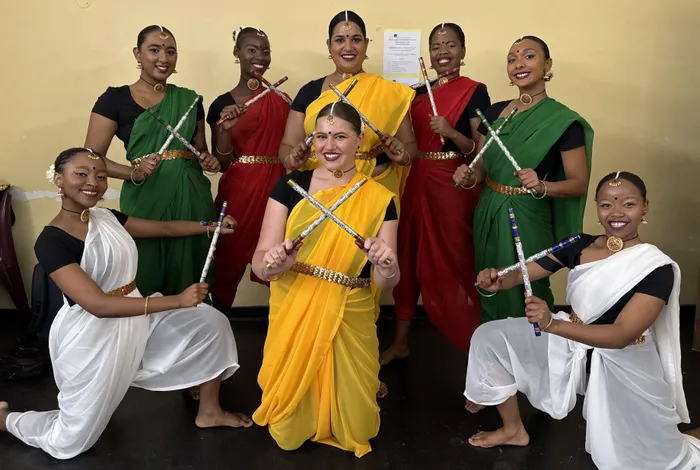
Top: Lerusha Munien, Natasha Tsanwani, Saranya Devan, Keneilwe Motsekedi and Cassidy Flatwell. Kneeling: Kabo Kola, Ree Strauss and Karabo Seitshiro. Teaching Indian classical and folk dances to multiracial students, the writer insists Tamil New Year must step out of the margins and onto the national calendar, with government recognition affirming its cultural richness and inclusive spirit.
Image: Supplied
EVERY April, Tamil families across the world welcome Tamil New Year, a day of renewal and reflection. Homes are cleaned, trays of fruit and flowers are prepared, prayers are offered, and elders bless the young. It is a moment that binds generations, language, and memory. And yet here in South Africa, this deeply significant cultural moment passes almost unnoticed beyond the walls of homes and temples.
This absence is not because the community is small. Quite the opposite. South Africa is home to more than 500,000 people of Tamil heritage. After all, Tamils made up the largest linguistic group of indentured people who arrived in South Africa between 1860 and 1911. Tamil New Year, also known as Puthandu, marks the beginning of the Tamil month of Chithirai and symbolises new beginnings, prosperity, and spiritual renewal.
Tamil New Year 2026 which began yesterday, Tuesday, April 14, is named "Parābhava" which translates to "defeat," "overthrow," or "humiliation". In an astro-spiritual context, it is interpreted as the year the ego falls so the soul can rise. It is considered a time when pride is reduced and people learn important life lessons, encouraging reflection and spiritual growth.
Tamil language and culture have survived colonialism, apartheid, and displacement. They have endured and flourished. But recognition? That remains limited. There is something quietly disheartening about how Tamil New Year exists here: vibrant, meaningful, but largely invisible in the national cultural imagination. No widespread public acknowledgement. No major civic celebrations. No sense that the country pauses, even briefly, to recognise the significance of the day for hundreds of thousands of South Africans.
Contrast this with happenings across the globe. In countries like the United Kingdom and United States, Tamil communities are not only visible they are institutionally acknowledged. Tamil diaspora populations in these countries are substantial, with over 100,000 in the UK and hundreds of thousands across North America.
Local councils, state bodies, and political representatives regularly issue formal greetings marking the Tamil New Year and other Tamil festivals. Public events, cultural showcases, and even official proclamations have become part of the annual rhythm. In Australia, government representatives have publicly recognised the Tamil New Year, framing it as part of the country’s multicultural identity and expressing appreciation for the community’s contribution to national life. And in New Zealand, Tamil organisations actively bring their culture into the mainstream, hosting large public events, exhibitions, and community celebrations that position Tamil identity as part of the national story, not outside of it.
Across these contexts, the message is clear: Tamil culture is not marginal; it is part of the fabric of the nation. So why not in our country? South Africa prides itself on being a multicultural democracy, a nation that recognises diversity as strength. It has 12 official languages (11 plus sign language) and a constitutional commitment to cultural expression. And yet, the recognition of diasporic cultures remains uneven.
Tamil New Year offers an opportunity not just for celebration, but for visibility, and inclusion. This is not about elevating one culture above others. It is about recognising what is already here. Because Tamil culture in South Africa is not new. It is not imported. It was first rooted over 160 years ago, shaped by struggle, resilience, and contribution. And perhaps that is where the urgency lies. If we do not push for broader recognition, these cultural practices risk being confined to private spaces sustained by communities, but unseen by the nation.
Tamil New Year deserves more than quiet observance. It deserves to be part of South Africa’s public cultural calendar - visible, acknowledged, and celebrated. This is also where institutions must step forward. Bodies such as the Commission for the Promotion and Protection of the Rights of Cultural, Religious and Linguistic Communities (CRL) have a constitutional mandate to safeguard and elevate the country’s diverse cultural expressions.
Recognising and advocating for the national visibility of Tamil New Year should form part of that responsibility. It is not simply a cultural observance but a marker of identity, continuity, and belonging for millions of South Africans of Tamil heritage. I would have expected community leaders, including figures such as CRL Commissioner Raj Govender, to have ensured that President Cyril Ramaphosa was informed about Tamil New Year. Their silence or omission risks reinforcing the invisibility of a community whose traditions have long enriched the national tapestry. Puthandu Vazthukal - Happy New Year.