

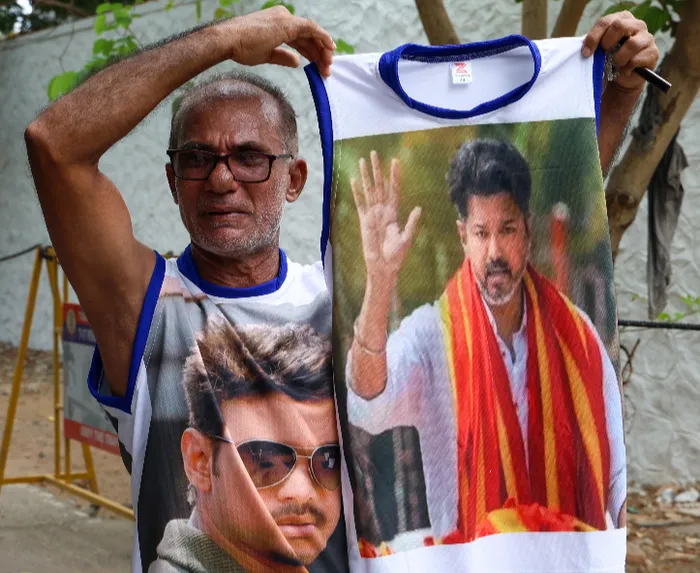
A Tamilaga Vettri Kazhagam (TVK) supporter holds a T-shirt with actor and party president C Joseph Vijay printed on it
Image: IANS
IN A DRAMATIC and unprecedented turn of events, the political landscape of Tamil Nadu has been fundamentally reshaped. The recent election has delivered a decisive mandate to actor-turned-politician Vijay, whose party, the Tamilaga Vettri Kazhagam (TVK), has secured a clear majority - marking the first time in modern history that a non-Dravidian formation has come to power in the state.
For decades, Tamil Nadu’s political narrative has been defined by the dominance of the Dravida Munnetra Kazhagam (DMK) and the All India Anna Dravida Munnetra Kazhagam (AIADMK). Rooted in a powerful socio-political movement, these parties shaped not only governance but identity, language politics, and social justice discourse in the state. Election after election, power alternated between them, creating a political rhythm that appeared almost immovable.
Vijay’s victory disrupts this entrenched pattern in a manner that few could have anticipated. It is not simply a change in leadership - it is a redefinition of political possibility. It highlights a decisive shift in voter consciousness, particularly among the youth, who appear increasingly disillusioned with traditional political structures and more inclined toward leadership that promises authenticity, accountability, and transformation.
Tamil Nadu, like much of India, is undergoing a demographic shift where young voters constitute a powerful electoral force. This generation is less bound by historical loyalties and more driven by aspirations - economic mobility, clean governance, and dignity in public life. In Vijay, they appear to have found not merely a politician, but a symbol of renewal.
Unlike conventional political figures, Vijay entered politics with a deeply entrenched emotional connection to the electorate. For decades, his films consistently portrayed him as a fearless crusader against corruption and injustice. His characters challenged entrenched elites, exposed systemic failures, and championed the rights of the ordinary citizen. These were not merely cinematic storylines - they became moral narratives embedded in the public imagination.
Today, that cinematic identity has transitioned into political reality. For many voters - particularly the youth - the idea of Vijay stepping into leadership did not feel unfamiliar. Instead, it felt like the continuation of a long-standing narrative: the hero stepping out of fiction to confront real-world injustice.
Equally significant is the manner in which Vijay’s campaign appears to have bypassed traditional caste-based voting patterns. While caste has historically influenced electoral outcomes in Tamil Nadu, this election suggests a subtle but important shift. Vijay’s appeal cut across entrenched divisions, uniting voters under a broader narrative of change and accountability. If sustained, this could mark a transformative evolution in the state’s democratic fabric.
Importantly, Vijay’s influence extends far beyond India. Like myself, there are thousands - indeed millions - of followers of Vijay across the global Tamil diaspora, including in South Africa, the United Kingdom, Canada, Australia, and other parts of the world.
In cities such as Durban, where Tamil cultural identity remains vibrant, his films have long served as a bridge between heritage and modern identity. His political rise has therefore been followed with deep interest, pride, and emotional investment by diaspora communities who see in him both a cultural icon and now a political figure of consequence.
The parallels with the late MG Ramachandran (MGR) are both compelling and instructive. MGR, like Vijay, leveraged his cinematic image of moral authority to build enduring political legitimacy. His tenure as chief minister demonstrated that charisma, when coupled with a welfare-driven vision, could translate into impactful governance.
However, Vijay’s rise represents a departure in a critical respect. While MGR operated within the broader Dravidian political framework, Vijay’s emergence signals a break from that very tradition. His leadership reflects a new political grammar - less anchored in ideological legacy and more responsive to contemporary aspirations.
Yet, this shift comes with immense responsibility. Governance is far more complex than cinema. It requires negotiation, compromise, institutional understanding, and the ability to make difficult decisions in ambiguous circumstances. The moral clarity of film narratives rarely exists in public administration.
This brings us to the central question that will define Vijay’s tenure: can he translate symbolic capital into effective governance? The expectations are immense. Voters have not merely supported a party - they have invested in a vision. They expect decisive action against corruption, improved service delivery, and a governance ethos rooted in transparency and accountability.
At a broader level, Vijay’s victory reflects a global trend. Across many democracies, there is growing disillusionment with traditional political elites. Voters are increasingly turning to outsider figures who promise disruption and renewal. Vijay’s rise fits squarely within this evolving pattern of democratic engagement.
However, such movements are not without risk. Personality-driven politics can, at times, overshadow institutional strength. The challenge for Vijay will be to balance his personal appeal with the strengthening of democratic systems, ensuring that governance remains inclusive, participatory, and sustainable.
For international observers, Tamil Nadu’s election offers a compelling case study. It highlights how culture, media, and politics intersect to shape electoral outcomes. It also demonstrates the capacity of democratic systems to reinvent themselves - even in contexts where political traditions appear deeply entrenched.
Ultimately, the message from the people of Tamil Nadu is clear and profound. They have chosen change over continuity, aspiration over tradition, and possibility over precedent. In doing so, they have elevated their “hero” from the silver screen to the highest office in the state.
The applause has faded. The cinematic script has ended.
What remains is governance - unscripted, complex, and real.
And in this unfolding real-life drama, Chief Minister Vijay must now prove that the hero the people believed in is not confined to cinema, but capable of delivering justice, integrity, and progress in the theatre of public life.
Dr Rajendran Govender writes in his personal capacity.