

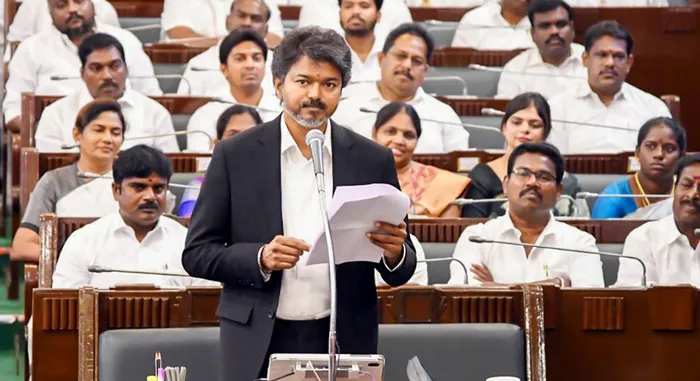
Tamil Nadu Chief Minister C Joseph Vijay delivered a congratulatory address to newly-elected Tamil Nadu Legislative Assembly speaker JCD Prabhakar and deputy speaker M Ravi Shankar during the assembly session in Chennai.
Image: IANS/X/@CMOTamilnadu
THE ascension of top South Indian actor to the position of chief minister of Tamil Nadu state following the recent elections, has highlighted the decades-long nexus between the film industry and the politics in the state.
The script of Tamil Nadu’s political history has always favoured the cinematic. From the fire-brand dialogues of M Karunanidhi to the demi-god status of MG Ramachandran (MGR) and the iron-willed charisma of J Jayalalitha, the journey from the silver screen to the top political position is a well-trodden path.
However, the recent swearing-in of C Joseph Vijay – popularly known as "Thalapathy" (Commander) – as the chief minister, marked perhaps the most significant structural shift in the state's politics in over half a century. Vijay’s transition was not merely a career change; it was a carefully-choreographed production.
The cornerstone of this transition was his 69th and last film, Jana Nayagan (People’s Hero). Originally slated for release in January, the film became the focal point of a high-stakes legal and political battle. The Central Board of Film Certification (CBFC) and the Election Commission effectively stalled the film, citing its overt political themes and potential to influence voters during the elections.
Paradoxically, the delay worked in Vijay's favour. The absence of the film on screens created a vacuum that Vijay filled with a relentless 234-constituency ground campaign under the banner of his party, Tamilaga Vettri Kazhagam (TVK).
Now, with the elections won and the chief minister’s chair secured, the film is finally set for a global release – no longer as a campaign tool, but as a victory lap for a sitting head of one of India's most unique states.
Continuing the movie-star-to-chief-minister tradition by taking the oath of office, Vijay joins an elite pantheon.
Tamil Nadu remains special in the Indian subcontinent for its star-to-statesman/woman pipeline. The tradition began with MGR, who leveraged his image as a protector of the poor to break away from the DMK and rule for a decade. It continued with Jayalalithaa, who combined cinematic glamour with administrative steel.
Vijay’s rise, however, is distinct. Unlike his predecessors, who rose through established Dravidian parties before branching out, Vijay built TVK from the ground up as a third way, challenging the decades-long duopoly of the DMK and AIADMK parties.
His victory signals a shift from the traditional Dravidian ideological battles to a more personality-driven governance model that resonates with a younger, post-ideological electorate. In a state where political rivalry often borders on the personal and the vitriolic, Vijay’s first few days in office have been remarkably un-Dravidian. Eschewing the tradition of immediate political vendettas, the new chief minister spent his first 48 hours reaching out to his opponents.
His visits to the residence of the former chief minister and now leader of the opposition, MK Stalin, as well as meetings with other party leaders, sent a clear message: the era of gentlemanly politics has returned to Tamil Nadu.
By treating his rivals with public respect, Vijay has signaled that while the election was a battle, governance must be a collaborative effort. This reconciliatory approach is a strategic masterstroke, helping to stabilise a coalition government that includes the Indian National Congress and several smaller regional players.
If the outreach was about optics, the first-day edicts were about intent. Vijay’s first official act – the signing of three major files – targeted the core of his people-first manifesto.
In a move that directly addresses the rising cost of living for the middle class and the poor, Vijay fulfilled his promise of 200 units of free electricity. This edict is expected to benefit millions of households, positioning him firmly as a successor to MGR’s welfare state legacy.
To fulfil his promise of female empowerment, Vijay announced the formation of a specialised, high-tech task force dedicated to the safety of women. This was accompanied by a commitment to fast-track courts for crimes against women.
Recognising a growing crisis among the youth, his third major order established an autonomous task force to scrub the state of narcotics – a move that was a central pillar of his campaign rhetoric.
So with a promising start as the lights dim on his acting career and brighten on his political tenure, Vijay faces the daunting task of moving beyond mass appeal to mass administration. The adulation he receives is no longer measured in box office collections, but in policy outcomes.
By blending the welfare-heavy traditions of his predecessors with a modern, less-confrontational political style, CM Vijay has managed to capture the imagination of Tamil Nadu. Whether he can sustain this momentum or if the complexities of a coalition government will dim his star, remains to be seen.
For now, however, the "People’s Hero" has successfully transitioned from the screen to the real world, and the state of Tamil Nadu is watching with bated breath to see if the ending is as triumphant as the opening scene.