

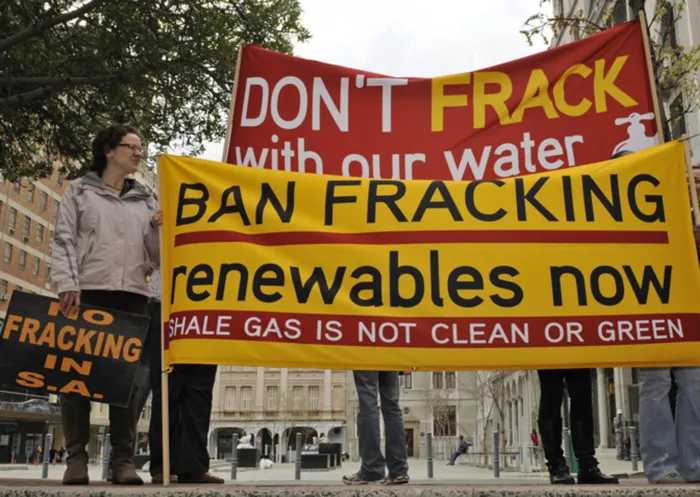
Anti fracking protesters outside the building where Mineral Resources Minister Susan Shabangu addressed the Press Club in Cape Town. Picture: Jeffrey Abrahams. Anti fracking protesters outside the building where Mineral Resources Minister Susan Shabangu addressed the Press Club in Cape Town. Picture: Jeffrey Abrahams.
In Business Report on Wednesday, September 7, the general manager upstream for Shell South Africa, Jan Willem Eggink, wrote a feature in which he sang the praises of what shale gas fracking can offer the Karoo, how safe the process is, how willing Shell is to do the right thing environmentally and how trustworthy Shell is.
This is not the experience of the people of the Karoo. Jan Willem Eggink’s ability to talk with passion about the Karoo is also highly questionable considering that he has spent little, if any, time in the Karoo.
“Shell has not done anything to gain our trust,” says Karoo farmer Lukie Strydom who together with fellow Karoo farmer and Agri Eastern Cape member Dougie Stern went on a two-week frack finding mission to the US in June and July this year to research shale gas fracking firsthand on behalf of the people of the Karoo.
“On Freek Robinson’s show on Kyknet on the 24 July 2011, Jan Willem Eggink, openly denied being aware of the contamination of a Shell well in Charlestown while we were in the US. Yet he had the newspaper article covering this spill in his possession because I personally gave it to him,” says Strydom.
“With the same evasiveness they refuse to tell us where they intend sourcing the millions upon millions of litres of water for the fracking process. All they say is ‘we won’t compete with the farmers’ water’ but they don’t clarify what this means,” says Strydom.
“What it could mean is that they intend to source water from deep water aquifers, which they can claim doesn’t compete with the farmers’ water, but what this could do is lower the water table because the inter-relationship between the Karoo’s aquifer systems is unresearched,” he says.
Strydom and Stern’s trip was sponsored by BKB, one of the largest co-ops in the Karoo, and they visited New York State and Pennsylvania. They visited well pads and affected communities and spoke with farmers, veterinarians, scientists, business people and oil executives.
“The picture of shale gas fracking we got from the US is bloody scary!” says Stern in a feature published in Farmer’s Weekly on August 19, 2011. “It is a toxic, environmentally destructive affair and many things do go wrong as a result of human error, well blow-outs, spills and contamination. We saw it all, including methane leakage from the fracking process in farmers’ water. We can confirm the process is not safe as it stands.”
“We spoke to several farmers who can no longer farm because the gas wells have destroyed their properties and destroyed the land values,” adds Strydom. “The last thing we must do is to put the future of the Karoo and our country into the oil and gas companies’ hands because they are not to be trusted.”
Shell and all the other oil and gas companies repeatedly claim the fracking process is safe and the technology has been mastered, but Stern and Strydom found the opposite.
“The toxic waste that comes back out of the wells after fracking – which contains lead, arsenic, mercury and radioactive materials – is even more frightening than the chemicals that go in,” says Strydom.
Both farmers spoke about the air, water, dust and noise pollution from the wells and gas processing systems, the endless trucks and the vast amounts of diesel burned.
“Think about an average of 1 100 truck trips per fracking operation, with up to 30 fracking operations possible on one well pad, transporting the sand, water, chemicals and toxic flowback fluids on our dust roads, and you will get some idea about the dust pollution, potholes and road destruction. Our animals will not be able to graze the vegetation because it will be caked in dust and the noise will disturb their breeding cycles,” says Stern.
What they also discovered is that when things go wrong and a farmer’s water is contaminated, the oil and gas company lawyers are first on the scene with non-disclosure agreements they get the farmers to sign. This means they may not speak to the media in exchange for a negotiated cash payout. The farmers are then left with poisoned water and become completely reliant on the oil and gas companies to deliver drinking and household water to them in containers.
“Not only does South Africa lack any legislation governing shale gas fracking, it is completely unprepared for the logistics, dangers and consequences of shale-gas fracking. What is also becoming increasingly clear is that the oil companies’ economic forecasting of profits and yields of shale gas does not match the reality,” says Strydom.
“There is such an oversupply of shale gas in the US that the price has dropped from $12 (R86) to $4 per 1 000 cubic feet (28 cubic metres) in the last few years. According to economists it costs approximately $6 per 1 000 cubic feet to produce the shale gas, which means it is now being sold at a loss in the US.
“In 2008, leading gas production company Chesapeake’s share price dropped by 60 percent and its profit by 50 percent, yet the chief executive paid himself a $100 million bonus,” says Strydom, adding that Shell has said that it wants to tip its investment from 40 percent gas and 60 percent oil to 60 percent gas and 40 percent oil.
To keep the image of the shale gas boom afloat it is being suggested that the oil and gas companies woo new investment markets such as South Africa, China and Australia with hyped production figures and economic models that are not reliable. In reality the US has shown that shale gas production can drop by 70 percent or more after the first year.
Stern and Strydom say that there are so many questions that have not been answered in South Africa, such as the actual sites where Shell intends to explore, how the shale gas would be piped from source and to where?
“In the US they have an elaborate gas pipe infrastructure that doesn’t exist here. Power stations would also need to be built, and all this significantly increases the carbon footprint of shale gas’ full carbon life cycle, which could well exceed that of coal. We also need to know where shale gas fits into South Africa’s energy picture,” says Stern.
South Africa is Africa’s highest emitter of carbon and the government has committed to reducing our carbon emissions (primarily from the use of fossil fuels – coal, oil and gas) by 34 percent by 2020 and 42 percent by 2025.
Regarding shale gas fracking’s job creation potential, Stern and Strydom add that it is a myth that the oil companies will provide thousands of jobs for unskilled, unemployed people in the Karoo.
“In the US the oil companies ship in the skilled people they need,” says Strydom. “Shell has admitted there will be no more than a handful of unskilled labour jobs. We asked them for a breakdown of the kind of jobs and skills requirements needed for the production process, but they have not provided this.”
Both farmers say they cannot stress enough how the lack of any legislation governing shale gas fracking in South Africa poses a serious health and environmental risk. “One of the many reasons why there is such a mess in the US is that the oil companies there managed to gain exemption from key acts, such as the Clean Water Act, the Clean Air Act and the National Environmental Policy Act. Without regulations here, the same could happen,” says Stern.
“If you consider that the target for Pennsylvania alone is 100 000 production wells, which is a similar size to the Karoo, then you can understand that with this kind of surface impact, our current farming models will not be sustainable,” adds Strydom.
“Once the land is disturbed to this degree, it cannot be rehabilitated, which means that after the oil companies have left in approximately 10 years, the agricultural economy of the Karoo will be no more.”
While the focus of shale gas fracking has been on the Karoo, it poses a similar risk to other farming areas and communities in South Africa, such KwaZulu-Natal and the Western Cape where shale gas exploration applications have been lodged.
“The bottom line is we do not trust them and no one in the US trusts them either,” says Strydom. Hence the widely repeated joke they heard in the US: “How do you know when an oil or gas executive is lying? His lips are moving.”
“We as a nation need to exercise far more caution and control over all these issues,” emphasises Strydom. “Our government needs to put together a task team of geologists, ecologists, toxicologists, engineers, economists and other specialists to conduct an independent study on the issues surrounding shale gas fracking. The study must include a full life cycle cost-benefit analysis and a comparison of the job opportunities of shale gas fracking compared to renewable energy.
“What our trip has shown beyond any doubt is that we cannot trust the oil and gas companies to even begin to explore our country without the strictest controls and regulations from the government. Because if we do make a mistake in judgment it would haunt us for many years to come.” - Business Report