

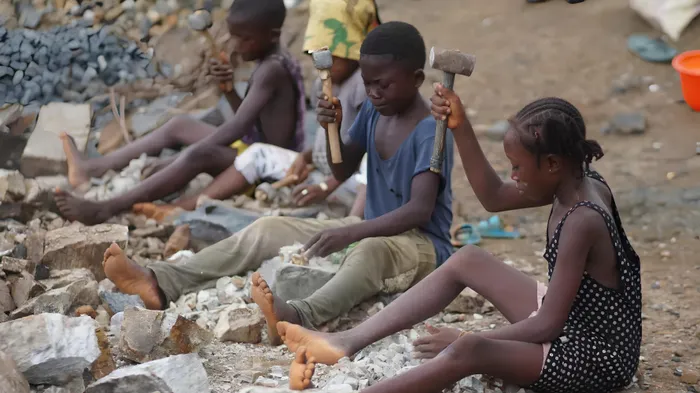
Lack documentation is one of the major factors shaping risk and vulnerability among migrant children.
Image: UNICEF
When six-year-old Joshlin Smith disappeared from Saldanha Bay in February 2024, the case horrified South Africans and reignited fears around child trafficking, exploitation and the vulnerability of children living in poverty.
More than a year later, Joshlin has still not been found, with the investigation still open and active, despite the sentencing of three accused in May 2024. Detectives continue to follow up on all information, with extensive efforts undertaken both locally and abroad,” Western Cape police spokesperson Colonel Andrè Traut previously said.
Joshlin disappeared on 19 February 2024. She was six years old at the time.
In 2025, her mother Kelly Smith, her boyfriend Jacquen “Boeta” Appollis and their friend Steveno van Rhyn were convicted and sentenced for kidnapping and trafficking the child. Evidence presented during the trial alleged Joshlin was sold for R20,000.
The case has become one of South Africa’s most disturbing modern child protection cases. But academic research suggests it also sits within a much broader web of poverty, instability, violence and exploitation affecting vulnerable children.
Research published by the Center for Civil and Human Rights at the University of Notre Dame found that poverty and weak education systems remain among the major drivers increasing children’s vulnerability to trafficking and exploitation.
“In general, two principle forces drive human trafficking: supply and demand markets,” the paper noted. “A market for prostitution and cheap labour largely precipitates demand, while poverty and poor education standards essentially drive supply.”
The paper noted that South Africa functions simultaneously as a source, transit and destination country for trafficking activities.
Researchers also warned that children are particularly vulnerable because they are more susceptible to coercion and manipulation. “Children are also generally more susceptible to coercion and perhaps are induced into thinking that they agreed to be trafficked,” the study said.
One of the major challenges facing authorities is that trafficking is often difficult to identify. “It is extremely difficult to detect and prevent, mainly because of its cross-border, transnational nature,” the researchers found.
The paper added that many child victims do not necessarily identify themselves as trafficking victims. “A simple car ride, for instance, may be a form of trafficking.”
The study also noted that trafficking networks frequently involve organised criminal structures operating across multiple actors and jurisdictions.
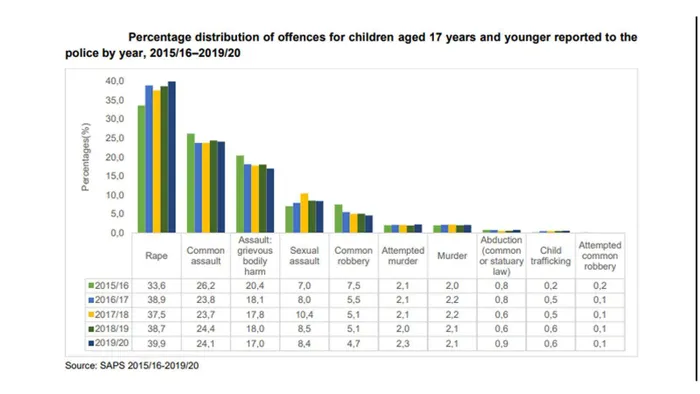
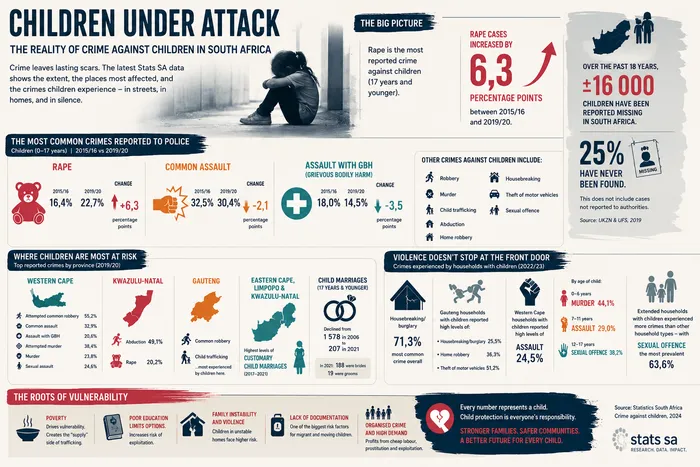
Crime statistics published by Statistics South Africa in 2024 paint a broader picture of the violence affecting children. The agency warned that crime against children has “a lifetime impact on children, resulting in an unpleasant environment and poor development of the country”.
According to Statistics South Africa, rape remained the most prevalent crime reported against children aged 17 and younger between 2015/16 and 2019/20.
The report also found major regional variations in crimes affecting children.
KwaZulu-Natal recorded high levels of reported child abduction and rape, while Gauteng recorded high levels of child trafficking and common robbery involving children.
The Western Cape recorded high levels of attempted murder, murder, assault and sexual assault involving children.
The data also highlighted how violence extends beyond direct crimes against children themselves.
Statistics South Africa details crimes against children
Image: StatsSA
Statistics South Africa’s data also showed that children are frequently exposed to broader household and community violence, including burglary, assault, robbery and sexual offences.
A 2019 paper jointly published by the University of KwaZulu-Natal and the University of the Free State found that approximately 16,000 children had been reported missing in South Africa over an 18-year period.
About 25% were never found. The researchers warned that this did not include unreported cases.
“We conclude that missing children cases are intricately intertwined with the layers of violence that have become embedded in South African society in the democratic era,” the paper stated.
At the same time, researchers have also warned against sensationalism and moral panic around trafficking.
A 2020 University of Pretoria study developed through the Centre for Child Law found that while trafficking does occur and children remain highly vulnerable, reliable data on the scale of trafficking in South Africa remains limited.
The researchers warned that trafficking is frequently conflated with irregular migration, smuggling and broader movement of vulnerable children.
“What is known about trafficking is largely based on ad hoc studies, questionable and outdated statistics, anecdotal information, and common myths,” the report stated. The study argued that some policies implemented in the name of child protection may actually increase vulnerability for migrant children.
The researchers found that “the consequences of using child trafficking to represent the myriad realities of children on the move and especially in the name of ‘child protection’ are that migrant children are exposed to additional risks and vulnerabilities”.
The atrocity that is crimes against children in numbers.
Image: ChatGPT
The report identified lack of documentation as one of the major factors shaping risk and vulnerability among migrant children.
It specifically noted that migrant children are exposed to additional risks and vulnerabilities
“Documentation was identified by all individuals involved in addressing the vulnerabilities of child migrants and by child migrants themselves as the key issue shaping the experiences of and the levels of risk faced by child migrants.”
The researchers questioned why this had not led to stronger interventions focused on documenting vulnerable children. The University of Pretoria study also challenged broader public assumptions around trafficking prevalence.
“The low number of trafficking cases and little engagement with trafficking cases show that the discourse of child trafficking does not reflect the realities on the ground,” the researchers stated.
“While there is evidence of children facing high levels of vulnerability and there are some cases of trafficking being encountered, there remains a disconnect between the reality and discourse.”
For child protection organisations and researchers, Child Protection Month therefore raises not only questions about trafficking itself, but also about the deeper social conditions that leave children vulnerable to exploitation, violence and disappearance in the first place.
IOL BUSINESS