

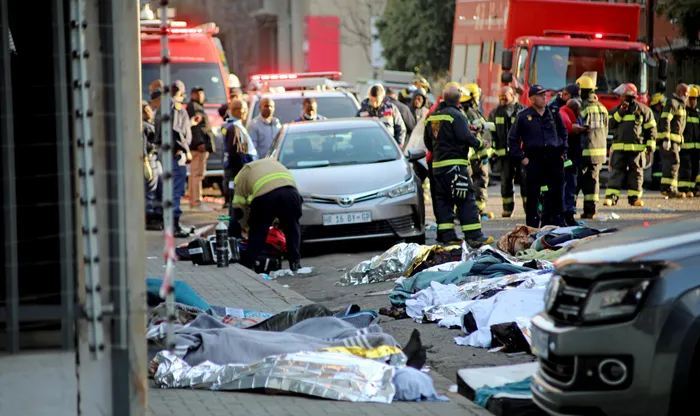
More than 70 people tragically died in the Joburg CBD when a fire gutted the Usindiso Building.
Image: Timothy Bernard | Independent Newspapers
A Johannesburg building fire and the killing of DJ Warras, an activist against hijacked buildings, have underscored a deeper crisis facing municipalities: many do not know what they own, who controls it, or what it is worth.
This was raised during a meeting of Parliament’s Standing Committee on Appropriations, which was considering reports on the Adjustments Appropriation Bill and Special Appropriation Bill.
In a submission to the committee, the South African Local Government Association said municipal asset registers, including those assessed annually by the Auditor-General, are often incomplete or inaccurate.
This is because municipalities do not always know how buildings are classified or what they are used for.
The association told members that this uncertainty leaves asset values unknown and weakens budget forecasting when disasters occur.
In the discussion, the example of a Johannesburg building fire was cited.
The municipality was left facing a severely damaged structure without immediate clarity on ownership or leaseholders, while the disaster response was already underway.
The most widely reported deadly fire in recent Johannesburg history was the Usindiso building fire in August 2023, where at least 76 people died in a hijacked, overcrowded building in the CBD.
The matter was discussed in the broader context of governance failures linked to buildings in Johannesburg, following the death of Warrick Stock, widely known as DJ Warras.

Warrick Robert Stock,known as Dj Warras, a beloved South African entertainer, was tragically killed in a shooting
Image: Matthews Baloyi
Warras was shot dead in the city’s central business district on 16 December 2025. Police have said he was approached by several suspects as he parked near Zambezi House, opposite the Carlton Centre.
The DJ was killed in what is being investigated as a targeted attack linked to his work addressing hijacked and unlawfully occupied buildings.
He was a dynamic and respected force in South Africa's media and creative industries. Born in Durban, he forged a multifaceted career that stretched across radio, television, digital platforms and live performance.
Warras' death was referenced during committee deliberations as highlighting the risks associated with contested, poorly managed and unlawfully occupied properties.
National Treasury director Letsepa Pakkies told the committee that asset register weaknesses are also exposed during insurance claims. As a result, payouts are delayed or disputed because the information contained in the registers is incomplete or unreliable.
Pakkies said municipalities are permitted to use up to 5% of allocations from the Municipal Infrastructure Grant to establish and validate asset registers, enabling them to identify and evaluate assets properly, but that uptake of this provision has been poor.
Committee chairperson Mmusi Maimane said the issue of asset register accuracy underpinned the increase in allocations to disaster relief and contingency reserves reflected in the medium-term budget policy statement.
Maimane said accurate asset values are essential for municipalities to account properly for infrastructure when disasters occur.
Member Kingsley Wakelin supported the point and raised the need for more effective follow-through on audit assessments, drawing on his experience in Tshwane and Johannesburg.
Maimane responded that the central issue remained the accuracy of asset registers rather than project management, particularly to ensure that infrastructure is properly accounted for in the event of disasters.
Wakelin further proposed that all spheres of government develop proactive disaster mitigation strategies, noting that disaster-related budget adjustments are often made after the fact rather than being aligned with preventative planning.
The committee agreed that persistent shortcomings in municipal asset registers, audit reliability and disaster preparedness continue to undermine effective disaster response, infrastructure accountability and public safety in South Africa’s cities.
IOL BUSINESS