

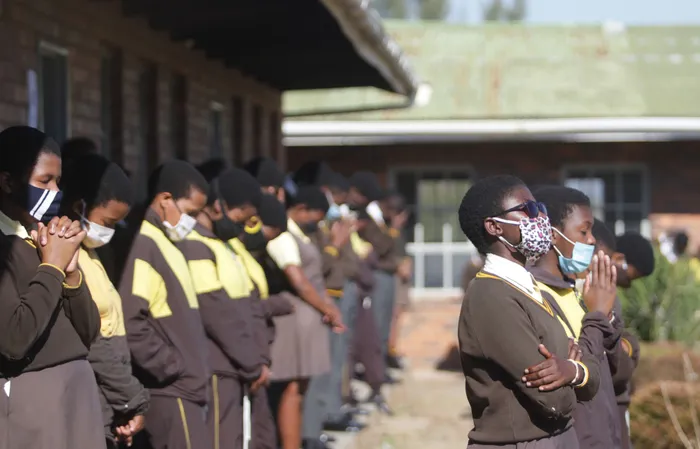
Traumatised pupils pray at Masijabule high school at Swayimane after six of their teachers were injured during a shooting at Wartburg before reaching school. PICTURE :Bongani Mbatha /African News Agency (ANA)
by Shabodien Roomanay
It is often said that nations are built on the backs of teachers. History has shown that where nations have placed emphasis on education, research and development, they made huge progress.
Simply put, the development index, which measures the living standard of a people, of these nations is generally much higher.
Consider the Scandinavian countries, China, South Korea and India where the emphasis has been on educating future generations. A glance at education budgets across the world shows a fairly great correlation between economic growth, GDP and educational outcomes.
Pre-1994 educational outcomes in South Africa are a case in point. For every R100 spent on a white child, the ratio was R50, R30 and R10 respectively on Indian, coloured and black children.
White schools were over-resourced, universities were built and the best minds employed to teach students to carry the baton of apartheid as the next generation of white and Afrikaner leaders.
Hendrik Verwoerd infamously announced to the world in a speech in 1953 that: “it makes little sense to teach mathematics to a black child if he or she could not use it in a career”. The impact of this meant that generations of black children were denied growth in the sciences while white children were not only encouraged, but also supported, to excel in the sciences.
Many individuals and departments at various universities supported these policies with academic back-up. Today, many who were responsible and are still around, would deny involvement.
Sweden, Norway and Denmark spend on average 8% of GDP on education. South Africa, a “third world” country, spends 6.2% whereas the UK spends 5.5% and the US 5%. South Africa’s spend on education is the highest on the continent.
In addition, as a percentage of the annual budget, South Africa spends on average 19% of its annual budget on education; the UK and US about 13.5% and Scandinavian countries average 15%. Since 1994 to date, South Africa would have spent about R4 trillion on educating its children.
Children, who still sit on paint cans for chairs in classrooms, die after falling into pit latrines and teachers who keep an eye on pupils by peeping through holes in the walls have not benefited from the huge spend. Clearly, is there is gross mismanagement. Or is it large-scale incompetence?
According to the Programme for International Student Assessment (PISA-2018), South African 15-year-olds rank about last. Of the 77 countries measured for competency in Languages, Science and Mathematics, South Africa does not feature at all.
This shocking statistic must be measured against an increasing year-on-year matric pass rate celebrated by the ministry as having achieved it objectives. What is ignored is that all that has happened is that we now have more certified, but functionally illiterate, cohorts of pupils exposed to the real world with few real capabilities.
A 15-year review of education commissioned by the Presidency in 2008 and compiled by Professor Nick Taylor was so detailed that if some of the recommendations were considered, the nation would have made major strides.
Instead, the following anecdote from the report is still present across the country in many schools: in Limpopo province, a literacy and mathematics assessment designed for Grade 6 learners was administered to Grade 3 teachers. The average score for these teachers was 67%; of the 25 teachers assessed, only 1 scored 100% and 3 scored below 50%. So clearly there is a deep-seated, systemic issue that needs to be urgently addressed.
South Africa needs to seriously consider incentivising mathematics and science boffins to consider teaching as a real option. Or bring in Zimbabwean or Indian maths and science teachers to help train our local educators to be seriously competitive as a nation.
All educators should be attending ongoing, compulsory, frequent development programmes that are up to date. Those who fail to meet the mark should be removed from the system.
There are many highly talented people at universities and schools who would easily contribute, within six months, to a new and diverse educational construct that would prepare the next generations for their future.
The country can ill afford another “commission of inquiry”. And to be frugal, the ministries of primary and secondary education should be combined. Separation is a colossal waste of taxpayer’s money.
* Roomanay is past Headmaster of Islamia College, Chairperson of the Board of Muslim Views and Founder of the Salt River Heritage Society.
** The views expressed here are not necessarily those of Independent Media.
Cape Argus
Do you have something on your mind; or want to comment on the big stories of the day? We would love to hear from you. Please send your letters to [email protected].
All letters must have your proper name and a valid email address to be considered for publication.