

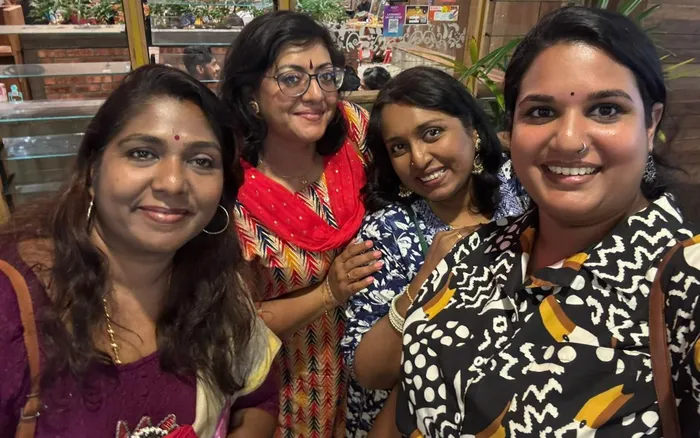
Saranya Devan (the writer, right) with Malaysian Tamil teachers, from left: Lalitha Rajamanickam, Purani Wataraju and Komathi Kaliappan.
Image: Supplied
THERE is a particular silence that settles in when a language begins to fade; it is not the absence of sound, but the absence of familiarity. Words and phrases once spoken in kitchens, temples, and family gatherings slowly retreat, replaced by convenience, assimilation, and time. For many South African Tamils – and non-Tamils - that silence is becoming more noticeable.
Spoken Tamil, once the heartbeat of community life, now often survives in fragments - an affectionate phrase from a grandparent, a prayer recited by rote, a song remembered without fully understanding its meaning.
I write this column after conducting my weekly Bharatha Natyam class and found it so sweet when my student Sahana responded to me in Tamil, here and there, knowing that I could understand her little cari moments, accompanied by her head bobble/wobble to signify "okay," "yes," "I understand" or "fine".
It got me thinking about how there are still a few youth who want to still be able to mix the Tamil lingo in. Our (South African Indians’) history of indenture, displacement, and forced adaptation has meant that language was one of the first things to slip away. English became the bridge to opportunity, Tamil, for many, became something to be preserved rather than practised. Over time, preservation without use has proven futile.
But why does Spoken Tamil matter now, in a country as linguistically rich and diverse as South Africa? To lose Spoken Tamil is not simply to lose words; it is to lose a way of being connected to ancestry, to history, and to self. Once the last fluent speaker dies, the language effectively dies. There is also something quietly radical about choosing to speak one’s mother tongue in a world that constantly pushes toward homogenisation.
I am reminded about the words of our Father of Democracy, Nelson Mandela, who said: “If you talk to a man in a language he understands, that goes to his head. If you talk to him in his language, that goes to his heart.”
In South Africa, where multilingualism is officially celebrated yet unevenly practised, reclaiming Tamil in its spoken form becomes an act of cultural confidence. It says: we are not only part of this country but we carry a past that still has a voice. Encouragingly, there are efforts underway to bring that voice back into everyday life. For the fifth year in a row, free Spoken Tamil classes are being offered on Sunday afternoons, reconnecting communities with the rhythms and accessibility of the language.
An initiative by the Malaysia-Durban Tamil Socio-Cultural organisation, these classes are particularly meaningful as its emphasis is on speaking, not perfection, not grammar, but conversation. The kind that allows someone to greet an elder, tell a story, bargain on the streets of Chennai, or simply feel at home in their own linguistic inheritance.The involvement of teachers from Malaysia adds another layer to this exchange, reminding us that Tamil is not bound to a single geography.
It is a global language with multiple accents, inflections, and lived experiences. In learning from one another, there is an opportunity not only to reclaim but also to reimagine what spoken Tamil can be in a South African context. Of course, revitalising a language is not the work of a few classes alone. It requires a shift in mindset, from seeing Tamil as something formal or occasional, to something lived and spoken daily, however imperfectly.
It asks parents to risk speaking to their children in Tamil, even if the response comes back in English. It asks young people to embrace the awkwardness of learning, of mispronouncing, of trying.
If Spoken Tamil is to survive and thrive in South Africa, it will not be because it was preserved in textbooks or ceremonial spaces alone. It will be because people chose, consciously and collectively, to speak it again. In homes, in WhatsApp voice notes, in casual conversations that stitch language back into the fabric of everyday life. The silence can still be broken. But only if we are willing to fill it with our own voices.
It is my fervent prayer that younger generations will reclaim Spoken Tamil and other mother tongues, whether through formal study, community classes, or even digital platforms. It is a way of saying: we may have been forced to adapt, but we can choose to reconnect.
For more information on these Spoken Tamil classes which commence this Sunday, March 29, email [email protected].