

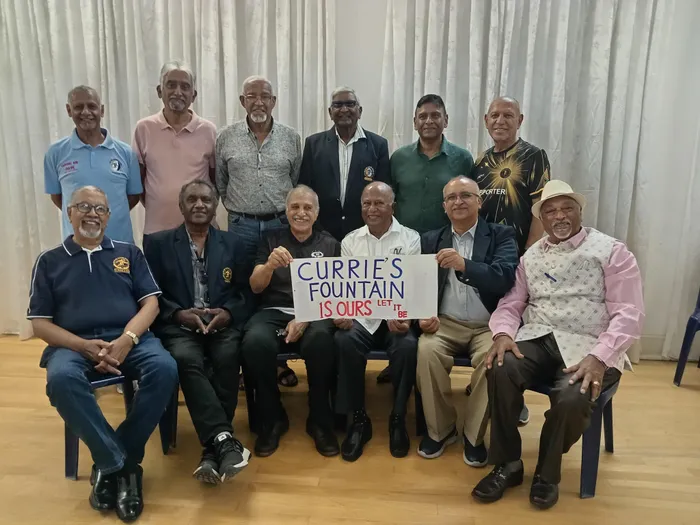
Members of the The Curries Fountain Heritage Preservation Foundation remain steadfast in their hope that the icon sports ground will be declared a heritage site.
Image: Rachel Vadi
The fate of Curries Fountain, a site woven into the fabric of South Africa’s sporting, political and cultural history, now rests with the KwaZulu-Natal Amafa and Research Institute. The heritage authority met on Monday, 23 March, to decide on an application to declare the iconic Durban ground a protected heritage site. The outcome has not yet been released.
For those who have fought to preserve its legacy, the wait is heavy with hope.
Anand Jayrajh, an attorney and executive committee member of the Curries Fountain Heritage Preservation Foundation, has spearheaded the application. At a public meeting at Sastri College on Sunday, he confirmed that Amafa’s council had met the following day.
“We are hopeful that Amafa’s decision will be in our favour,” Jayrajh said. “We have done all the necessary paperwork in our application. We now await their decision.”
The foundation, formed in 2024 by a concerned group of community members, has been pressing for heritage status to safeguard a site that many believe is unmatched in its historical significance.
Curries Fountain was never merely a sports field. It was a rare gathering place for black South Africans during apartheid, where sport was weaponised in the pursuit of non-racialism, and where political rallies drew thousands. The 1913 land tax strike, the 1959 burning of the dompas campaign led by Albert Luthuli, the launch of Cosatu in 1985, and the relaunch of the ANC Women’s League in 1990 all took place on its grounds.
Its sporting history is equally storied. It was the first turf cricket wicket for black cricketers in the country, hosting teams from India, Ghana and Kenya. Football legends such as Henry “Black Cat” Cele, “Sugar Ray” Xulu, Dharam Mohan, Lionel Hamiel, Daya Maistry, and “Excellent” Mthembu graced its field. Athletics, boxing, cycling and even motor racing drew crowds, and the ground became a cultural hub where bands like the Jets, Flames and Invaders played, often under police watch.
The origin of Curries Fountain predates its sporting and political life. In 1878, during a severe drought, Durban councillor H W Currie sank an artesian well in the area below the Botanic Gardens. The well, named Curries Fountain, supplied water to the growing city until the 1890s. The land later became a sports ground for the Indian community and, over decades, transformed into a crucible of resistance and unity.
Today, the site is owned by the eThekwini Municipality and managed by the Curries Fountain Sports Development Centre, a partnership involving the Durban University of Technology and civil society. About R2.5 million has been spent on upgrades, but advocates say heritage status is essential to protect its soul.
Maya Singh, president of the heritage foundation and a former school principal, has carried a hand‑made sign through years of advocacy. It reads: “Curries Fountain is ours; let it be.”
“One day, I am going to put this sign up in the Curries Fountain museum as part of our history,” he said. “The memories of the historical role that the site has played are forever etched in the heart and soul of the community. If it is not accorded the necessary protection, then there is the real danger that this will be lost forever.”
Jayrajh echoed the urgency. “Curries Fountain has played vital and integral roles in the sporting, cultural and political development of South Africa and is an important historical and heritage site that needs to be preserved and protected.”
With the Amafa council’s decision pending, the foundation and the wider community now wait to learn whether the site will receive the formal protection its advocates believe it has long deserved. If approved, the declaration would open the door to further development, including a museum and heritage centre, while ensuring that the grounds remain a living monument to the generations who gathered, played and fought there.
For Singh, Jayrajh and the many who have rallied behind the cause, the coming days will determine whether a century of memory is formally secured. The outcome, they say, will not be an ending, but a new chapter in the long life of Curries Fountain.