


Members of the organizing committee of the 50 year Tin Town Reunion event that took place in Stonebridge in Phoenix.
Image: SUPPLIED
Fifty years since floods destroyed the legendary Tin Town in Springfield Park, Durban, hundreds of survivors and their descendants gathered at the Stonebridge Community Hall in Phoenix for a poignant reunion. They came to remember, to reconnect, and to share stories of survival and triumph in the face of devastation.
On 21 March 1976, the banks of the Umgeni River burst, unleashing catastrophic flooding that saw the area, long vulnerable to such disasters, suffer its greatest loss yet. A total of 482 shacks, home to 781 families, were flattened, leaving many with nothing but the clothes on their backs.
Film‑maker and author of Legends of the Tide, Viroshen Chetty, describes the area, also known as Springtown Flats, as “a closely‑knit, predominantly Indian market gardening community.” He notes that families were “free Indians who tried to carve a living for themselves and their families by growing and selling vegetables along the banks of the Umgeni River, a region rich in alluvial soil.” Families were leased about five acres each by the municipality to cultivate their crops, living in homes without electricity, running water or sanitation.
Chetty describes Tin Town as “the vegetable garden of Durban,” where city markets were supplied daily with fresh produce. The market gardeners transplanted farming skills from their native Indian villages, growing indigenous vegetables including vendakai (okra), kerala (loofa), and an array of herbs, alongside carrots, beetroots, and tropical fruits like mangoes and pawpaws.
Yet the abundant success of these market gardeners was regularly thwarted by the recurring floods of the Umgeni River. The most devastating occurred in 1917, claiming 400 lives and necessitating the courageous rescue efforts of the Padavatan Six, who saved 176 people from drowning, an act still recognised as Africa’s largest civilian rescue.
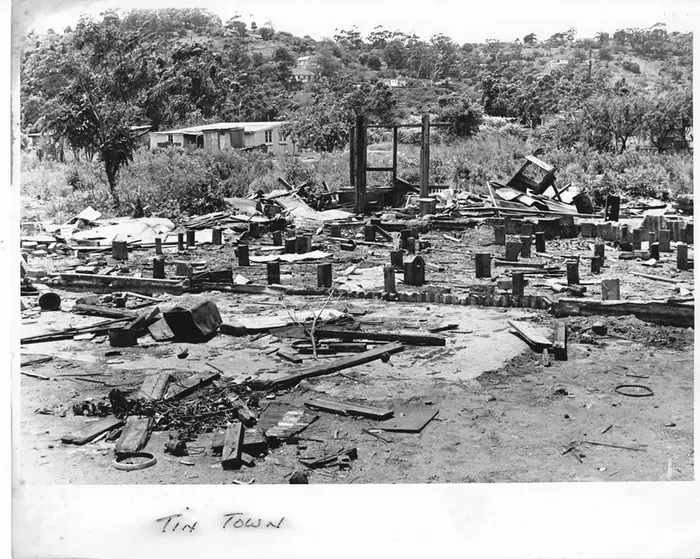
An image of the aftermath of the 1976 Tin Town flood as sourced by Legends of the Tide author, Viroshen Chetty.
Image: SUPPLIED
The floods of 1976 forced hundreds of families to evacuate their homes in the dead of night, facing an uncertain future as armies of water consumed their lives.
Ronnie Budhai, who lived at house number 408 in Tin Town, was just thirteen when disaster struck. His mother, Shantimathy, unexpectedly transformed into an entrepreneur, launching one of the community’s first tuck shops. Budhai remembers: “A neighbour unable to buy groceries asked my mum to sell them a few items. That was the start of her little business which turned us into a family of entrepreneurs.”
Vividly recounting the flood, he explains: “There was a dump between the river and Tin Town; I think that’s what saved many of us. The water flowed slowly, filling rooms and houses up to the rooftops. A lot of people were evacuated to safety.”
Despite the destruction, Budhai retrieved money stored in pickle jars from his submerged home by swimming each day to gather what he could. “Next morning, everything was under water. We waited months for the water to recede,” he said, describing the resilience that emerged in the wake of disaster.
Romella Singh, now a 67‑year‑old resident of Mount Edgecombe, recalls her own story of survival at eighteen. “Our house was built a little higher, so it didn’t flood. But we were evacuated for safety. The river rose slowly, and that’s how we survived,” she remembers.
Singh’s family eventually moved into the newly built homes of Phoenix, preserving the spirit of Tin Town despite losing their previous lives. “It was different, but still the same. For example, it was the first time my mother had electricity and running water,” she shares, reflecting on the trials faced but also the triumph of resilience.
The fifty‑year reunion at Stonebridge was filled with exuberance. “After all these years, there was a togetherness once again,” Singh remarked. “Of course, we’ve all grown up, and maybe we didn’t recognise each other. But the excitement was there. I even met someone from my class in standard nine!” Her laughter echoed through the hall as memories were brought to life, tears shed, and joy reignited among survivors of the humble market garden community.