
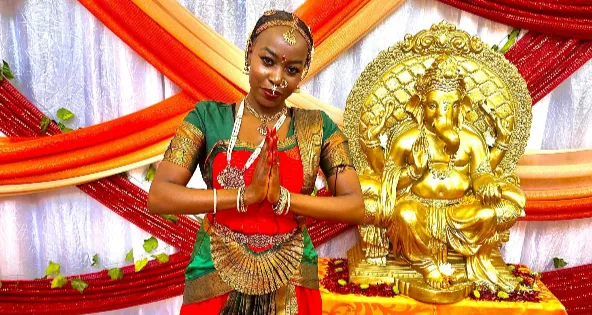
Mukelisiwe Phakathi is redefining her identity through Bharatha Natyam.
Image: Supplied
AT 33-YEARS-OLD Mukelisiwe Phakathi is redefining her identity through Bharatha Natyam, an ancient Indian classical dance form she discovered just two years ago.
From childhood fascination to spiritual connection, this former KwaZulu-Natal resident, who is a member of the South African Tamil Association and a devotee of Lord Shiva, participates in cultural events such as Pongal and Onam.
Originally from Newcastle, Phakathi’s passion for dance and cultural exploration has blossomed in the city of Johannesburg, which pulsates with diversity and rich traditions.
Phakathi's journey into Bharatha Natyam was ignited in her childhood, inspired by the SABC 2 show Eastern Mosaic.
"I fell in love with how the dancers controlled their bodies, especially the facial expressions. That planted a seed within me," said Phakathi, who is in a compliance role in a bank.
"In varsity, I started my yoga journey and slowly started adopting Sanatan Dharma practices, which made me have a deeper understanding of yoga as a philosophy and not just a physical activity. I then came across Bharatha Natyam reels on social media that triggered the memories from when I was a child and I just went deep in it and fully involved myself in the art form."
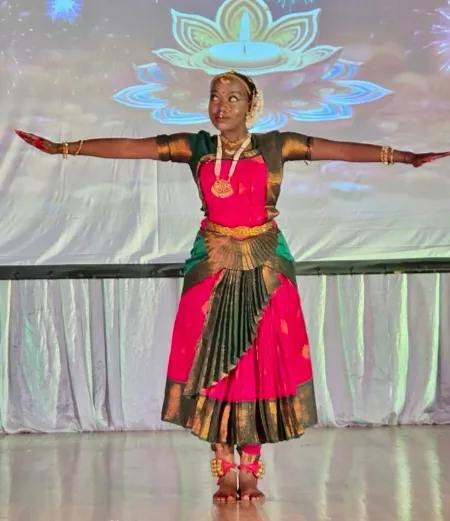
She said she fell in love with how Bharatha Natyam dancers controlled their bodies, especially their facial expressions.
Image: Supplied
She then joined the Shivalaya Bharatanatyam dance school in Fourways, Johannesburg.
"At first, it was a challenge because my body and mind had been mapped out already. However, I had been doing yoga and dancing ever since I could walk, so that helped quite a bit. Believe me though, body conditioning requires decades and I am working on it every single day."
Her Guru is Swarna-Tamilmodzhi Rajendra who completed her formal training in Tamil Nadu in South India.
"All the traditional processes for dance are followed. For example, before I started I had to do a guru pooja signifying my commitment to the art form in front of the guru and Lord Nataraj."
Phakathi said Bharatha Natyam would "humble you" and dedication and commitment were imperative.
"I have done seven Adavus (the foundational, rhythmic movement units of Bharatha Natyam) and I am currently on my eighth. I have performed the first of the eight Margams (Alarippu-blossoming of a flower) and am currently learning Sabdam, which is more focused on Abhinya (expression). Technical precision and expression must be achieved along the journey."
She said her focus remained Bharatha Natyam, the "mother of classical Indian dance" and was considering learning another form, Odissi.
"After I have mastered the technical skill Bharatha Natyam carries, I will use that as leverage to learn Odissi, which is also one of the eight Indian classical dance forms."
Her guru, she said, curated the costumes, choreography, designs and colours.
"When I perform, I go to my dance classmate's house to get ready and we help each other with the head gear strings and pins. I have found a community that is so welcoming and I am grateful for their support and welcoming energy."
She said her family was "shocked but not that shocked" that she started Indian classical dance and followed the Hindu religion.
"They know I am a seeker of knowledge and experiences. They are aware that I am not walking the path of Christianity like them and there have been some tension points. But like all families, we are open and working through it. They accept me as an individual with her own journey to walk. My granny on the other hand is so happy that I am dancing because she used to say I must take up dance as a discipline.
"My community used to mock and belittle me but now they are proud. There seems to be a condescending attitude towards Indian culture because of the lack of understanding of the symbolism within the Hindu religion. The Indian community though, they have been so amazing and supportive, especially the women. I am so appreciative of that."
Phakathi said Bharatha Natyam was an art form that was rooted in Indian culture and "you can’t separate the two".
"The art form is advanced because it is sort of a reflexology. You get to move the entire body muscles, including facial muscles, and that is a phenomenal skill that increases brain processing. I want to extend my gratitude to the Indian people all over the globe for the support and warm words of encouragement. I will continue to participate respectfully."
Phakathi will visit India in September, where she hopes to visit temples in South India.