

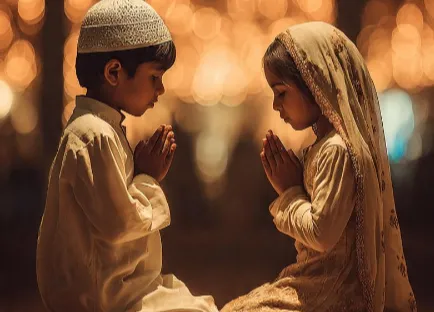
THE writer says she uses the word 'Ramzaan' instead of 'Ramadaan' because this was the word everyone used when she was a child.
Image: Meta AI
WHEN I think back to Ramzaan as a child, the strongest memory is of the atmosphere – a frisson in the air, a feeling of expectation, of preparation and, curiously, of excitement. Why would a child be excited at the prospect of adults fasting around them to the extent that she wanted desperately to join them? (It is only compulsory to fast from puberty onwards). It is perhaps because Ramzaan was not taught to us as a time purely of abstaining from food and drink from dawn to dusk. It was a revered, auspicious time, a time to cherish and make the most of, a time of spirituality and an opportunity to get closer to the Creator.
I remember my parents teaching me that it was not about hunger and thirst, but the lessons to be learnt instead: empathy for the hunger of the poor; discipline of thought, word and deed; and the restraining of one's baser instincts. They were sterling lessons to a child growing up and they are the same lessons I have passed on to my children. I remember the discipline well. I was at a mixed school for most of my schooling years, and the hardest part for a child during Ramzaan was when someone had a birthday, and they handed out chocolates and other goodies to the class.
One could keep the chocolates for iftar, the time of fast breaking, but alas, if there was birthday cake, one usually had to forgo it. Today, the fasting month is very similar to when I was growing up. My mother never believed in preparing vast quantities of samoosas and pies, and storing them for the month. We did break fast with one or two savouries, but otherwise ate normal food. The practice of eating only carb-laden fried snacks and not much else is unhealthy for a body that has been deprived of nutrients for the entire day. Add to that sugary drinks, and one is asking for trouble.
Our usual iftar now consists of dates, a fruit starter, one or two savouries or haleem, and then, after prayers, a balanced meal of protein, vegetables and carbs. We usually drink coconut water (which is great for restoring electrolytes) or a home-made lemonade. The pre-dawn meal (sehri) is usually oats, eggs or banana fried in ghee (a healthy fat). A welcome development is that some mosques now accommodate women for the taraweeh prayers (the nightly prayers of Qur'an recitation).
One of the goals in Ramzaan is to complete reading the entire Qur'an, either individually or in congregation. I attend these and find them very spiritually uplifting. For those wondering, I use the word "Ramzaan" instead of "Ramadaan", because this is the word everyone used when I was a child. Ramzaan is Urdu, Ramadaan is Arabic. We are Muslims hailing from the Indian subcontinent and therefore have always used the Urdu word. In the last two decades or so, Islam in South Africa has become Arabised and all former Urdu terms were changed to Arabic. Islam is a universal religion meant for all cultures. So I continue using the word Ramzaan because I am used to it and to honour my heritage. Ramzaan Mubarak!

Raeesa Soraya Mahomed
Image: File
Raeesa Mahomed is a multimedia personality and a transformational life coach.