

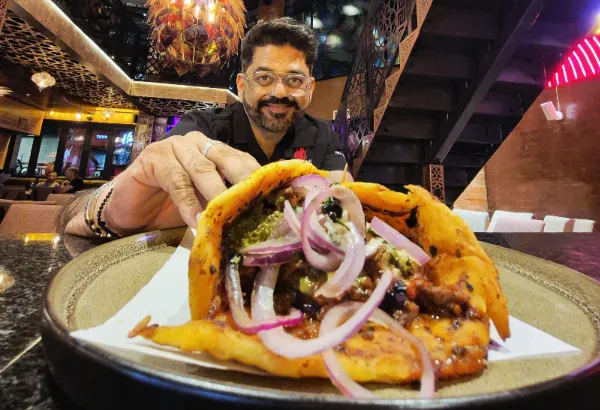
Director Sandesh Rampersad recently opened a new Roti & Chai branch in Rosebank.
Image: Supplied.
The story of Roti & Chai is not one that began in a boardroom with a polished business plan or a mountain of capital; it began with the visceral, quiet urgency of survival.
For founder Sandesh Rampersad, the spark was born from a moment of total loss.
"There wasn’t a boardroom moment or a perfect business plan, there was just a father, two daughters and an empty fridge," he shared.
Recently divorced, at the time, and having lost both his home and previous business, the pressure to provide for his children became the catalyst for a culinary revolution.
"That pressure could have broken me, but instead it pushed me back into the flavours I grew up with in my grandmother’s kitchen."
The transition from a desperate necessity to a growing brand found its footing in 2015 at the Musgrave Night Market.
While walking past the crowds, Rampersad experienced a sudden clarity: "Something inside me said, ‘My tandoori chicken wrap needs to be here'."
Operating from a simple mobile food setup, he began serving recipes straight from his grandmother's recipe book. The response was immediate and emotional.
"People didn’t just buy the food, they came back, they brought friends, they asked where we’d be next. In that moment, I realised that this isn’t just survival, this is my calling and the birth of a brand.
"That’s when Roti & Chai stopped being an idea and became my life’s work."
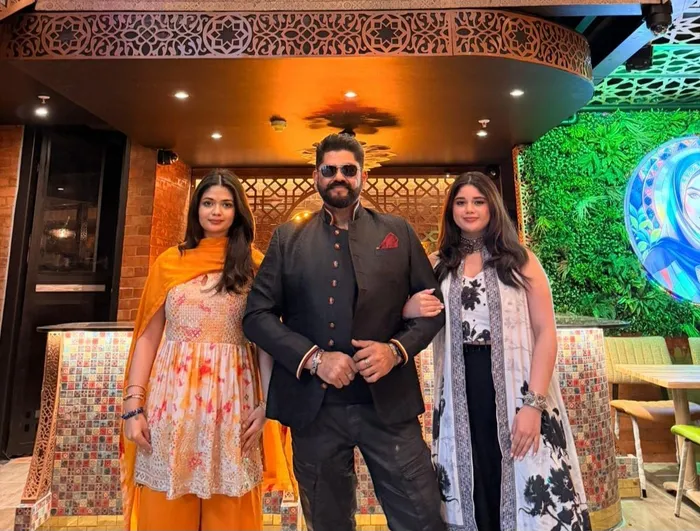
Sandesh Rampersad with his daughters, Sayali and Medhiya, the heart and inspiration behind the journey from trailer to Rosebank.
Image: Supplied.
This transition from the streets to established storefronts in Durban’s Florida Road and eventually the high-energy district of Rosebank, Johannesburg, was fueled by a philosophy of radical humility.
"I must admit that I didn’t enter the food industry with a grand plan. What I did have was hunger, literal and metaphorical, and a willingness to listen.
"The biggest lesson is simple: humble beginnings are an advantage, not a disadvantage. When you start with nothing, you learn to listen to your guests, to your team, to the market," he said.
From those early food truck days, the team learned to test and adapt without the interference of ego.
"If a dish didn’t work, we changed it. If a guest had feedback, we took it seriously. That mindset still drives us today, from Durban to Rosebank. We’re always refining, always learning, and never too proud to go back to basics if that’s what it takes to serve an honest plate of food.
"This philosophy shaped the brand’s DNA. Every dish was tested, retested and perfected. Every piece of feedback mattered."
The identity of the restaurant is anchored in the name itself, a deeply nostalgic nod to the soulful staples of his childhood.
"My grandmother used to make sweet, spiced chai and serve it with hot butter roti. Simple, soulful food that shaped my childhood. It’s both nostalgia and strategy.
"Roti & Chai takes one to the streets of Mumbai, Delhi and Calcutta, but written in a South African accent. It’s a love letter to my childhood. Hot roti, sweet chai and the warmth of my grandmother’s kitchen," said Rampersad.
Beyond nostalgia, there was a strategic gap in the South African landscape that Roti & Chai was destined to fill.
Rampersad explained: "I saw a clear gap. Indian food in South Africa had often been pushed into either very traditional or very 'fine dining' spaces. I wanted to create something in between, real, honest Indian street food, elevated but not pretentious, fast but still crafted with care. The name had to be instantly familiar, warm and unfiltered. Roti & Chai felt like home."
Taking that "home" feeling to Rosebank was a calculated move that signalled the brand's maturity.
"Rosebank is not a place you go to 'try your luck'. You go when you know who you are. By the time we looked at Gauteng, we had already proven the concept in Durban: from a food truck in 2015 to Florida Road, Suncoast and uMhlanga. We had refined our menu, our systems and most importantly, our culture.
"What gave me confidence wasn’t just the numbers. It was the people, my daughters, Sayali and Medhiya, my management team, my kitchen crew, my front-of-house staff. They had grown with the brand, they understood the standard, and they were ready to carry our story into a new city.
"The move wasn’t just about expansion. It was about proving that a Durban-born street‑food brand could stand tall in one of the country’s most competitive dining districts."
To keep that Durban spirit alive in the middle of Joburg, they have to work hard to protect their roots and original traditions.
"We protect our flavours like a family heirloom. Every recipe, from the tandoori marinades to the masala chai, is documented, standardised and trained rigorously. But the real secret is that we don’t just train skills, we train palates. My team knows what Roti & Chai is supposed to taste like, not just how it’s supposed to look."
Many core staff members have been with the brand since the beginning, acting as guardians of the memory of his grandmother’s kitchen. This human element is what keeps Rampersad grounded during the inevitable storms of the restaurant industry.
"On the hardest days, I go back to the image of my two daughters helping me at markets, approving recipes, and believing in this dream before anyone else did. They were my anchors when I had nothing, and they still are. The other anchor is my team."
Rampersad shared that when a guest sat down at his establishment, the goal was a connection that transcended a mere transaction: "I want them to leave feeling seen and connected. Yes, the food must be memorable, but the real magic is when someone feels like they’ve just visited a friend’s home, not just a restaurant.
"If a guest walks out thinking, 'That reminded me of my grandmother' or 'I felt like I was back on the streets of India, but in the middle of South Africa', then we’ve done our job. The feeling I want them to carry is warmth, a sense that they were part of a story, not just a transaction. Food fills the stomach, but hospitality fills the heart. That’s the feeling we chase."
For him, at the heart of it all remains the dish that started the journey: the tandoori chicken wrap in hot butter naan, the original "naanwhich".
Rampersad said it was the perfect edible timeline of his life: "That dish carries my grandmother’s influence, my daughters’ approvals, and the early market days all in one bite. It’s smoky, messy, comforting, and honest, exactly what Roti & Chai is about."