

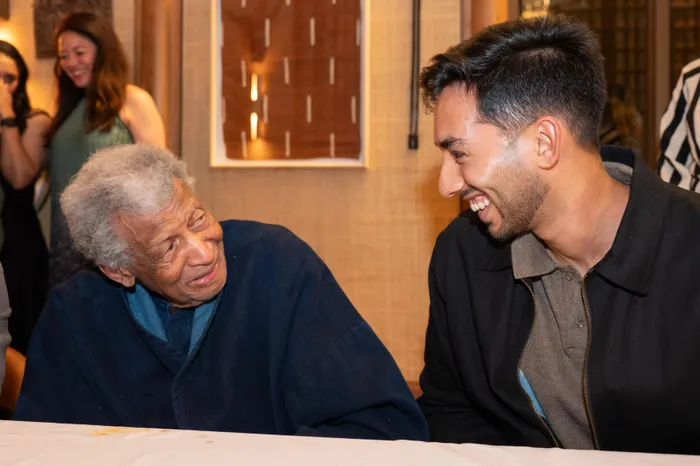
Music legend Abdullah Ibrahim pictured with Cape Town International Jazz Festival Chairman, Rayhaan Survé.
Image: Armand Hough / Independent Newspapers
I was maybe eight or nine years old when Abdullah Ibrahim played in our living room. I cannot tell you everything about that afternoon, but I can tell you what it felt like.
Family and friends had crowded into every available space: people sat cross-legged on the carpet, lined the staircase shoulder to shoulder, and peered in through the kitchen entrance as though a doorframe could be a front-row seat. And then he struck the first note.
The room went still. Not the polite quiet of a concert hall, but the sacred silence of people who understood, without being told, that something important was happening.
Last night, once again, I sat across from Uncle Abdullah as we had dinner at Rooi, the restaurant inside the One & Only hotel in Cape Town, and I was captured again.
He is 91 now. His hands, the same hands that held that living room in a trance, now rested on the white tablecloth as he spoke. Not about music at first, but about history and the universe. About telescopes and ancient knowledge. About what we have forgotten and what we never bothered to learn. About time itself.
It was the kind of dinner where you forget to eat because the conversation feeds you more than any meal could.
He spoke about his grandfather being the chief stable boy for Paul Kruger. About his grandmother, who was a church pianist and whose heritage traces to the Khomani San people. He remembered, that in Kensington, they never went to the hospital but first went to the earth and its herbs to survive. He told me about his relationship with the team behind the Square Kilometre Array (SKA), the mega-telescope being built in the Northern Cape that, once completed, will be powerful enough to peer back an equivalent time to within seconds of the Big Bang. The scientists at SKA had invited him to perform under the stars in that vast Karoo darkness.
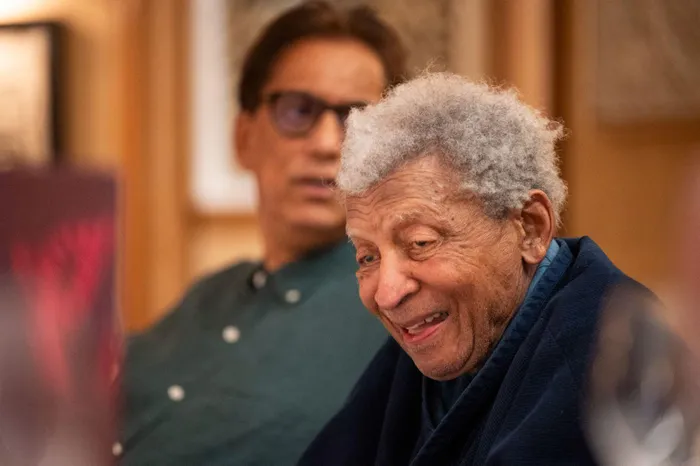
Abdullah Ibrahim will be performing at Rosies at the Cape Town International Jazz Festival this weekend.
Image: Armand Hough / Independent Newspapers
But what excited Uncle Abdullah most, was the convergence.
Here was the most advanced scientific instrument on Earth being constructed in a landscape where "Khoi-San" communities have read the heavens for thousands of years. The technology was catching up, he suggested, to what the ancient ones already knew.
From the telescope, the conversation drifted, as it does with Uncle Abdullah who is so full of stories, to Adam’s Calendar in Mpumalanga, believed by some to be the oldest man-made structure in the world. He spoke about the Bushman cave paintings on the West Coast, a few hours from Cape Town, where you descend deep into the rock and find markings that predate written history. Scrapings on stone that tell of ships and ice ages and journeys we have barely begun to understand. He leaned across the table: “We don’t know about ourselves,” he said. “That’s the problem.”
This is a thread that runs through every conversation I have had with him over the years. The education system, he believes, has failed us profoundly, because it has taught us the wrong story. Nowadays school history begins with Jan van Riebeeck, as though nothing existed before 1652. We used to have an old public holiday, Van Riebeeck's Day, also known as Founders’ Day, but we were not found, we were already here.
He told me how he once boarded one of the tour buses that wind through Cape Town and listened to the narration with growing disbelief. The history of the "Khoi-San"*, of Adam’s Calendar, of the ancient trade routes, none of it was there. The bus told a story that began with the arrival of ships from Europe. Everything that came before had disappeared.
He shifted in his seat and paused before noting, that science now confirms that 96 percent of the world’s population carries DNA linking them to the "Khoi-San", the oldest living ethnic group on Earth, whose ancestral lands span the Northern Cape, southern Namibia, and the Kalahari.
“It makes you think about where life started,” he said quietly, “and what connects us to that ancient origin of humanity.”
From a 91-year-old pianist in a Cape Town restaurant, this was not small talk. It was a worldview delivered between courses.
The evening would not be complete without the story of how Dollar Brand was born, a tale Uncle Abdullah tells with the comic timing of a man who has been dining out on it for sixty years. As a young man, his name on his South African passport was one that drew uncomfortable attention when he landed in post-war Germany.
You see, to avoid suspicion during apartheid, he would go by Adolph Johannes Brand. The passport control officer’s eyes went wide. It was the early 1960s and the wounds of the Second World War were still raw. Uncle Abdullah decided, there and then, that a name change was in order. Later, travelling through Africa, a border official informed him that a page was missing from his passport and threatened to deny him entry, until a banknote slipped between the pages resolved the mystery. “I found the missing page,” the official announced. “It was a dollar. You can go.”
The truth is more layered than that, but I don’t mind it. I love the way uncle Abdullah spins the stories that seem to flow from him without disruption. He lights up when he begins to recount the memories, often switching to Afrikaans for old jokes. It’s amazing that at 91 and after many years living abroad, he remembers them all.
The stories continued to flow. He spoke about the Star bioscope in District Six, where the gangsters sat in the first two rows and everyone else found seats in the back. He recalled the American singer Johnny “Cry” Ray, performing at a segregated show for non-white audiences. There was a wrestler on the street whose stage name was Iron Man. There were the seven steps. There was Manenberg. Every sentence opened a door to another Cape Town, one that lives in the memory of those who knew it and is slowly disappearing, lost on those that won’t listen.
At one point he paused and said, with what I think was sadness, that families used to sit around fires in winter and tell old folk stories. Some stories were meant to teach, others to frighten. The children knew them all. And then television arrived, and everyone sat in the corner facing the screen, and nobody told stories anymore.
Perhaps the most striking moment of the evening came when Uncle Abdullah described a visit to a "Khoi-San" community in the Northern Cape, where he asked an elder to explain the process of becoming a traditional healer. The answer was disarmingly simple: “If you want to be a healer, you must die.”
He let the words hang in the air. It is the same principle as the Amazonian traditions, the same surrender. You cannot mend another person’s world until you have let go of your own. I thought about his music then, the way a single Ibrahim composition can feel like a death and a rebirth inside the same phrase, and the philosophy suddenly made sense.
This Friday, March 27, Uncle Abdullah will take to the Rosies stage at the Cape Town International Jazz Festival for what promises to be one of the most anticipated performances in the event’s 26-year history.
Rosies is an intimate venue, limited capacity, no additional cost beyond your festival ticket, and it is exactly the kind of setting that suits him. Abdullah Ibrahim has never needed a stadium. He needs a room, a piano, and people willing to listen.
At 91, every performance carries the unspoken weight of legacy. He is the boy from District Six who became Dollar Brand on a dock, who became Abdullah Ibrahim in a new life, and who became, over six decades, one of the greatest jazz musicians the world has ever produced. That he is doing this on home soil, in Cape Town, at a festival he has graced many times before, makes it something more than a gig. It is a homecoming of sound and memory.
The Cape Town International Jazz Festival runs on March 27 and 28 at the Cape Town International Convention Centre, with over 40 local and international artists across four stages. If you are there on Friday night and you can get into Rosies, do not miss Abdullah Ibrahim. And if the room goes quiet when that first note lands, the kind of quiet I remember from my family’s living room twenty years ago, trust it. That silence is not empty. It is full of everything he has been trying to tell us.
* I choose to use quotation marks when referencing the "Khoi-San" people as an intentional note that this was an imposed term, rather than a true representation of the different groupings that lived in our home land.
* Rayhaan Survé is the chairman of the Survé Family Office and the CTIJF.
** The views expressed do not necessarily reflect the views of IOL or Independent Media.