

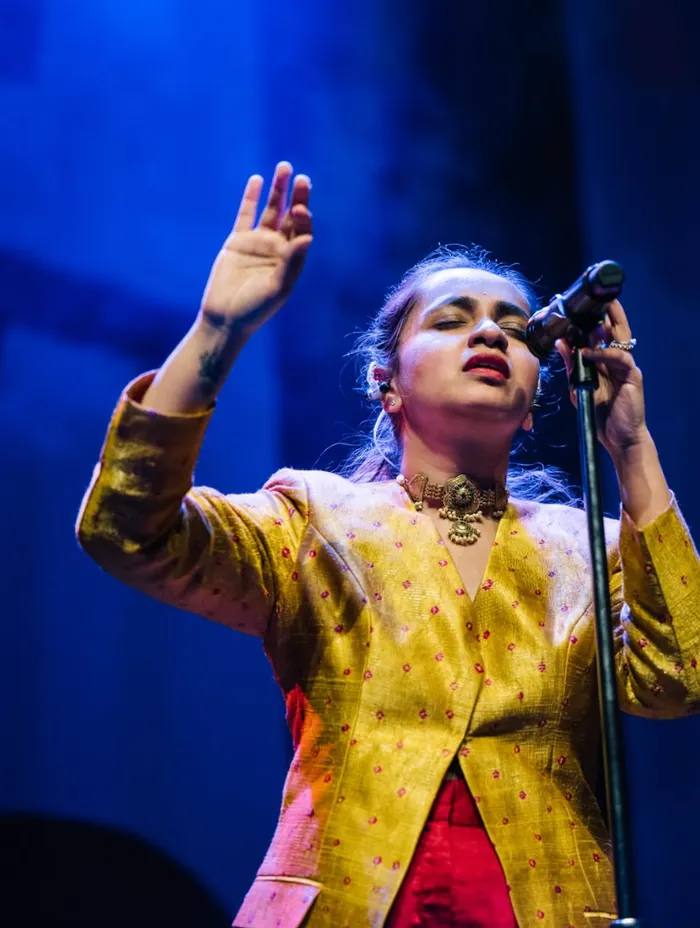
Varijashree Venugopal performing at the Cape Town International Jazz Festival.
Image: Supplied
THERE are moments at a music festival when you realise you’ve stumbled into something far more intimate than spectacle. Something that feels almost like a shared secret. That was my experience this past weekend at the Cape Town International Jazz Festival, when I found myself in a packed venue (the Rosies Stage) at 8.45pm on a Saturday, waiting for a 9pm set by an artist I knew more by reputation than by immersion, Varijashree Venugopal.
By the end of the performance, that distance had completely dissolved. Varijashree’s music doesn’t announce itself loudly. It unfolds. Rooted in the intricacies of Carnatic tradition yet fluidly conversing with jazz, her soundscape resists easy categorisation. What we witnessed was not simply a performance, but an act of fusion between systems, between cultures, between audience and artist.
Accompanied by a remarkable ensemble including the masterful Jayachandra Rao on mridangam, alongside drums, violin, and keys, the set opened up a sonic world that many in the Cape Town audience were clearly encountering for the first time. And yet, there was no sense of alienation. Instead, there was curiosity. Leaning forward. Listening harder.
The mridangam, in particular, became a site of fascination. Not just as a rhythmic backbone, but as a dynamic, almost conversational instrument. Varijashree herself drew attention to its tonal versatility even referencing the interchangeable elements of the instrument but what truly captivated was how rhythm became language.
The recitation of solkattu (spoken rhythmic syllables) wasn’t merely technical display; it was performative, embodied, and infectious. And then something shifted.What could have remained a virtuosic showcase instead became participatory. Varijashree invited the audience into the architecture of her music, encouraging claps to mark tāla (beats), asking for vocal responses, gently guiding us that felt, surprisingly, accessible.
There’s something profoundly disarming about being asked not just to listen, but to join. And the audience, diverse, curious, and visibly moved responded with enthusiasm. Her use of Kannada lyrics added yet another layer. Even for those unfamiliar with the language, the emotional clarity of her phrasing carried through. This is where her artistry is perhaps most striking. What stood out most, though, was the generosity of the performance.
In a festival environment that often prioritises scale and spectacle, Varijashree offered something quieter but no less powerful: depth.
A reminder that jazz, at its core, has always been about dialogue, about listening across difference, about improvisation as a form of relation. Walking out of that venue, there was a palpable sense that something had landed. Conversations lingered. People were still attempting rhythms with their hands, still humming fragments they didn’t fully understand but didn’t want to let go of. Sometimes, the most unforgettable performances are not the ones you anticipate but the ones that invite you into a new way of hearing.
THE POST