

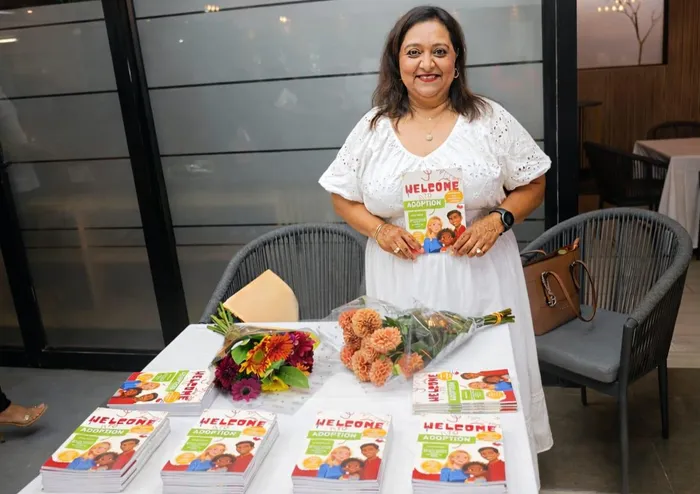
Jeevanthri Pillay, a social worker and the author of Welcome to Adoption.
Image: Supplied
Planning to adopt, but overwhelmed by the process? Jeevanthri Pillay, a social worker and the author of Welcome to Adoption, speaks with Candice Soobramoney about creating a loving home for a child in need.
Jeevanthri “Jeevie” Pillay recently released her book, Welcome to Adoption, a guide that simplifies the legal process of children’s adoption.
Pillay, who has over 36 years’ experience in the welfare sector, and more than 17 years of specialised practice in adoptions, said her professional journey had been deeply rooted in child protection.
She has worked extensively with vulnerable children and prospective caregivers, and she guides families through complex and sensitive life transitions.
"I am passionate about bringing together children in need of permanency, and loving, stable families."
In this Q and A, Naidoo provides insight into the adoption process.
Q: Can you briefly outline the adoption process?
A: An adoption orientation occurs after the initial query and screening process, which includes interviews with applicants and extended family members, obtaining character references, conducting psychosocial assessments, performing home visits, and securing police clearance and child protection register clearance. Depending on the case’s circumstances, it can take between
10 and 18 months from screening to granting the adoption order.
Q: Do couples look for children of a specific race?
A: Yes, most of the queries are race specific. Cross-cultural adoption is not for everyone. If you are a childless couple with a fervent wish to be parents through adoption, you need to process whether a child's hair and complexion define the fulfilment you seek as a parent, or if you would rather wait indefinitely for a child of the same race, or continue expensive, unsuccessful fertility treatments.
Q: Do prospective parents prefer newborns or toddlers?
A: If it's not a related adoption, childless couples prefer newborns or babies as young as possible. Prospective applicants feel that integrating a younger baby is easier. However, families with biological children will consider older children. As soon as a child is adoptable, they should be linked to their forever family. An adoptable child should not remain in child and youth care centres longer than necessary. Older children will either be fostered or remain in a centre.
Q: How do you assess an older child's adoption readiness?
A: They are assessed by their case managers. I don't work directly with children except if it's a newborn. I work with colleagues who are case managers for children requiring permanent placement. The introduction and phasing of the placement is not a rushed process. This allows the social worker to assess the progression of the interaction between the applicants and the older child regarding bonding and attachment, before making a decision for permanent placement. The applicants will also host the child at their home for overnight and weekend visits to establish whether the child integrates successfully into the family. If the placement does not work out, the child will be returned to the child and youth care centre, or placed in foster care if foster parents are available.
Q: During the adoption process, do prospective adoptive parents meet the birth parent(s), and do you mediate this?
A: Some birth parents prefer to meet the applicants. Others don’t. Yes, social workers mediate these meetings. There is anxiety and nervousness. Birth parents who request a meeting with the applicants, find that this helps them gain closure about their decision for adoption. For applicants, this meeting helps them share information with their adopted child, about their meeting with, and their impressions, of their birth parents.
Q: Do you only handle adoptions in South Africa, or can South Africans seeking race-specific babies find help in other countries?
A: I'm accredited to undertake national private adoptions in South Africa for South Africans. Unfortunately, only black children leave South Africa. The Department of Social Development accredits some organisations to facilitate inter-country adoptions. Many years ago, the Catholic Women's League was accredited to bring children from India to South Africa to be matched with Indian couples. However this is no longer an option.
Q: How do you ensure a child's heritage is respected and supported after placement?
A: I conduct educational sessions on cross-cultural issues, and encourage prospective adoptive parents to create opportunities for their child to learn and connect with their culture of origin. We then discuss and follow up on this during post-adoption services.
Q: What are the total estimated costs, including any legal fees, for private adoptions?
A: There are no legal fees for adoption. The social worker facilitates the entire adoption process, from orientation to the granting of the adoption order. Fees depend on whether it is a family adoption or a non-related adoption, and which courts are used (travel costs increase if the courts are located further in KwaZulu-Natal). A less complex adoption can cost approximately R35,000. That includes services for all members of the adoption triad over approximately one year. Costs vary depending on the circumstances of each case. It is not one-size-fits-all.
Q: How do you support adoptive parents in preparing their extended family to welcome a child?
A: We support extended families through interviews and discussions about adoption.
Q: Is your job rewarding?
A: It is both rewarding and heartbreaking since you are dealing with grief, loss on the part of birth parents, and happiness and joy in finding a forever family for a vulnerable child, and ensuring that they become productive members of society.
For details on the book, call 073 827 3087 or email: [email protected]