

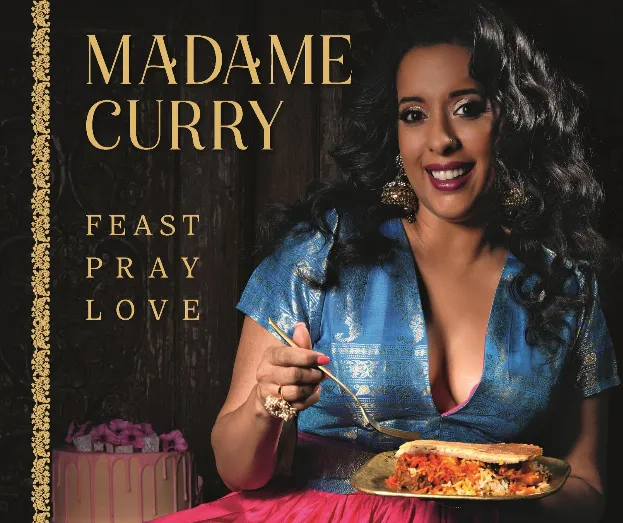
Yudhika Sujanani's new book.
Image: Supplied
Yudhika Sujanani, a celebrity chef and media personality, recently released her book Madame Curry – Feast Pray Love. This collection of recipes celebrates both beloved heritage dishes and the popular favourites that have become part of our shared national palate. Candice Soobramoney spoke to Sujanani about the cookbook that goes beyond cooking.
Q: Was there a specific moment or realisation that made you feel like it was the right time to put your cooking into a book?
A: There wasn’t one dramatic moment, and I suppose it often feels like there’s never really a perfect time to write a book. This idea of this book has percolated over time in moments, years and decades. I had been collecting recipes, stories, memories, and ideas for a long time, but I also struggled with writer’s block, and that caused delays in the project. Life happens alongside the writing, and sometimes you carry the book within you long before you’re actually able to put it onto paper.
Turning 50 played a significant role in helping me overcome that block. Reaching this stage of my life brought a different kind of clarity and urgency. It made me think deeply about legacy, about preserving not only recipes, but the stories, traditions, and history attached to them. I realised that food is never just food. It carries family, culture, migration, memory, celebration, and survival. And with that came the understanding that this book was important, not only for me personally, but for the people who would one day read it and perhaps see parts of their own lives reflected in its pages.
Q: When did you start testing and collating recipes and when was the book completed?
A: The recipes themselves have really been a lifetime in the making because so much of my cooking comes from lived experience, from family kitchens, from instinct, from restaurants, and from years of feeding people both at home and professionally.
But in terms of intentionally collating, testing, refining, and documenting these recipes specifically for the book, that has been an ongoing process spanning many years, even decades. Some recipes were already part of my repertoire and simply needed to be translated into a format readers could successfully recreate at home. Others required repeated testing, adjustments, measurements, and detailed note-taking because so much of traditional cooking is done by feel, memory, and intuition rather than exact quantities.
That was probably one of the biggest challenges, turning inherited, instinctive cooking into something structured without losing its soul.
The process wasn’t linear either. There were periods of intense productivity and periods where the project slowed down considerably. I also had to put a great deal of thought into how ingredients and produce have changed over time. Products are not what they were 20 or 30 years ago, and recipes often need adjustment because of that. It’s one of the reasons I believe revised editions of cookbooks are so important, because food evolves, ingredients evolve, and cooking itself evolves with time.
Q: How many cookbooks have you previously written?
A: I self-published three books: Curry Me Home, Curry Me Home Again, and Memoirs. I also released a revised hardcover edition of Curry Me Home Again, which came out of necessity because the book was so widely used. A hardcover format felt more functional and durable, and we also changed the binding to a stitched version, which made a significant difference to its longevity.
Self-publishing was a major learning curve for me. It was essentially like running a business on its own, from production to distribution, marketing, and everything in between. It taught me a great deal about ownership, resilience, and what it truly takes to bring a book into the world independently.
One of the biggest milestones in my career came when Penguin, one of the largest publishing houses globally, approached me with the opportunity to publish with them. It was an incredible moment to have my work recognised at that level and to bring my writing into a far wider space. It felt quite magical, and also very affirming, to move from self-publishing into a global publishing platform.
Q: How much of your own history or heritage is included in these recipes?
A: History and heritage have been deeply important in shaping my cooking, but it goes far beyond instructional recipes. What I’ve tried to do in Madame Curry: Feast, Pray, Love is capture food as memory, culture, and lived experience, as much as it is about technique.
A lot of my work is rooted in the foundation of my family kitchen and the women who shaped my earliest understanding of food. My paternal grandmother, Lutchmee, played a central role in that early imprint. Her cooking was instinctive, generous, and deeply rooted in tradition. It gave me my first language of flavour, even before I understood it as cooking.
But over time, I’ve also had to find my own voice within that inheritance. This book is very much about that translation process, taking what I absorbed in those early kitchens and reinterpreting it through my own life, my own experiences, and the way I now understand food.
So rather than being only about heritage in a literal or nostalgic sense, the book is also about how that heritage lives in me today. It’s about how I experienced food, how I saw the world through it, and how I’ve learned to speak that language in my own way, every day in the kitchen.
Q: Can you break down what we can expect with the categories: feast, pray and love?
A: The three sections of Feast, Pray, Love are really rooted in the heart of every family and community. No matter who we are or where we come from, life always seems to gather around three things: we feast together, we pray together, and through all of it, we love one another. Food becomes the thread that ties all of those moments together.
Feast is the chapter of abundance, celebration, and gathering. It’s filled with hearty, soulful dishes that are made for festive tables and joyful occasions from Diwali celebrations to weddings and family lunches at home. These are the meals that announce celebration before a word is spoken: roasted leg of lamb, parda breyani, chicken curry, wedding lamb, and dishes that carry warmth, generosity, and memory. It’s about hospitality and the joy of feeding people you love.
Pray is deeply nostalgic and close to my heart because it honours the food prepared around prayer seasons, fasting periods, and spiritual observances. It focuses largely on vegetarian dishes and egg-free confectioneries from the simple, wholesome curries to sweets made by the matriarchs of our families. These are recipes that are slowly disappearing but are now experiencing a beautiful revival. Dishes like tamarind mixed vegetable curry, braised sugar mango, mango pulusu, gulab jamun, laddus, and magaj speak to a quieter kind of comfort and devotion. This chapter is really about reverence, tradition, and the sacredness of food made with intention.
Love is my whole heart on a plate. It’s the food that feels personal, emotional, and deeply comforting - the meals and bakes that instantly transport you back to someone’s kitchen or a cherished memory. From South Indian fish curry and chops chutney to semolina cake and one of my favourites, peanut butter cake, these are the recipes where you can truly taste love. This chapter is about nurturing, memory, tenderness, and the invisible ingredient that exists in every meaningful meal.
At its core, Feast, Pray, Love is not simply a cookbook. It’s a reflection of history, heritage, faith, family, and the love that has always lived in our kitchens.
Q: What did you learn about yourself or your food while putting the book together?
A: Putting this book together taught me that food is never just food. Every recipe carried a story, a memory, or the imprint of someone who came before me. I realised how deeply rooted my cooking is in history, heritage, and the women who shaped me, especially the matriarchs in my family whose hands and instincts guided so much of what I do in the kitchen today.
I discovered that many of the dishes I grew up with, particularly the simpler curries, prayer foods, and confectioneries, are quietly disappearing. In documenting them, I understood that this book became more than a collection of recipes. It became an act of preservation. I felt a responsibility to honour those flavours and memories before they were lost.
On a personal level, I learned that my cooking has always been deeply emotional. I don’t cook from a place of performance. I cook from memory, comfort, generosity, and love.
The process also reminded me that food has an extraordinary ability to connect people. Whether it’s a humble mixed vegetable curry with tamarind or a celebratory breyani, the meals we remember most are never really about perfection. They’re about how they made us feel and who we shared them with.
Q: Was there any specific "secret" you debated including but ultimately decided to share in the book?
A: I think what became important to me was reaching a stage in my career and in my life where I realised it was never really about gatekeeping. I’ve been sharing my recipes for the last 17 or 18 years, and it has been an incredible adventure and such a meaningful journey.
There were recipes in this book that I had never properly measured before because they were created through feel, instinct, and experience rather than exact quantities. One of the biggest examples is our legendary mealie cake, which we now courier all over the country to places like Cape Town, East London, Gqeberha, George, and Durban.
We are sending mealie cakes out almost daily. I originally learned to make it in Durban, and the recipe was always based on visual cues and feel rather than measurement.
When I decided to include it in the book, I had to slow down, measure everything carefully, and test it repeatedly to make sure it would work consistently in home kitchens. That was quite a significant moment for me because it felt like I was finally putting into words and measurements something that had always lived in instinct.
Sharing recipes like the snowballs was also a big step. Those recipes are tied not only to taste, but to memory and feeling. Certain confectioneries and dishes hold emotional significance for people, and that made sharing them feel deeply personal.
Ultimately, I realised that preserving and sharing these recipes mattered more to me than holding them too closely. Food traditions survive because they are passed on.
Q: If a new home cook reads your book, which recipe would you like them to try first?
A: I think I’ve shared some of my very best recipes in this book. They are nostalgic, tried and tested, and deeply rooted in memory and feeling. For me, food has never only been about taste or flavour. It’s about how food transports you. A single dish can take you back to a childhood kitchen, a celebration, a prayer gathering, or a moment shared with someone you love.
So I don’t think I have one specific recipe I’d want a home cook to try first because I have so many favourites for so many different reasons. Truly, if someone cooks any recipe from this book, I would feel incredibly honoured to be welcomed into their homes and kitchens, and to become a small part of the memories they create around their own tables.
That, to me, is the real purpose of food. It connects us, comforts us, and allows stories and traditions to live on from one generation to the next.
Q: Which recipe in the book is the most underrated that you wish more people would try?
A: I don’t think there are necessarily underrated recipes because people have such varied tastes when it comes to food. What strikes me more is that certain recipes can feel intimidating to people, and one of the biggest examples of that is rotis. But like anything in life, practice makes perfect, and that applies to food as well.
A lot of confidence in cooking comes from how comfortable and relaxed you are in your kitchen. The secret to amazing food, memorable meals, and meaningful moments is often the confidence of the person cooking. That’s something I really wanted to address in this book.
I’ve tried to break recipes down into very simple, approachable steps because anything complicated can be pulled apart into smaller, manageable components. Once people understand that, cooking becomes far less intimidating and much more enjoyable.
One of my personal favourites in the book is the braised sugar mango with tamarind. It’s incredibly popular in the Telugu-speaking community and deeply nostalgic for so many of us. I love eating it with fresh white bread. On paper, it may sound unusual, just mango braised with onions, garlic, chilli, sugar, and tamarind, but it is absolutely delicious. Those are often the recipes that surprise people the most.
Q: What is a common mistake home cooks make, and how does your book help them?
A common mistake is not taking time to understand the process before starting. People focus on the end result, but cooking has a rhythm and flow that gets disrupted when you are unprepared or rushing.
If your ingredients are not prepped or you are fumbling for spices mid-cook, things burn or get missed. The secret is really in the basics. Read the recipe properly, set everything out first, and understand the steps before you switch on the heat.
A few minutes of preparation at the start saves a lot of stress at the end.
Q: Your book is being sold in different countries, and people are buying multiple copies. Tell us about this.
A: It has been incredibly humbling to see the book reach readers beyond South Africa, with orders coming in from many parts of the world where there is a strong South African and Indian diaspora, as well as from international food lovers discovering it online.
What has been especially moving is not just where it is being sold, but how people are buying it in multiple copies, either to gift or to share with family members abroad. It has become something people send across borders as a piece of home and memory, which is really what I hoped for with this book. It is a small souvenir from South Africa.
So far, I have had seven copies purchased by a lady in Canada. She bought two copies for her sisters in South Africa and the rest were collected to be sent to her. We have also had copies sent to London, and there are ongoing orders there as well. The book is also available in e-book format on Amazon, which has generated additional sales.
It has been heartwarming to see people sharing moments online, having a coffee and reading the book in its digital form. We have also had requests to courier the book to the Netherlands, the United States, and Australia, among other places. It has truly been moving to see that kind of response.
Q: How can readers order, or where can they buy the book?
A: The books are available directly through our store, and we have been couriering books over the last two weeks. What is special about purchasing directly from us is that we are able to send out signed copies and also personalise the book with an inscription.
In South Africa, it can also be purchased from major book retailers and online stores, including publishers and distributors such as Penguin Random House South Africa and stockists like Exclusive Books and other leading bookstores. It is available in physical stores as well as online with delivery options.
For international readers, it is available through global online platforms, including Amazon in Kindle e-book format. So readers can either order a signed copy directly from us, purchase through local bookstores, or download the Kindle edition for immediate access anywhere in the world.