

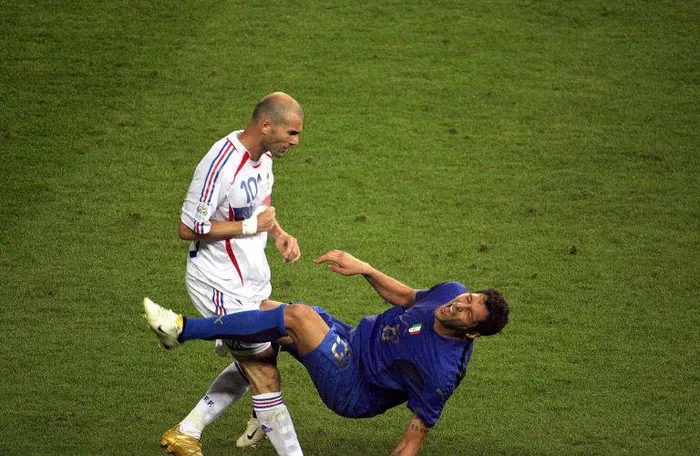
Zinedine Zidane sent Italian defender Marco Materazzi flying with a blow to the chest during the 2006 Fifa World Cup final.
Image: AFP
The global football landscape returned to its traditional heartland in 2006, breaking fresh cultural ground as the Fifa World Cup was hosted by a reunited Germany for the very first time.
For the host nation, it marked a monumental opportunity to showcase a modern, open, and vibrant country to the global stage, with Jurgen Klinsmann’s young team determined to shed Germany's reputation for rigid efficiency in favour of a refreshing, attacking brand of football.
Yet, while the tournament celebrated unity and high-scoring drama under the banner of "A time to make friends", it was also played under the heavy shadow of immense domestic pressure for the eventual champions.
Italy arrived in Germany amidst the explosive chaos of the Calciopoli match-fixing scandal back home, forcing Marcello Lippi’s squad to forge an iron-clad siege mentality.
On the pitch, the tournament became synonymous with the "ballet of the veterans" and the birth of a new era. While a golden generation of icons like Zinedine Zidane and Ronaldo prepared for their international swansongs, the tournament opened the door for a historic passing of the torch as young prodigies Lionel Messi and Cristiano Ronaldo made their very first World Cup appearances.
In a massive structural undertaking, 12 world-class venues were selected across the host nation, completely modernising Germany's stadium infrastructure.
The spectacular, high-stakes final was played at the Olympiastadion in Berlin, a historic monument beautifully retrofitted with a state-of-the-art translucent roof and boasting a capacity of over 72,000 seats. It was the ultimate, dramatic stage for a tournament that captured the imagination of the football world.
The tournament featured the established 32-team format, split into eight groups of four. The top two teams from each group progressed to a straight knockout round of 16. It was a format that bred immediate intensity, though the traditional powerhouses largely asserted their dominance in the group stages, setting up a heavyweight, star-studded knockout bracket that produced some of the most physical and tactically absorbing fixtures in modern football history.
The tournament marked a watershed moment for newcomer nations and unexpected heartbreaks. While a rampant Ghana shocked the Czech Republic to become the only African nation to march into the knockout stages, the group fixtures provided incredible drama, none more so than the infamous "Battle of Nuremberg" between Portugal and the Netherlands, which saw a record four red cards and 16 yellows shown.
Host nation Germany wore the national colours with immense pride in Group A, kicking off the tournament with a breathless 4-2 victory over Costa Rica. Led by Klinsmann, the Germans swept through the group stage with a perfect record, igniting a wave of euphoric patriotism across the country that came to be known affectionately as Das Sommermärchen (The Summer Fairytale).
Meanwhile, a highly fancied England side topped Group B despite losing Michael Owen to a horrific knee injury just minutes into their clash with Sweden. Argentina also laid down an early marker in Group C, scoring one of the greatest team goals in World Cup history — a 24-pass masterpiece finished by Esteban Cambiasso — during a 6-0 demolition of Serbia and Montenegro.
Quarter-finals: Germany 1, Argentina 1 (4-2 on penalties); Italy 3, Ukraine 0; England 0, Portugal 0 (1-3 on penalties); Brazil 0, France 1
Semi-finals: Germany 0, Italy 2 (aet); Portugal 0, France 1
In the third-place play-off clash, Germany beat Portugal 3-1 in a jubilant Stuttgart encounter, with youngster Bastian Schweinsteiger netting two spectacular long-range strikes to ensure the hosts ended their magical summer on a high.
Italy were crowned world champions for a record-breaking fourth time, completely redeeming the nation's footballing reputation. The Azzurri beat a formidable French outfit 5-3 on penalties after a tense 1-1 draw in the final, solidifying the legendary status of Lippi's defensive generals, Fabio Cannavaro and Gianluigi Buffon.
The tournament, however, will forever be defined by its final, shocking twist. Zinedine Zidane, who had single-handedly inspired France to the final with a series of timeless masterclasses, scored an audacious early chipped penalty before being sent off in extra time for a sensational headbutt on Italian defender Marco Materazzi, capping off one of the greatest individual careers in sports history in the most dramatic fashion imaginable.
Debutants Ukraine pulled off one of the most unexpected and miraculous runs in recent tournament history, bouncing back from a heavy 4-0 opening defeat against Spain to reach the World Cup quarter-finals.
Guided by legendary striker Oleg Blokhin and spearheaded by Andriy Shevchenko, the tournament newcomers ground out a historic penalty shoot-out victory over Switzerland in the round of 16 — a match that remains fiercely debated by football purists for its sheer lack of attacking quality, as the Swiss became the first team in history to fail to score a single penalty in a World Cup shoot-out.