
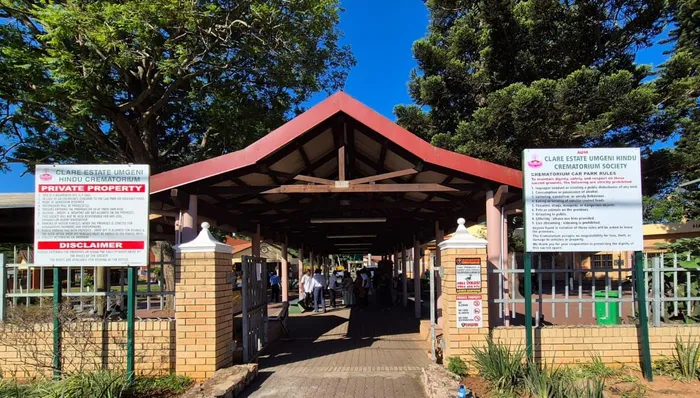
THE Clare Estate Umgeni Hindu Crematorium Society has issued an official response to the recent allegations regarding financial management and the tariff increases.
Image: Sibonelo Ngcobo/Independent Media
The Clare Estate Umgeni Hindu Crematorium Society has issued an official response to the recent allegations regarding financial management and the tariff increases.
‘Clare Estate Crematorium under fire for fees hikes amid financial misconduct claims’ and ‘Community leaders call for transparency amid crematorium tariff increases’, the POST, February 11-15, refers.
In this response, Pradeep Ramlall, president and chairperson of the society’s board of management, clarifies the crematorium’s non-profit status, explains the necessity of fee adjustments, and provides comparative pricing information with other facilities while defending its governance practices and financial transparency.

Pradeep Ramlall
Image: File
THE Clare Estate Umgeni Hindu Crematorium Society categorically rejects the malicious, false and defamatory allegations from an unverified and anonymous WhatsApp message circulating on social media and in recent media reports regarding its governance, finances, and tariff structure.
These allegations are false.
The society is a duly registered non-profit organisation governed by a legally-binding constitution and overseen by a volunteer board of management elected by its members at a biennial general meeting as per the constitution.
The board comprises professionals from diverse disciplines, including accountants, engineers, quantity surveyors, teachers, business professionals, and members from the public sector.
They include: Pradeep Ramlall (president and chairman), Nirosh Naidoo (vice president), Pravin Madanjeet (internal auditor), Rashen Bhagothidin (registrar), Himanth Seeparsad (health and safety), Collin Chetty (treasurer), and Thegrajh Kassie (secretary).
The society’s financial statements are independently audited annually by CYL Chartered Accountants, registered with the Independent Regulatory Board for Auditors (IRBA).
The audited financial statements for the 2025 financial year was tabled at the general meeting in June 2025 with no adverse findings.
As part of its organisational turnaround plan, the society has achieved a three-month turnaround time for producing audited financial statements, a clear indicator of strengthened governance and operational efficiency.
The society is fully compliant with the Department of Social Development as a registered non-profit organisation as of 2025.
All relevant documents were made available to and viewed by the journalist concerned, this week. The society is not a social welfare body, but a well-managed private crematorium operating within the legal framework applicable to non-profit entities.
Fees adjustments and funding requirements
Fees adjustments are undertaken only after detailed financial modelling and are driven by rapidly escalating electricity tariffs, environmental compliance obligations, cremator maintenance, infrastructure upgrades, staffing, and safety standards.
These adjustments are essential to ensure uninterrupted, lawful, and dignified service delivery. We receive no government funding and operate entirely on user fees.
While local government legislation places responsibility for cemetery and crematoria services on municipalities, growing shortages of burial space have resulted in more families of all races and religions choosing cremation.
Verified private and municipal crematoria tariffs reflect the following current basic rates:
Clare Estate Umgeni Hindu Crematorium (Private): R2 750, increasing to R3 020.
Cedar Ridge Crematorium (Private): approximately R2 800, with an anticipated increase.
Typical private facilities in Johannesburg: R6 000 – R10 000.
Pietermaritzburg Municipality: R3 500 – R3 800 (subsidised).
eThekwini Municipality facilities: approximately R1 800 (subsidised).
Tongaat Municipal Crematorium: approximately R1 800 (subsidised).
Stellawood Crematorium (municipal): approximately R2 300 (subsidised).
Municipal tariffs do not reflect the true cost of cremation services. In many instances, inadequate planning for asset maintenance and replacement has contributed to the decline or collapse of public crematoria.
The society’s average increase over the past five years has been approximately 12% per annum. The planned 10% increase is based on inflationary factors and sustainability modelling.
Operational sustainability has been maintained through efficiencies and the voluntary professional contributions of dedicated board members.
Financial management and asset replacement Auditors and member-approved governance policies require ring-fencing of funds for asset replacement and long-term sustainability.
The capital investment reserves are clearly reflected in the society’s balance sheet and cannot legally be used to fund operational costs or losses.
The society must provide for both planned and unplanned high-value maintenance, including replacement of refractory linings and hearth systems, as supported by professional engineering reports.
All assets have useful design life, but if it is well maintained, the life is extended.
R3 million has been planned for refractory upgrades and R2 million for unplanned maintenance and improvements.
Projected infrastructure and compliance needs, over the next five to 10 years, are estimated to approach R50 million.
While the society is not currently near the figure that is bandied around from leaked sources, prudent planning is required to ensure long-term viability.
These expenditures are essential for compliance with Atmospheric Emission Licence conditions; non-compliance would result in suspension of operations and regulatory fines. Claims of missing funds are entirely false.
All funds are transparently reflected in audited financial statements. Money has been ring-fenced for asset replacement. Clause 3.6 of our constitution only allows registered members access to our financials on a perusal basis.
Services and facilities
The society provides world-class services. While certain municipal facilities operate a single cremator, the society operates six modern, quick-burning cremators equipped with abatement technology.
Families are provided with air-conditioned halls and a tranquil environment alongside the Umgeni River.
The adjacent Sivananda Ghat allows for dignified ash immersion, similar in spiritual significance to the Ganges River.
The society offers real-time online booking and maintains capacity for up to 30 cremations per day when required.
During the Covid-19 pandemic, it was the only fully functional crematorium in Durban, providing essential services during a period of unprecedented mortality and helping to mitigate public health risks.
Assistance to destitute families is provided discreetly, often in collaboration with undertakers, to maintain dignity for bereaved families.
Professional fees and atmospheric emission licence
The society is one of very few facilities holding an approved Atmospheric Emission Licence valid until 2027. Compliance requires stringent maintenance programmes, specialised engineering oversight, and annual emissions testing by SANAS-accredited laboratories using specialised testing methodologies.
A registered professional engineer must assume responsibility for the facility as a hazardous installation.
The society benefits from professional engineering oversight provided by its chairman (Pradeep Ramlall), who carries the required qualifications and professional indemnity.
These professional services are provided without any cost to the society and helps to reduce cost to in the tariff model. Ultimately as volunteers, we do not get paid and yet we are criticised or accused of maladministration.
Many public facilities are unable to operate lawfully due to the absence of approved air emission licences.
Planned public function As part of its 122nd anniversary programme, the society intends to host its annual public event in April or May, where stakeholders and members of the public will be invited to attend.
Response to misinformation and clarification
The society further rejects claims of secrecy or exclusion. It operates strictly within its constitution and applicable law, and remains open to constructive engagement with mainstream organisations in good faith. However, it will not tolerate the spread of misinformation that damages public confidence in a critical community institution and causes harm to grieving families.
A few years ago, some new organisations met to provide free funerals. This apparently failed dismally because of legitimacy and inability to raise funds for so called “free funerals”.
Now these so-called Hindu leaders want to tap into our reserves by acting as intermediaries or brokers. Some of them have questionable pasts, and operate as keyboard warriors with no traceability and reference.
Some unemployed people are trying to get commissions from undertakers as well. It is rather pathetic. The society has strengthened its governance with rules as it plans to avoid potential problems in the future.
We are transforming as an organisation and keeping abreast of legal requirements in terms of corporate governance, NPO, PBO, SARS and the Company’s Act. Our advisors are a panel of reputable attorneys, including Anand Nepaul, Reeves Parsee and Ravindra Maniklall.
Our processes are tabled and approved at the SGM where registered members are invited. There is nothing sinister. The Clare Estate Umgeni Hindu Crematorium Society reserves all its legal rights in respect of defamatory statements and unlawful conduct, and remains committed to transparency, dignity, accessibility, and service excellence for all communities, regardless of religion, race, or background.
With regard to speculation that there is a move to change the status of the organisation from Public Benefit Organisation (PBO) to Non-Profit Company (NPC), the society has to comply with the requirements of the Companies and Intellectual Property Commission as advised by the legal team because it is not compliant with the new legislations and companies act.
The advice received is from the attorneys Reeves Parsee of Larson Falconer Hassan Parsee, who will register the society in terms of the CIPC which is currently not registered in the name of Clare Estate Umgeni Hindu Crematorium.
This was approved by a full board of management meeting and subsequent at special general meeting of the bonafide members of the society and the meeting was conducted by Reeves Parsee and assisted by Anand Nepaul and Ravindra Maniklall in the presence of the external auditors, Daison Naidoo of CYL Chartered Accountants.
The resolution supporting the registration of an NPC was adopted by the registered bona fide members. Simply stated the NPC will provide the society to have all its accounts linked to the registered company which was not done since inception.
Reaction
Dr Rajendran Govender’s remarks raises concern because, despite years of dysfunction and failures at municipal crematoria across KwaZulu-Natal, there appears to have been limited public action or accountability efforts directed at those issues. Instead, attention is now focused on one of the few functioning and well-managed crematoria in the province, which may seem misplaced. The statement questions why similar urgency, transparency demands, and stakeholder engagement were not pursued when municipal facilities were failing families and disrupting essential services.
Where was Shameen Thakur-Rajbansi when calls for regulation arose during and after Covid-19, when many families faced exceptionally high funeral costs? The renewed call for “regulation” now appears selective and inconsistent. If pricing oversight is genuinely necessary, why has there been limited focus on the largely unregulated funeral industry, where pricing structures are often opaque and can place significant financial pressure on grieving families? Funeral policies frequently pay out substantial amounts, yet the resulting costs borne by families and consumers have received comparatively little public scrutiny.
Why is attention being directed toward a crematorium that operates transparently within the framework of the NPO Act, governed by a constitution, and subject to independent audits? Why is oversight being demanded of a non-profit institution with clear governance structures, while other service providers whose pricing often exceeds cremation fees face little or no equivalent examination? The broader question is whether accountability is being applied consistently across the bereavement sector.
Private-sector efficiencies and cost structures cannot simply be compared with subsidised public facilities, particularly where municipal systems have failed communities in areas such as Chatsworth, Pietermaritzburg, and other smaller towns across KwaZulu-Natal.
The question is not whether accountability is important, but whether it is being applied fairly and consistently across the broader funeral and bereavement sector. Legal position and commitment The Clare Estate Umgeni Hindu Crematorium Society reserves all legal rights in respect of defamatory statements and unlawful conduct, and will take appropriate action where necessary. Attorney Anand Nepaul has been engaged to deal with this matter as there are individuals hell bent on destroying the legacy of this 122-year-old institution.
The society continues to align itself with evolving legal and governance requirements, including compliance relating to non-profit governance, public benefit status, tax obligations, and company law, with guidance from reputable legal advisors.
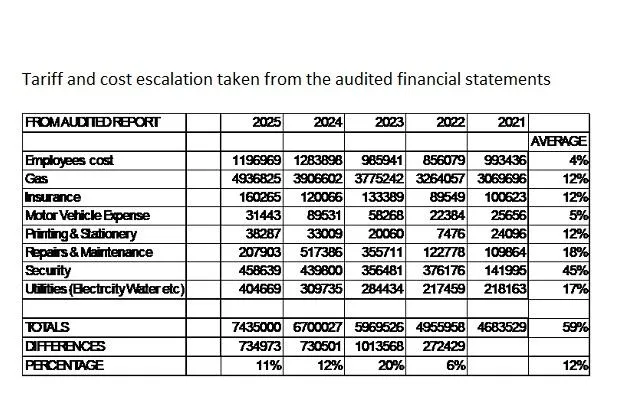
Tariff and cost escalation taken from the audited financial statements
Image: SUPPLIED
EDITOR’S NOTE: This week, the Clare Estate Umgeni Hindu Crematorium Society made available its bank statements, the 2025 auditor’s report, the emissions certificate valid until 2027 and the Department of Social Development compliance letter for our scrutiny. All the documents have been verified and do not reflect any financial maladministration or non-compliance.