

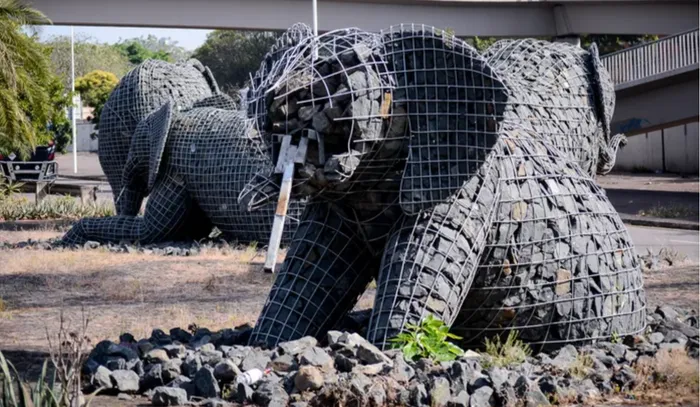
The Elephant Sculptures by Andries Botha that was completed in 2010 was meant to celebrate a proud African heritage of the the city of Durban.
Image: Suppiled
IT IS SURPRISING that Selvan Naidoo (the POST, March 11 – 15), who enjoys researching the colonial archives for information about the experiences of his indentured forebears, now advocates decolonisation of statues, names, symbols and memorials from Durban.
Statues and monuments provide not only reference to times past. More importantly, they provide context to history and to the march of change. The measure of change depends on precedents. If those are erased or removed, then by what means can one point to progress and change? From what can the liberated claim to be liberated? A school report card like an accountant’s review of income, profit and loss has no relevance unless it makes reference to previous results and performance.
However, if the removal of relics, names, monuments, etc. of the past is motivated by Colonialism Derangement Syndrome (CDS), the task at hand is monumental. Maybe start with demolishing the city hall. When every building of colonial note has been reduced to rubble, which should ease the unemployment situation, then move on to books and library trashing. Once the past has been vanquished and deodorised, those afflicted by CDS will be able to establish the new, untarnished history of whatever new name Durban is given.
A quotation of President Cyril Ramaphosa which Naidoo cites is very significant to this topic: “The cost of our Struggle is incalculable. We cannot even begin to count what it costs to be here.”
His reference to “here”, of course, is meant purely in the context of liberation from apartheid. But if that context is widened, then what was "here" before British colonialism commenced under Martin West in Natal in the late 1840s? Just untamed bush, no buildings, no schools, no infrastructure; nothing existed which today is taken for granted.
Without colonialism, Naidoo’s forebears would never have come to Natal because indenture would not have been necessary. Everything Naidoo hangs his hat on in terms of his history and heritage is the legacy of colonialism in Natal. So, Naidoo, it’s not a smart idea to go down the colonialism demolition road.
His endorsement of the "Rhodes Must Fall" idea also needs to be right-sized. Cecil Rhodes bequeathed a trust which is worth £100 million and today is known as the Mandela-Rhodes Trust. Each year it finances the education at Oxford University of at least 12 African students. Rhodes’s philanthropic legacy was endorsed by Nelson Mandela in 2003 when he was made a co-custodian of the trust at a conference attended by former Rhodes scholar and US president Bill Clinton.
What is noteworthy about Naidoo’s reference to "Struggle" monuments is the extent to which some of them lack appreciation. The Passive Resistance Park in Umbilo was allowed to degenerate into a haven for hoboes and drunken, drug types. Moses Mabhida Stadium, to all intents and purposes, is a white elephant.
Also relevant is Naidoo’s desire to rename Wentworth after a "Struggle" hero. Renaming is a second-hand tribute, like regifting. It lacks sincerity, and smacks of economy. If a name deserves to be honoured, then it should be applied to a new road, structure or area. In the case of Wentworth, the name of an extensive farm on the Bluff which was auctioned in 1854, Naidoo’s effort to eradicate it from records would prove very costly if not impossible. The reason is that the erf description of all properties within the bounds of the former Wentworth farm, mine included, are cited as “portion of Wentworth”.
History is a vast multifaceted tapestry of human experience. Erasing it destroys context. Without reference to it, acclaim for achievement, struggle and survival is meaningless.
DR DUNCAN DU BOIS
Wentworth