

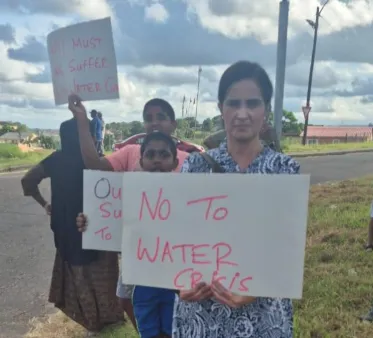
In this holy month of reflection and sacrifice, perhaps the greatest lesson is just how precious, and how fragile, that life truly is. We wait, we share, and we hope. We hope that soon, in Durban, the water will be everywhere again, and finally, right there in Fathima’s kitchen tap. Moorton resident, Dilhara Sheik, at a protest held in Croftdene in Chatsworth recently.
Image: Yoshini Perumal
THE other day, my neighbour Fathima stopped me at the gate. She had that particular tiredness, the kind that comes from carrying more worry than sleep.
“Jerald Bhai,” she said, her voice soft but heavy.
“This Ramadaan is becoming so difficult. We are fasting, but the water is going off all the time. Yesterday, we couldn’t even prepare properly for iftar.”
Fathima is not a woman given to complaint. She’s calm, dignified, the kind of person who makes the world feel steady. So, when she speaks of struggle, you listen. In Shallcross, and across so much of Durban, the taps are running dry. And for our Muslim families in the holy month of Ramadaan, this isn’t just an inconvenience. It’s a crisis of faith and function.
Think of it. All day, no food, no water. Then, at sunset, the fast breaks. The first thing the body craves is not the biryani or the samoosas, but cool, clean water to rehydrate after a long day.
Before dawn, there is suhoor, the last chance to drink before the next day’s fast begins. Then come the daily prayers, requiring whudu, the ritual washing. Without water, these sacred rhythms are thrown into chaos.
“Sometimes the water comes for only an hour,” Fathima explained. “We rush. Fill buckets, cook, wash, prepare. It’s a panic, every single day.”
I tried to lighten the moment. It’s the Durban-Indian way. When the storm hits, humour is the only umbrella we have.
“Fathima,” I said, gesturing at the dry hose pipe, “right now, Durban is living that old poem, ‘Water, water everywhere, but not a drop to drink.’ And the only moisture on my face is my tears.”
She laughed, despite herself. But the laughter doesn’t fix the pipe.
How did we get here? The official story is a tangle of familiar woes, old, crumbling infrastructure installed decades ago; a growing population thirstier than ever; and climate change tightening its grip on our dams. We hear that nearly 60% of our water is lost to leaks before it even reaches us. It’s like buying ten loaves of bread and watching six of them fall out of the bag on the walk home.
But the immediate problem has a name, Nagle Dam. A critical valve there failed, slashing the supply to the main treatment works by 150 megalitres a day. That’s a colossal shortfall.
Now, the municipality has no choice but to ration what’s left, throttling reservoirs like ours in Northdene to a trickle, releasing water for just a few hours a day to stop the entire system from collapsing. They say it might take two weeks to fix. When you’re standing in your kitchen with a dry tap, two weeks feels like a lifetime.
This is the reality Fathima and her family are navigating. It’s not just about thirst. It’s about dignity. It’s about having the water to wash, to cook, to maintain the simple hygiene that lets you face the world. As I joked to her, “Without water, we become like raisins, still useful, but not very cheerful.”
So, we cope. We’ve all become part-time reservoir managers. We store water in every available bucket and pot when it flows. We turn the tap off while brushing our teeth. We reuse the washing-up water on the garden. And we watch out for each other. That’s the thing about a crisis in a place like Shallcross, it becomes the great equalizer. The dry tap speaks the same language in a Muslim home, a Hindu home, or a Christian home. It doesn’t
care about your religion or your politics.
When I finished explaining the bit about the Nagle Dam valve to Fathima, she just nodded slowly.
“You know,” she said, “at least everyone is suffering together. It makes it a little easier to bear.”
There’s a strange kind of comfort in that. A shared hardship is still a hardship, but it’s also a shared humanity. Water, in its absence, is reminding us how deeply interconnected we are.
Before she turned to go home, Fathima smiled again, a real one this time. “Jerald Bhai”, she said, “when the water comes back properly, we must have a real celebration.”
“Of course,” I replied.
“You bring the biryani, and I’ll bring the buckets.”
In times like these, you hold onto the laughter. But behind the joke is a simple truth, water is life. And in this holy month of reflection and sacrifice, perhaps the greatest lesson is just how precious, and how fragile, that life truly is. We wait, we share, and we hope. We hope that soon, in Durban, the water will be everywhere again, and finally, right there in Fathima’s kitchen tap.
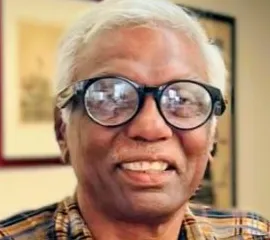
Jerald Vedan
Image: Supplied
Jerald Vedan is an attorney, community leader, and social commentator based in KwaZulu-Natal.
** The views expressed do not necessarily reflect the views of IOL or Independent Media