

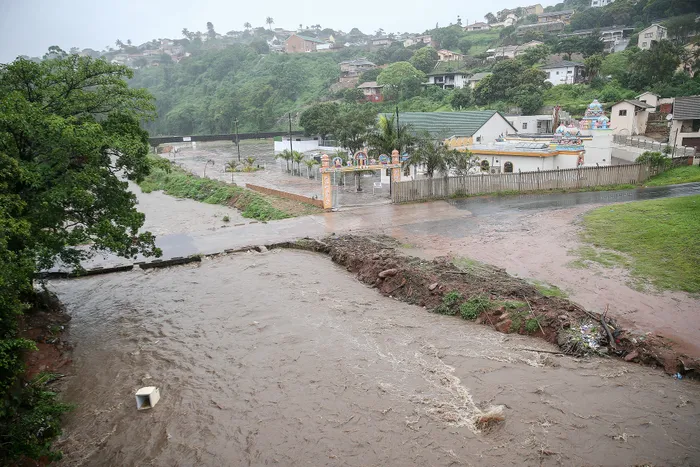
KWAZULU-NATAL’S inclusion in the roll-out of a geospatial information management strategy is a welcome step for our province which has faced repeated floods, infrastructure damage and serious service delivery challenges. The Umhlatuzana Hindu Temple in the background after the 2022 floods.
Image: Picture Leon Lestrade/African News Agency(ANA)
KWAZULU-NATAL’S inclusion in the roll-out of a geospatial information management strategy is a welcome step for our province which has faced repeated floods, infrastructure damage and serious service delivery challenges.
Good disaster response depends on good information. Municipalities and provincial departments cannot plan properly if they do not have accurate, up-to-date data showing where communities are most at risk, where infrastructure is vulnerable, and where response teams are needed most.
This is not a new call by the DA. We have long argued that better data, early warning systems and stronger disaster management capacity are essential if KZN is to move from reacting after crises to preventing avoidable harm.
As a responsible Government of Provincial Unity (GPU) partner, the DA supports the use of data for effective planning and service delivery. If properly implemented, this strategy can help the government identify risks earlier, co-ordinate responses better, and make more informed decisions.
The focus must now be on practical implementation. The public should be informed on which municipalities will be prioritised, how data will be kept updated, and how it will be linked to disaster management and service delivery teams on the ground.
This initiative has the potential to improve planning, strengthen disaster readiness, and help protect communities. It must now be turned into visible action where residents need it most.
MARLAINE NAIR, MPL
DA KZN spokesperson on Cogta