

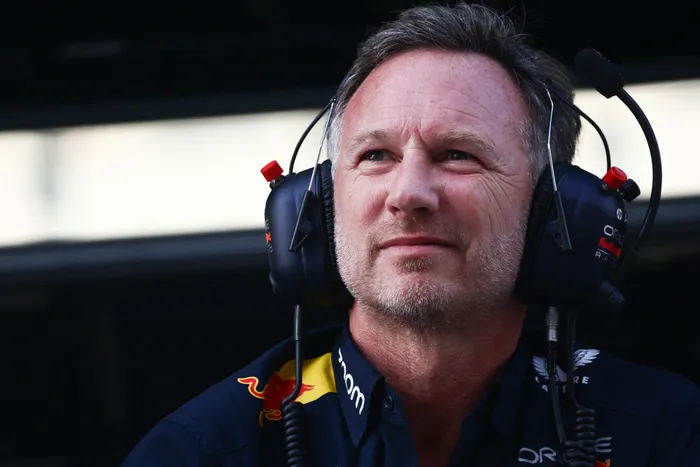
Former Red Bull team principal Christian Horner could return with Alpine. | AFP
Image: AFP
Christian Horner’s name is once again circulating around the Formula 1 paddock, with fresh reports suggesting Alpine could emerge as the most realistic pathway for the former Red Bull team principal to make a sensational return to the sport.
While nothing has been confirmed, the idea of Horner linking up with the Enstone-based outfit has quickly gathered momentum as F1 looks ahead to a transformative 2026 season.
Horner’s exit from Red Bull earlier this year brought an end to one of the most successful team principal tenures in modern F1 history. Across two decades, he oversaw multiple championship cycles and helped turn Red Bull into a benchmark operation.
Any return, however, was always expected to come with conditions. Reports indicate Horner is not interested in a simple advisory role but would instead seek genuine authority, potentially paired with a long-term strategic stake in a project.
That is where Alpine enters the conversation. Despite being backed by the Renault Group, Alpine has endured a turbulent few seasons marked by leadership changes, inconsistent performance and unfulfilled potential.
The team has world-class facilities, a strong technical base and a clear desire to reset ahead of the 2026 regulations, which include new power units and chassis rules. For Horner, that combination could represent both a challenge and an opportunity.
Alpine’s structure may also be more flexible than some of its rivals. With investors already involved and a stated ambition to become a front-running team, there is scope for a senior figure to exert wide-ranging influence over sporting, technical and commercial directions.
Horner’s proven ability to unify departments and attract top talent would align neatly with Alpine’s need for stability and vision.
Timing is another key factor. Any move would likely hinge on contractual limitations and gardening leave provisions, making a 2026 return the most realistic scenario.
That dovetails perfectly with Alpine’s own long-term planning, as teams prepare for one of the biggest regulation shifts in F1 history. Bringing in an experienced leader at that moment could help Alpine avoid the missteps that have hampered it in recent years.
There is, of course, scepticism. Horner has been linked with several teams since leaving Red Bull, and Alpine has publicly remained tight-lipped. Ferrari, Aston Martin and others have been mentioned in passing, but none appear to offer the same blend of influence, ambition and availability that Alpine potentially can.
For now, the story remains one of possibility rather than certainty. Yet in a paddock that thrives on bold moves and fresh starts, the idea of Christian Horner returning to Formula 1 at the helm of Alpine is one that refuses to fade.
If Alpine truly wants to reinvent itself, Horner may represent the clearest route back to relevance and, eventually, the front of the grid.