

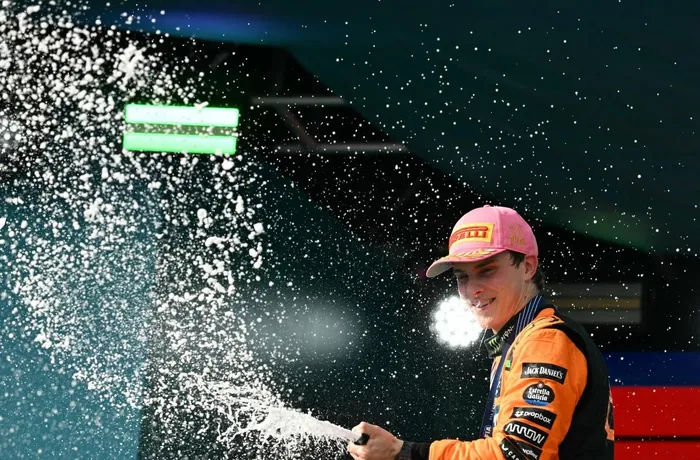
Oscar Piastri has had a breakthrough season at McLaren and with that, comes scrutiny.
Image: AFP
Oscar Piastri’s rapid rise in Formula 1 has positioned him as one of the sport’s most valuable long-term assets, but with success has come scrutiny.
Following a breakout season at McLaren, the Australian has found himself at the centre of speculation about his future, and, more pointedly, about the influence of his manager, former F1 race winner Mark Webber.
The warning has come from ex-F1 driver Juan Pablo Montoya, who believes Piastri must be careful not to allow Webber’s own unresolved history in the sport to shape critical career decisions.
Webber, famously endured a complicated tenure at Red Bull, where team dynamics and internal politics often left him overshadowed during Sebastian Vettel’s championship years. Montoya’s concern is that those experiences could subconsciously colour the advice Piastri receives today.
On track, Piastri has delivered emphatically. His 2025 campaign was defined by maturity beyond his years, race wins, poles, and consistent performances that kept him firmly in the title conversation deep into the season.
At times, he even appeared the sharper of McLaren’s two drivers, pushing Lando Norris relentlessly and forcing the team into difficult strategic calls.
Yet it is precisely those moments that have sparked debate. McLaren’s occasional strategic preference for Norris has reignited the familiar F1 narrative of number-one drivers and internal hierarchies.
Montoya argues that, while frustration is natural, Piastri must distinguish between short-term setbacks and long-term opportunity. McLaren, after all, have handed him a car capable of winning races and fighting for championships, a luxury many elite drivers never receive.
Webber’s role in Piastri’s career has been instrumental, guiding him through junior categories and into F1 with remarkable efficiency.
However, Montoya’s warning is not a criticism of Webber’s management, but a reminder that today’s McLaren is not yesterday’s Red Bull. Teams evolve, leadership changes, and competitive windows open and close quickly in modern Formula 1.
For Piastri, the key lies in autonomy. The most successful drivers in history have listened to advisors while ultimately trusting their own judgement. At just 24, Piastri has time on his side, leverage in contract negotiations, and a team eager to build around youth and speed.
The danger, Montoya suggests, is reacting emotionally rather than strategically. If Piastri allows past grievances, even those not his own, to possibly dictate his path, he risks abandoning a project that may yet deliver world championships.
\In a sport defined by timing and precision, patience could prove his most valuable asset should he want to be crowned World Champion next season.