
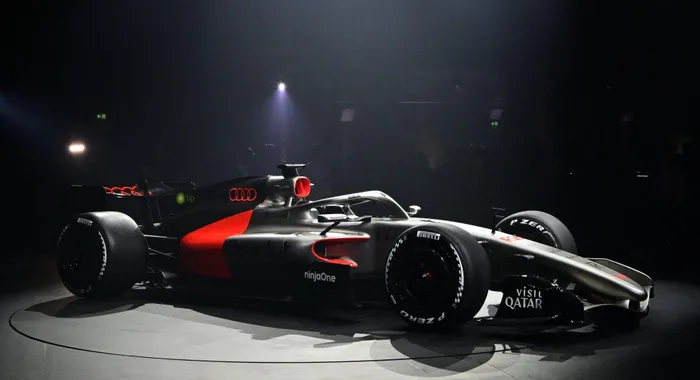
Audi enters F1 amid the sport's most radical rule changes in 12 years.
Image: AFP
Audi’s long‑anticipated entry into Formula 1 has officially kicked off with a bang, and not just for the reasons the German marque would ideally have chosen. The 2026 season marks Audi’s debut as a full constructor and engine manufacturer, bringing a bold new car, a mix of seasoned and rising driver talent, and early‑season controversy that has reverberated across the sport.
After years of preparation, Audi’s first fully‑branded Formula 1 car, the Audi R26, hit the track under its new identity following the takeover of the Sauber team.
The R26 made its official preseason shakedown appearance at the Circuit de Barcelona‑Catalunya, ahead of collective testing, with drivers Nico Hülkenberg and Gabriel Bortoleto splitting duties behind the wheel.
Hülkenberg, one of the most experienced pilots on the grid, brings veteran insight to the project, having accumulated well over 250 Grand Prix starts prior to 2026.
Bortoleto, the young Brazilian sensation and recent Formula 2 and Formula 3 champion, represents the future, a compelling blend of seasoned know‑how and raw pace that Audi hopes will accelerate its climb through the F1 hierarchy.
Leading the team is Jonathan Wheatley, Audi’s team principal, whose extensive F1 résumé includes years as Sporting Director and team management roles at Red Bull before joining Sauber in 2025 and steering its transformation into the Audi‑factory outfit.
Alongside him in the management structure is ex‑Ferrari boss Mattia Binotto, heading technical development and the overall project.
The Barcelona shakedown and early testing provided a first real glimpse of Audi’s pace — and hinted at the challenges ahead. While the team was among the first to put the R26 on track during an initial private shakedown, collective testing proved tougher.
A technical issue during the opening session cut team mileage short; Bortoleto’s run was limited to just 27 laps before a mechanical problem forced the car to stop, triggering a red flag and ending Audi’s day prematurely.
Despite these setbacks, the team remained positive. Bortoleto described the running as providing “a lot of learnings,” reflecting a methodical, data‑driven approach to understanding the new car under fully competitive conditions. With several days of testing still to go, Audi’s focus is on reliability, gathering data, and refining systems ahead of the season opener in Melbourne.
While Audi’s on‑track debut has drawn attention, the paddock has perhaps been even more engrossed in a brewing off‑track storm: a dispute over how rival manufacturers are interpreting the new 2026 power unit regulations, specifically the compression ratio rules.
Under the 2026 regulations, the internal combustion engine’s geometric compression ratio is capped at 16:1, a reduction designed to balance performance with the sport’s push for sustainability and greater electrical power contribution.
However, it has been widely reported that some competitors, particularly Mercedes and Red Bull Powertrains, may have engineered their engines to run at effectively higher compression ratios (closer to the previous 18:1) during normal operating conditions while still passing the mandated cold, static measurement tests.
Audi (joined by other manufacturers such as Ferrari and Honda) has openly criticised this perceived “engine trick,” warning that exploiting what some see as a loophole in the regulation’s wording could yield a significant performance advantage, perhaps worth several tenths of a second per lap, and distort competition before the season even begins.
The FIA has acknowledged the debate and expressed a desire to resolve it before the first race, but recent meetings have yet to deliver a definitive solution, leaving the interpretation, and potentially a competitive edge, intact for the start of the championship.
This early controversy underscores how high the stakes are in Formula 1’s new technical era. Audi’s entry has shifted the dynamic of the grid not only through its presence as a major manufacturer but also by challenging how regulations are interpreted and enforced.
Whether the compression ratio debate will fundamentally impact early season competitiveness, or be clarified later, remains to be seen, but it has already ignited discussion within the paddock about regulatory precision and sporting fairness.
With the R26’s first miles under its tyres and the team’s leadership steering through both on‑track development and technical debates, Audi’s debut season is shaping up to be one of the most talked‑about storylines of 2026.
Fans and rivals alike are watching closely as the German outfit blends engineering ambition, racing heritage, and strategic scrutiny in its pursuit of success in Formula 1.