

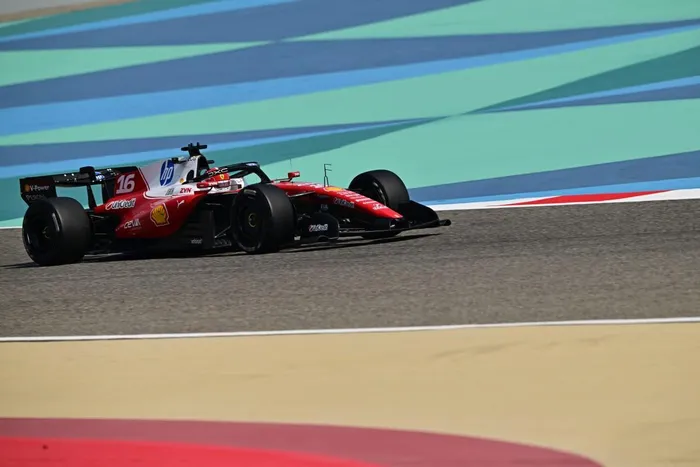
Ferrari's SF-26 dominated the narrative in Bahrain, showing the reliability and pace needed to challenge for the 2026 title. Photo: AFP
Image: AFP
The new regulation change may have been a blessing in disguise for Ferrari who have emerged as one of the front runners with just a week left before the lights drop in Albert Park for the Australian Grand Prix.
As Formula One enters its most sweeping set of regulation changes in years, the season‑opening Australian Grand Prix looms with unprecedented uncertainty, and yet one team has captured the paddock’s attention in Bahrain testing, Ferrari.
After a solid, well‑executed preseason campaign, the Scuderia’s SF‑26 appears not just ready for the opening round but very much positioned at the sharp end of the grid. Testing in Bahrain revealed a Ferrari car that blends reliability and race‑pace promise, a solid proof of concept under the new rules. They even managed to keep within engine compression ratios!
In a collective pre-season where mileage was as important as outright pace, Ferrari hit its targets, completing extensive running with both Lewis Hamilton and Charles Leclerc. Gathering crucial data on the car’s behaviour with the updated aerodynamic and power unit package was necessary for the season to come.
According to team principal Fred Vasseur, the objective was always about understanding and mastering the new machinery rather than simply topping timesheets.
“Happy, yes… our target was to do a lot of mileage and I think this went pretty well,” Vasseur said after testing, while reminding observers that absolute performance comparisons are always clouded by unknown fuel loads, engine modes and tyre choices during a test.
Tyre testing was halted in Bahrain due to the ongoing war in the middle east, so teams will go into this season short of critical data that they will have to supplement somehow.
That measured tone from Vasseur belies what others are seeing: Ferrari’s consistency in running and ability to execute race‑simulations that looked strong has turned heads.
Paddock whispers put Ferrari effectively alongside Mercedes as the pace setters heading into Melbourne, a notable shift given how difficult the past few seasons have been for the Prancing Horse. But it's safe to say that Ferrari have a better set of drivers than Mercedes does.
A key component of Ferrari’s competitive package in 2026 is its turbo choice, a smaller, more reactive unit that some doubted would deliver peak power down the straights.
Critics argued this might leave Ferrari vulnerable on power‑sensitive circuits. Yet at Bahrain, the turbo’s strong low‑end delivery and drive‑ability seemed to suit the unique demands of the new regulation cars, particularly in race‑like long runs and launch performance, an area where Ferrari looked markedly improved.
Even Ferrari‑powered customer teams likes Haas have showcased better starts off the line and top speed.
Off the track, the compression ratio saga has provided an intriguing subplot to the opening of this new era. Mercedes and other teams were rumoured to be exploiting a loophole in the regulation’s static measurement of the engine’s compression ratio, effectively achieving greater compression and power when the engine is hot on track.
Rival manufacturers, including Ferrari, pushed for clarification, leading the FIA and engine manufacturers to agree on a compromise for mid‑season adjustments to how ratios are measured. A change is expected to enforced in June, one that would regulate the compression ratio in both a 'cold' and 'hot' environment.
This controversy thrust technical fairness into the spotlight and, at times, overshadowed pure performance talk, illustrating how finely balanced the status quo appears to be.
Meanwhile, reigning champions McLaren F1 Team head to Melbourne with confidence, but not without doubts. Team boss Andrea Stella described their approach as “defensive,” acknowledging Ferrari and Mercedes as early pacesetters and stressing the importance of development throughout the year rather than glory on day one.
Despite McLaren’s formidable driver duo and back‑to‑back Constructors’ titles, the dynamic between teammates and their proximity to the front has left them slightly adrift in the preseason narrative.
Mercedes, too, brings a car worthy of contention, but with a nuanced driver landscape. George Russell has shown he can win races, yet his emotional intensity, especially in on‑track battles with Max Verstappen, seems to undermine the subtle, cool‑headed consistency often needed for a championship charge.
Verstappen’s ability to draw emotional reactions out of Russell suggests that the Silver Arrows pilot may, at least early in 2026, lack the “ice in his veins” trait shared by Hamilton and Verstappen, an intangible but critical asset in the journey of a world champion.
All of this sets up a season‑opening weekend loaded with potential storylines. Hamilton, finally in a car that looks capable of winning again, brings his vast experience and steely nerves to the challenge.
Leclerc, ferociously hungry for his first world title, has every reason to believe his package can match both his own aggression and Hamilton’s race-craft. Ferrari, for the first time in years, seems to have built a car that doesn’t just meet the talent of its drivers but truly matches it.
Will this be Ferrari’s year? If Australia is anything to go by, the answer might just begin to take shape under the Albert Park lights.
Comprehensive performance data from pre-season testing, team comments and evolving technical regulation context underscore why Ferrari looms large as one of the front‑running contenders as F1 kicks off its most transformative season yet.
Jehran Naidoo is sports reporter with focus on motorsport for Independent Media and editor of the social media channel The Clutch