

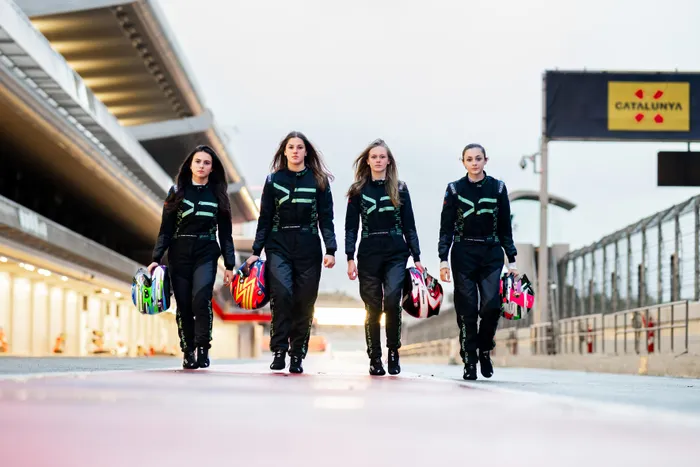
Gianna Pascoal has been selected as one of five new drivers to join the More Than Equal Driver Development Programme. Pictured from left are Ivonn Simeonova, Florescu-Potolea, Alexia Danielsson and Skye Parker
Image: Supplied
South Africa’s growing presence in international motorsport received another boost this week with the inclusion of 15-year-old Gianna Pascoal in a global high-performance driver development programme aimed at producing the first female Formula 1 world champion.
Pascoal has been selected as one of five new drivers to join the More Than Equal Driver Development Programme, a data-driven initiative that identifies and nurtures elite female racing talent from around the world.
She is recognised as one of the country's most promising young drivers, recently making history as the first female driver from South Africa to secure a seat in the FIA Karting Academy (Senior).
Extensive global search
Her selection follows an extensive global talent identification process that assesses drivers across performance metrics, physical capability, psychological readiness and long-term development potential.
The young South African joins an international intake that includes Alexia Danielsson (Sweden), Amelia Wyszomirska and Julia Angelard (both Poland) and Zoe Florescu-Potolea (Romania/United States). They will train alongside existing programme members Ivonn Simeonova (Austria), Lana Flack (Australia) and Skye Parker (United Kingdom).
Founded by businessman and philanthropist Karel Komárek and former Formula 1 driver David Coulthard, More Than Equal is focused on building a sustainable pipeline of female drivers capable of reaching the highest levels of the sport.
While the long-term ambition is clear, the programme’s immediate emphasis is on early intervention and structured development during the most decisive stages of a driver’s career.
Focused training
For Pascoal, inclusion in the programme gives her access to tailored technical coaching, as well as physical, mental and performance support delivered by a specialist in-house team. The approach mirrors long-term athlete development models commonly used in Olympic sport, rather than the fragmented, self-funded pathways that have traditionally defined junior motorsport.
A key focus of the programme is the transition from karting to single-seater racing - widely regarded as one of the most critical and high-risk phases in a young driver’s progression. It is also the point at which many promising careers stall due to a lack of resources, guidance or technical support.
Coulthard, who co-founded the initiative, said early development remains one of the most decisive factors in motorsport success.
“I have seen first-hand how critical early development is in motorsport. More Than Equal is about looking ahead and building a pathway that creates opportunity through preparation, structure and long-term development, informed by data and evidence,” he said.
Chief executive Tom Stanton added that the latest intake reflects both the depth of emerging female talent globally and the programme’s expanding reach.
“Building a sustainable pipeline of female talent requires long-term commitment and the right development environment. This intake strengthens our global programme and reinforces our focus on giving talented drivers the preparation they need to progress through the ranks.”
Growing recognition
From a South African perspective, Pascoal’s selection is particularly significant. While the country has produced motorsport talent across various disciplines, opportunities for female drivers at this level remain limited.
Her inclusion signals growing recognition of South Africa as a source of competitive young racing talent, backed by measurable performance rather than profile alone.
Lauren Forrow, head of driver development at More Than Equal, said the programme’s role is to guide drivers through moments of major transition.
“The move from karting into single-seater racing is one of the most critical stages in a driver’s development. Our job is to provide the structured technical coaching and performance support that allows drivers to adapt quickly and build strong foundations for the next phase of their careers,” she said.