

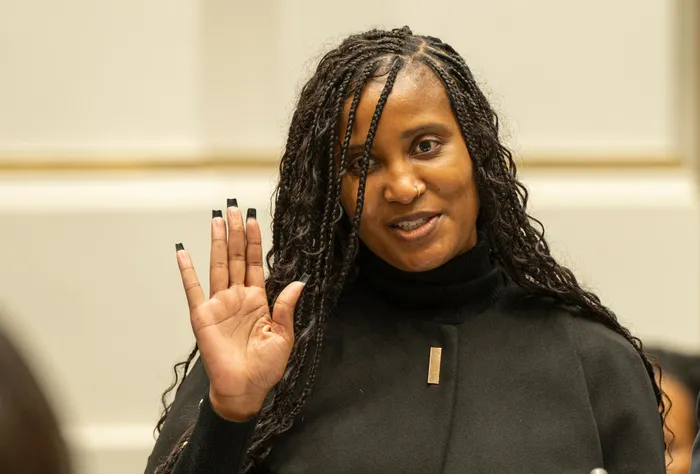
AS DUDUZILE Zuma-Sambudla stands trial for allegedly inciting the deadly 2021 South African unrest through social media
Image: File
NADIA KHAN
AS DUDUZILE Zuma-Sambudla stands trial for allegedly inciting the deadly 2021 South African unrest through social media, community leaders from Phoenix and surrounding areas respond to the case and reflect on its implications for social cohesion, cybercrime legislation, and justice.
Social media expert testimony in the trial suggests additional charges could have been laid under the Cybercrimes Act
In July 2021, violent protests and socio-political unrest resulted in widespread looting of shops and businesses and the burning and destruction of public facilities and private properties, mostly in KwaZulu-Natal and Gauteng.
Of the hundreds of people that were killed across the country, it was reported that close to 40 deaths occurred in Phoenix.
Earlier this year, Zuma-Sambudla, an uMkhonto weSizwe (MK) Party member of Parliament was arrested and charged with incitement to commit the offence of terrorism, incitement to commit violence, and violation of Section 17 of the Riotous Assemblies Act, 17 of 1956.
She pleaded not guilty to all charges at the start of trial earlier this month.
Zuma-Sambudla, who is the daughter of former President Jacob Zuma, is accused of inciting violence through her posts on social media after her father was imprisoned after the Constitutional Court of South Africa found that he was guilty of contempt of court on July 7, 2021.
According to IOL, during the trial last week, social media law expert Emma Sadleir testified that the State should have also included a cybercrime charge against Zuma-Sambudla.
Sadleir told the court that the accused should have been charged under the Cybercrimes Act for using social media platforms to foment violence, which is forbidden under this new law.
She argued that although the new law was not in force during the 2021 unrest as it only became law in 2022, the Zuma-Sambudla allegedly also posted similar violence-inciting- messages in 2023.
Sadleir further stated that after assessing all her tweets, she concluded that Zuma-Sambudla indeed instigated violence and had a case to answer for.
The trial is continuing.
REACTION
Ela Gandhi, chairperson of the Gandhi Development Trust, said the trial was a “bit late” in coming.
“I firmly believe in the slogan ‘justice delayed is justice denied’, but better late than never.
“My hopes are that the court will grant her a fair trial and listen to the complete story and deal with the issues with fairness and in a truly just manner weighing all the evidence. My hope is also that all the evidence will be presented to the court,” she said.
Gandhi, who is also the chairperson of the Phoenix Settlement Trust, said cyber-crime was a huge problem, often being used by young people in all sorts of ways to terrorise people.
“Bullying, vilifying and spreading malicious stories are inciteful ways in which social media is being used and this needs to be curbed. I do believe that if it is raised in this trial it can be a deterrent for the future. I believe cyber-crime should be dealt with firmly in order to deter further violations of people’s lives through the spread of false and inciteful material.”
Gandhi added that she believed that racism entrenched during apartheid years remained to haunt communities.
“There is much work needed to develop a strong South African identity and spirit in the country. Within this kind of tenuous situation any incitement on the basis of race is dangerous as it is like throwing a lit match on dry grass. Community consciousness should deter each of us from making remarks with racist innuendos and in particular deliberately spreading antagonism and hatred.
“Finally I hope that this trial will help to enlighten people on the need for us to learn to live together even if we have diverse political views or cultures or even class differences as these are realities with which we are living and while we are hoping that poverty, unemployment, poor education and corrupt thinking will be eliminated from our country.
“We also realise that this is not an easy task and that it can only be accomplished if all of us are willing to participate in the process to create such an ideal society which can happen if we have the will to make it happen,” she said.
Sham Maharaj, convener of the Phoenix Ubuntu Forum (PUF) said they called on the authorities to bring to trial all those who were involved in violence, and were also appealing for justice to take its course.
He said the PUF was formed as an urgent response to the widespread violence and to develop a social cohesion programme which would bring the communities of Phoenix and the Inanda, Ntuzuma and KwaMashu areas together to foster peace and reconciliation.
“The PUF was one of the first civil society organisations to publicly call for calm, the end to the violence and appealed to the government to identify, arrest and charge the perpetrators of the riots.
“We also made three submissions to various State appointed commissions that were established to receive submissions and evidence in regards to the July unrest. As part of our submissions we also provided evidence in the form of WhatsApp messages from various individuals and groups and we urged the authorities to investigate those who were behind spreading fear and messages to commit violence acts.
“However, we are disappointed that it has taken the justice system more than four years to get going on this matter. It was a great tragedy as more than 350 people died and billions of rands was lost. But we have faith in our justice system to speed up the process of the trial of the suspects who allegedly instigated the riots so that we can all have closure on this matter and we can together work with all peace loving communities to build a better future for all,” he said.
Roshan Jainath, convener of the Peace and Development Forum and a community activist in Pietermaritzburg, said holding people to account was a “monumental act of protecting and advancing the ideals of the Constitution”.
“I think that the wheels of justice, although very slow in this instance, are working well. South Africa is a constitutional state, and the rule of law remains sacrosanct.”
Dr Nora Saneka, chairperson of the Active Citizens Movement (ACM), said the trial would expose the impact on the community at that time and lack of protection from the police, and the levels of fear that were engendered.
“In ACM we uphold the rule of law and the principles of non-racialism and equality before the law on which our Constitutional democracy was founded.
“We hope in the case of Zuma-Sambudla the courts will operate without fear or favour. The 2021 riots were carefully planned and executed to get what certain people wanted - power over State authorities. In that they succeeded, as communities were under threat and defenceless with the police seemingly unable to take action.