
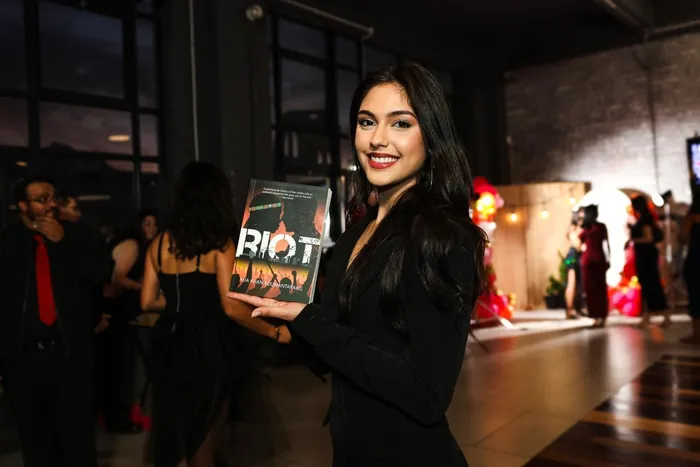
Debut author Alia Khan Koumantarakis will be launching her novel, RIOT.
Image: SUPPLIED
DEBUT author Alia Khan Koumantarakis has turned a turbulent chapter of South Africa's past into a moving literary piece, bringing to light the silent echoes of history in her novel, RIOT.
The official book launch will take place at the Olive Convention Centre in Durban on December 6.
Khan Koumantarakis, 20, who lives in Cape Town, said she began developing RIOT as a screenplay shortly after the unrest and violence that took place in Durban in July 2021.
“During the 2021 riots, I remember the shock and fear that spread through communities, and I couldn’t help but wonder if something like this had ever happened before. That’s when my mother told me about the 1949 riots, a time when the same city, the same streets, and the same communities were torn apart by violence and racial tension.
“What fascinated me was how few people my age even knew this event had occurred. I wanted to use storytelling, through film and literature, to uncover that silence and give it a voice. The initial script version was published in 2022. I later decided to adapt it into a novel, which was completed and published in 2025,” she said.
Khan Koumantarakis, who hails from Durban, said writing RIOT became both a creative and emotional journey.
“It was not just to retell a tragedy, but to understand the human side of it. I wanted to explore how history repeats itself when we don’t confront it, and how love, empathy, and shared humanity can exist even in moments of division and hatred.”
Khan Koumantarakis, who has a Bachelor of Arts degree in motion picture and owns a production company, Stalia Productions, said RIOT is a historical fiction and romantic drama novel set during the riots in 1949.
“A time when tensions between Indian and Zulu communities erupted into days of chaos, destruction, and loss. The story follows Zarik, the son of an Indian shopkeeper, and Nandi, a Zulu princess, whose forbidden love becomes a symbol of hope in a city unraveling around them.
“Through their relationship, the novel explores the complexities of identity, loyalty, and belonging in a divided society. It shows how the actions of a few can ripple through entire communities, but also how courage and compassion can bridge divides,” she said.
Khan Koumantarakis added that while the novel is fictional, it is deeply rooted in historical events.
“It is a combination of documented facts, newspaper archives, and real-life testimonies that I gathered from people whose families lived through that era. The result is a story that blends truth and imagination to reflect the emotional and social reality of South Africa, both then and now.
“While the main characters are fictional, many of the secondary characters and their experiences are inspired by real stories and testimonies shared with me by families who lived through the riots,” she said.
Khan Koumantarakis said through the novel her goal was to spark conversation and reflection, especially among younger South Africans who may not know about the 1949 riots.
“I want readers to question why certain parts of our history have been forgotten, and to see how understanding the past can help us build a more united and empathetic future.
“Beyond that, I hope RIOT serves as a reminder of how powerful storytelling can be. It is my way of showing that local stories matter, that African narratives are rich, layered, and deserve to be seen and heard on the world stage. If the book inspires even one person to start asking questions about their own history or community, then I have achieved what I set out to do,” she said.
Khan Koumantarakis added the central message of the novel is that “love and understanding can survive even in the darkest times”.
“It is about resilience, both personal and communal, and the importance of empathy in the face of division. On a deeper level, it is also a reflection on memory: how societies choose what to remember and what to forget. The novel challenges readers to look beyond stereotypes and prejudice, and to recognise the shared humanity that connects us all.
“Ultimately, RIOT is about healing. The idea that by confronting painful truths, we can begin to write new, more compassionate stories for the generations to come,” she said.
Khan Koumantarakis said her future plans included adapting the novel into a feature film, and to continue writing scripts that tell authentic African stories.
“My goal is to bring our history and shared experiences to an international audience, celebrating Africa’s diversity and complexity through cinema and literature.”
For more information on how to purchase the book visit www.riot1949.com