
A KWAZULU-NATAL teacher allegedly supplied exam answers to 52 matric candidates, while a separate breach at the Department of Basic Education headquarters resulted in seven papers being leaked to schools in Pretoria. Education experts warn these incidents reflect deeper systemic problems undermining South Africa's education integrity.
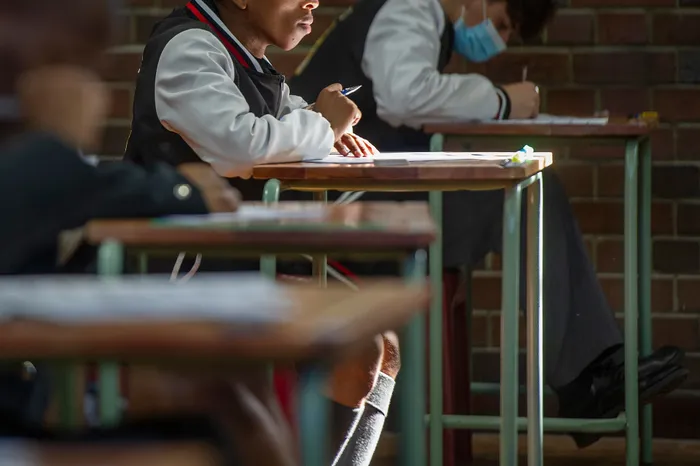
Image: File Picture: Armand Hough/Independent Newspapers
A KWAZULU-NATAL teacher allegedly supplied exam answers to 52 matric candidates, while a separate breach at the Department of Basic Education headquarters resulted in seven papers being leaked to schools in Pretoria.
Education experts warn these incidents reflect deeper systemic problems undermining South Africa's education integrity.
The Suid-Afrikaanse Onderwysersunie (SAOU) had raised concerns over a series of incidents threatening the integrity of the 2025 matric examinations.
“An investigation has been launched in KwaZulu-Natal, where a teacher allegedly supplied answers to 52 candidates in advance,” the union confirmed.
The revelations emerged just as the Minister of Basic Education, Siviwe Gwarube, convened an urgent media briefing on December 11 following the exam breach.
According to the Department of Basic Education (DBE), the breach was discovered through the department’s “internal monitoring and oversight systems”, prompting swift intervention to protect the credibility of the national results.
The 2025 NSC exams involved over 900 000 candidates writing across approximately 7 000 centres, with the assistance of 51 000 markers, moderators and mark capturers at 183 marking centres.
Marking began on December 1, but on December 2, markers in Gauteng flagged “unusual similarity” between a candidate’s English Home Language Paper 2 responses and the official marking guidelines.
“Candidates of six scripts demonstrated a close resemblance to the Marking Guideline, and in one case, selected responses were a replica of the Marking Guideline,” Gwarube explained.
Gwarube confirmed that the breach originated within the national DBE office where the papers are set. Preliminary findings show that seven papers across three subjects were accessed before the exam sessions, English HL Papers 1, 2 and 3, Mathematics Papers 1 and 2; and Physical Sciences Papers 1 and 2.
The documents were distributed via a USB storage device and appear to have reached seven schools in a specific Pretoria area. Investigators have already interviewed 26 pupils, many of whom admitted prior access to both leaked papers and marking guidelines.
Evidence suggests that one DBE employee, also a parent of a Grade 12 pupil, accessed the material, allegedly with assistance from another official within the examinations unit.
Umalusi spokesperson Biki Lepota confirmed that marking ran from December 1 to December 13, with results scheduled for release on January 13 as normal.
Teachers’ unions across the country expressed alarm over the unfolding situations of the issue of the teacher who allegedly supplied answers to 52 pupils.
SADTU provincial secretary Nomarashiya Caluza said: “It is wrong to interfere with examinations and no teacher must do that.”
NATU general secretary Mathemba Mabija added: “We are disappointed at the conduct of the teacher and we condemn any examination irregularity with the contempt it deserves. The union further suggests that due disciplinary processes be implemented in such cases because our education system does not deserve to have such unbecoming behaviour both from teachers and pupils. Matric examinations and any other exams should be treated and conducted with integrity and any wrong conduct undermines its credibility,” he said.
Education experts say the breaches reflect broader systemic pressures on schools.
University of KwaZulu-Natal academic Dr Wayne Hugo described the KwaZulu-Natal answer-sharing case as “corruption”.
“The case is not a small lapse in judgment. It is corruption. A teacher used privileged access to exam material to advantage a selected group of pupils. That breaks trust at the core of schooling, where teachers are meant to protect the integrity of learning, not manage access to shortcuts.
“Cheating of this kind damages the very pupils it claims to help. They learn that success comes from access and playing the system, not effort. If the results are withdrawn, their futures are disrupted. So it is a lose lose.
"People sometimes excuse this kind of cheating because there is no obvious cash exchange. That does not make it less corrupt. When authority is used to bend rules for a select group, it creates unfair advantage, undermines honest pupils, and entrenches the idea that rules are flexible if pressure is high enough.”
He warned that while paper leaks attract outrage, long-standing practices like excluding low-performing pupils from writing exams are often more damaging.
“It is not 52 pupils being helped to pass. It is often hundreds quietly removed from the statistics so that schools can protect their image. Those pupils lose the chance to try, and the system presents a clean pass rate that hides their absence.
“When principals push pupils out of exams or out of particular subjects to protect pass rates, schooling shifts from being about learning to being about numbers. It becomes an exercise in performance management rather than education. The most vulnerable pupils pay the price so that the school can look successful on paper,” said Hugo.
Professor Vimolan Mudaly, also of UKZN, called the behaviour “such a selfish act” and argued for harsh penalties.
“A thorough investigation has to be conducted and the ones found guilty should be committed to many years behind bars. This has become normalised and I am not sure whether the Department of Basic Education cares anymore,” said Mudaly.
Educational expert Labby Ramrathan warned that leaked-paper preparation undermines credibility.
“In this case, it is totally unacceptable and should be responded to accordingly. The implications of such a situation seriously undermine the credibility of the entire examination process resulting in very little trust in the matric examination system,” said Ramrathan.