

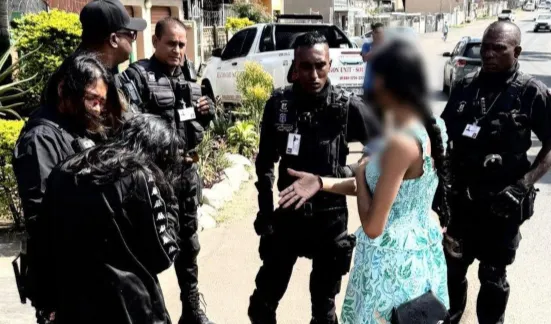
Several Reaction Unit South Africa officers with the 13 year old girl (left), who was found in Phoenix, after she was reported missing.
Image: Reaction Unit South Africa
WHILE reports of missing minors are handled with seriousness, for some entities it can result in a waste of resources when it is found that the children had left home willingly.
In December, posts were circulated on various social media platforms about a 13 year old girl from Chatsworth who was missing.
According to the reports at the time, it was alleged that she had left with a 25-year-old man, who was believed to be a tenant at her family home. She was found a week later by members of the private security company, Reaction Unit South Africa (Rusa), in Phoenix.
A criminal case was not opened.
Denzil Govender, the director of Ground Z3ro Search & Rescue, said this was one of many cases they received of missing minors.
“It happens frequently enough that it has become a concerning trend in most communities, with the highest number of reported cases being in Phoenix, Verulam and Chatsworth. Shortly after the 13 year old missing case, the family of a missing 15 year old girl approached us. She was found safe shortly thereafter. It some cases, they runaway from home more than once.
“Furthermore, 40% of our missing person cases are minors, with the other 60% being adults. However, in all of the cases related to minors thus far they have been found safe,” he said.
Govender added it was not uncommon for some missing persons' cases involving minors to turn out to be voluntary departures.
“Many minors often leave home to due to relationship issues, conflict, influence from older partners or peers, online interactions, seeking independence or escape from personal circumstances, or being drawn into drug addiction,” he said.
Govender said the volunteer-driven community based organisation assisted families and authorities in cases where a person had been reported missing.
“Our work includes taking the initial information from an immediate family member or reporting person, which could be a close friend or neighbour, on behalf of the family if they are too emotional to assist with information.
“We then compile a detailed missing person's flyer that includes verified information and the case number from South African Police Service, which is the most important requirement. Our team then begins the circulating of a missing person's flyer across our network sites and public platforms to alert the general public and community.
“Our members coordinate search efforts with the relevant roleplayers, which include security personnel and local community police forum teams. We also provide support to families during what is often a stressful and emotional time."
Govender said a missing person's case could absorb significant resources and time.
“There are various costs which our members, who are all volunteers, have to bear. These include fuel, equipment, and printing of flyers. They also use their own vehicles and give up their personal time. Hours are spent gathering information and coordinating leads, sometimes resulting in sleepless days and nights.”
He said while most missing person's cases were legitimate, a small number of individuals chose to “rebel” and go missing intentionally.
“While we are grateful when we are able to locate missing persons, especially minors, alive, irrespective of the circumstances surrounding their disappearance, there are rebellious individuals who decide to run away for a weekend of excitement without informing anyone causing great distress.
“While they may think it is a harmless escape, the reality is that it can have a lasting impact on those who care about them. Before making that decision to leave home without informing anyone, they need to think about the relationships they could potentially harm, the opportunities they could miss out on, and the reputation they could tarnish. It's important to remember that while a moment of rebellion may seem thrilling in the present, the repercussions could be far-reaching and impact your future in ways they never imagined."
Prem Balram, the head of Rusa, said: “The resources used are dependent on the situation. In instances where it is related to a possible drowning then the helicopter is used, which is quite costly. In other missing person cases, it requires a vast amount of manpower, sometimes up to 20 reaction officers. We will have groups of four to five officers that go into various areas that the person was possibly last seen to gather information. It requires the use of several vehicles from cars to bakkies and bikes.
“We deal with a lot of cases where resources are wasted due to the withholding of information by the complainant such as failing to disclose the missing person’s relationship status or substance abuse. Reaction officers will look in places where they think the missing person may be but they are at the partner’s home, a bar or drug den."
Balram said they received about 30 missing persons cases a week, of which about 40% were related to minors.
“In many of the minor cases, it was found that they are in relationships and they are not actually missing but have just run away with their boyfriends.”
Balram added that from January 1 to December 22, 2025, there were 889 individuals reported missing to Rusa.
“Runaway teenagers comprised a significant percentage of these statistics.”
Captain Cheryl Pillay, a police spokesperson at Chatsworth SAPS, said there was no waiting period to report a child missing.
“Police have prioritised children as a vulnerable group. Therefore, it is incumbent upon all of society to act immediately when a child is missing. The parent or guardian can visit the local police station with or without a photograph of the child, recent description of the clothing worn, and distinguishing marks. It is also vital to inform police should there be any, for example, custody issues.
“At the police station, police will complete a missing persons report thereafter establish a joint operations centre to activate role players in search of the missing child. Police will also seek the assistance of trained detectives from the Family Violence, Child Protection and Sexual Offences Unit who play a critical role in locating the child. The purpose of requesting the photograph will be for circulation purposes to assist with immediate activation,” she said.
Pillay said the police advised parents to monitor their children’s cellphones.
“This is to establish the social media networking sites as one must not eliminate child trafficking when reporting of missing children; such information is vital to investigations. Police will utilise the media and other platforms to circulate the missing child. It is important also to note that the interest of the child must be priority. Therefore police will work with a rapid response team to coordinate and activate stakeholders to locate the child.”
She added that authentic information would be released from police and not social media sites.
“The circulating of false information can prove detrimental in locating the child also cause harm to the child should the child be located. Police are appealing to structures to work within the ambits of the law.”