
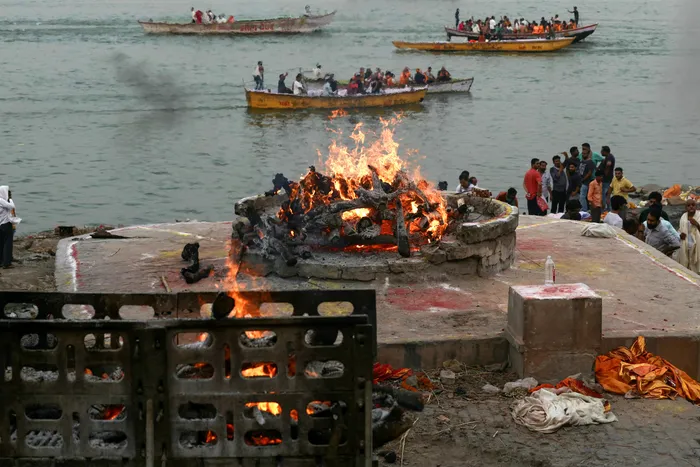
THE Sanathan Dharma Cremation Society is campaigning for the right to perform traditional shrouded cremations, promising dignified, eco-friendly and affordable funerals for the Indian community. In this photograph taken on June 16, 2024, boats ferry past burning funeral pyres at Harishchandra Ghat, along the banks of river Ganges in Varanasi.
Image: Niharika KULKARNI / AFP
THE Sanathan Dharma Cremation Society is campaigning for the right to perform traditional shrouded cremations, promising dignified, eco-friendly and affordable funerals for the Indian community.
But funeral directors are pushing back, citing health concerns and business impacts. We explore both sides of this cultural and economic debate
The society presented the proposal to the Department of Health (DOH) a year ago, with no response to date.
Vish Govindasamy, the society’s spokesperson, said the shrouding process was an age-old Indian practice, which would afford average-income and below average households the opportunity to give their loved ones a “dignified, affordable, and spiritually inclined” funeral.
“I formed the society in 2008 after I went on a trip to India, and saw how hassle-free and simple funerals were done there. This gave birth to the proposal to provide an alternative to the ‘grand’ funerals which we see today. Shrouding would not replace coffins, but would give people a more cost-effective way of having a funeral.
“Funerals have become a grand affair, and one would not know whether to laugh or mourn at funerals, with the large posters of the deceased, the photographs of them on vehicles and water bottles, and the fancy hearses and coffins.
“We are proposing a Sanathan Dharma cremation - where the undertaker would still perform the duties of removing the body, keeping it at their mortuary, assisting the family with bathing the body, arranging for the cremation, and conducting the funeral.
“The difference would be that the body is immediately shrouded after bathing, and placed on a wooden sheet. There would be no need for clothes, like a suit or sari, or jewellery, etc.
“This would allow families to cut funeral costs significantly,” he added.
Govindasamy said undertakers were not in support of the proposal, as they felt it would cut their profits.
“A Sanathan Dharma funeral could cost between R7 500 to R10 000. Funeral parlours would still profit from the funeral, as the process would only eliminate the coffin, and not their entire service.
“This will not be a standard, but it would be an option for those who want a simple funeral. Those who want the fancy hears, the doves, and the loud music will still have the option.
“The Indian community can be egocentric. We have this idea that when someone dies, we want to give them the best. We would beg, borrow and steal to make this happen. Some people go into debt and others spend months or years paying off the funeral debt.
“We need to steer away from this mindset and go back to our roots. The shrouding process will also be of benefit to environmental as air emissions levels would be lower. It will also address the issue of the current challenge of burial space and preservation of our trees that is critical to global warming and climate change,” he said.
“We are disappointed by the silence of the DOH, but we will knock on every door until our voices are heard and this proposal is passed,” he added.
Clive Moodley, deputy president of the Progressive Funeral Practitioners Association of South Africa, said they would not be in support of the society’s proposal.
He said funerals were already cost effective, as families had the option to burn the inner shell of the coffin, and not the entire coffin, bringing down the cost factor.
“One coffin is used about four or five times. How much cheaper can you go? There are also health risks that we have to take into consideration. We cannot put our staff and drivers through health risks with shrouding.
“This is our business. If business is taken away from us, how do we keep our doors open? Funerals are not dictated to by the undertaker. We take instructions from the families, and families want to give their loved ones a proper and dignified send-off,” he added.
Moodley said he does not believe that people would want to go back 30 to 50 years and opt for shrouding.
He said funerals had become like a “show and shine” with some as extravagant as a wedding.
Dhayalan Moodley, owner of Moodley's Funeral Services, said they were shocked by the society’s proposal.
“Wrapping a body in a shroud is not a straightforward process. There is potential for body fluids or blood to leak into the shroud. This would cause further trauma to the families. This proposal seems like an attempt to disrupt the funeral industry, driven by envy rather than concern for the community.
“The DOH has stringent regulations for a reason. Funeral services are about dignity and respect for the deceased and their loved ones. We should focus on supporting families and not creating unnecessary complications. Respect for the dead is not measured by the grandeur of the funeral, but by the dignity of the process,” he said.
Director at Wyebank Funeral Services, Lenny Reddy, said the proposal raised important points about cultural values and affordability.
“While the intention is to maintain dignity through simplicity, the practical application is challenging. In a professional setting, a coffin provides a necessary structure for the respectful handling and movement of the deceased. A shroud alone, while spiritually significant, does not offer the same level of physical protection or stability during the transport and preparation phases, which could inadvertently lead to situations that feel less dignified for the family and staff.
“At this stage, we would not support the proposal. Our current protocols and facilities are designed around the safe and hygienic use of coffins. Without a standardised, regulated alternative that guarantees the same level of safety and containment, we would be hesitant to move away from the current National Health Act requirements,” he added.
Reddy said the proposal would pose significant logistical and health risks for undertakers.
“Coffins serve as a vital barrier for biohazards and fluids. Shrouded remains would require entirely different handling procedures, specialised training, and likely expensive modifications to cremation equipment and transport vehicles to ensure hygiene standards are not compromised. For many smaller funeral homes, these overhead costs could outweigh any benefits,” said Reddy.