

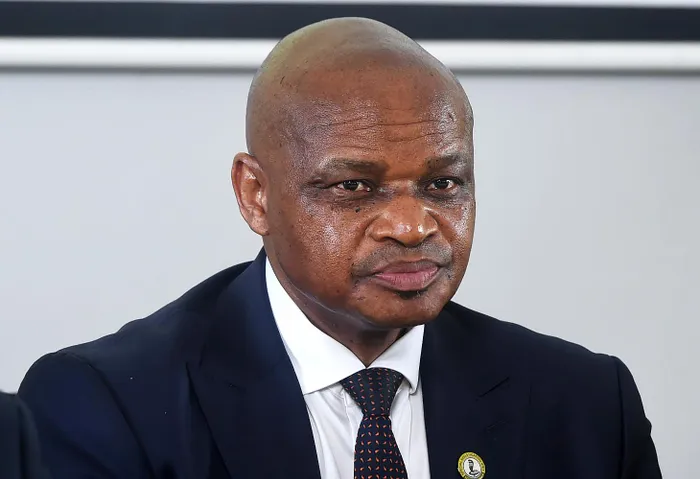
Jan Lekgoa Mothibi, the new National Director of Public Prosecutions.
Image: Umfanekiso ogciniweyo
PRESIDENT Cyril Ramaphosa's appointment of advocate Jan Lekgoa Mothibi as the new National Director of Public Prosecutions has drawn mixed reactions from across the political spectrum. While some praise his track record at the Special Investigating Unit, others question whether he can address the systemic issues within the NPA given his age and the magnitude of the challenges ahead
Mothibi, who is currently the head of the Special Investigating Unit (SIU), will assume the position as the NDPP effective from February 1.
President Cyril Ramaphosa set up an advisory panel for the selection of the NDPP, a statement by the presidency read.
The panel, which conducted an open and transparent selection process, selected six candidates for interviews out of 32 applicants.
The panel concluded its process and submitted its report to President Ramaphosa on December 12, 2025. In its report, the panel advised that none of the interviewed candidates were suitable for the role of NDPP.
Mothibi will take over from advocate Shamila Batohi who has served as the NDPP since 2019. He began his career as a public prosecutor in the Johannesburg and Soweto magistrates and regional courts. He also served as a magistrate in the Johannesburg and Soweto courts.
Political parties
Advocate Glynnis Breytenbach, the Democratic Alliance’s (DA) spokesperson on justice and constitutional development, said Mothibi’s appointment must be intended to translate into better management of the NPA, more prosecutions, and a reduction in crime.
“As the SIU head and with experience as a former prosecutor and magistrate, Mothibi is well-suited to lead the NPA.”
However, a major stumbling block was his age, she said.
“At 63 years of age, he has an extremely limited opportunity to make any impact at all, and will have his work cut out for him. It is somewhat concerning that the president has seen fit to appoint someone of advocate Mothibi’s age, given the serious and systemic issues currently within the NPA.
“The job itself is a much bigger one than that of head of the SIU. His appointment comes at a time when the NPA faces many difficulties. Criminality has taken hold of the country, and the NPA needs a leader who will recapacitate the hollowed-out institution and reform the prosecutorial service into a crime-fighting machine,” she said.
Breytenbach added Mothibi's appointment also came at a time when the positions of the deputy national directors was also vacant; a problem that needed urgent attention.
Mkhuleko Hlengwa, the Inkatha Freedom Party’s (IFP) national spokesperson, welcomed the appointment.
“We believe that advocate Mothibi is the right person for this critical responsibility at a time when South Africa requires firm, principled and capable leadership within the NPA.
“His track record speaks for itself. Throughout his career, he has demonstrated integrity, independence and a resolute commitment to the rule of law. His experience in combating corruption, strengthening accountability and restoring public confidence in key institutions makes him well suited to lead the NPA at this pivotal moment in our democracy,” he said.
Hlengwa added that South Africans deserved a prosecuting authority that was professional, independent and fearless in the pursuit of justice, without fear, favour or prejudice.
The uMkhonto weSizwe (MK) Party in a statement said the appointment appeared to be “pre-orchestrated, politically deliberated and part of a systematic process” aimed at placing Mothibi in a constitutionally critical position.
“Of grave concern is the timing of this process, which coincides with Mothibi’s own findings, during his tenure as head of the SIU, that there were prima facie evidence implicating Cyril Ramaphosa’s nephew, Hangwani Maumela, in the TembisaHospital corruption scandal.”
The MK Party said these findings were formally handed over to the NPA, specifically the Investigating Directorate Against Corruption.
“The MK Party firmly believes that Ramaphosa’s decision to appoint Mothibi as NDPP is to shield his nephew from imminent arrest and prosecution.”
The party further called on Mothibi to act decisively and without delay in arresting and prosecuting Maumela in line with evidence already presented.
Shameen Thakur-Rajbansi, leader of the Minority Front (MF), said: “I am skeptical about the process as the panel did not find a suitable candidate from fresh faces in those prosecutors interviewed leading to the unbridled powers of the President to do cadre redeployment.
“Mothibi has had a few successes in the SIU, but many cases are ongoing, and many times adhoc investigations committees in Parliament have to also abandon cases where SIU has failed to gather evidence internally.
“However, we would like to see successful prosecutions, such as in the Tembisa hospital corruption case which cost the life of whistleblower, Babita Deokaran. We also have to watch his effectiveness in resolving cases where advocate Batohi faced bottlenecks. At the same time, the President has to fill remaining, critical vacancies for the deputies as these hamper investigation outcomes,” she said.
Organisations/activists
Dr Nora Saneka, chairperson of the Active Citizens Movement (ACM), said while they congratulated advocate Mothibi on his appointment, it was unfortunate that the public did not have the opportunity to hear his views and vision as a potential NDPP.
“This appointment was made in the context that the panel was unable to find a suitable candidate. However, advocate Mothibi’s record in public service and credibility, including his role as the head of the SIU, should go a long way to allay any concerns regarding his suitability for the position.
"His performance at the SIU in the fight against corruption and the recovery of billions of rands in public resources, including the recent intervention at the Tembisa Hospital, provides hope that he will display the same commitment in fighting corruption in the wider ambit of the NPA,” she said.
Saneka added that the ACM was hopeful that advocate Mothibi would continue to display the same open and accommodating style of leadership in his new post and that he would continue to work with relevant stakeholders, including civil society organisations, in the pursuit of justice for all in the country.
“The ACM also hopes that the protection of whistleblowers will be one of his priorities, including bringing to book those behind the victimisation and killing of whistleblowers like Babita Deokaran and others.
“We also call on all organs of government to assure the independence of the NPA and guarantee to advocate Mothibi, and his team their fullest and unhindered cooperation and resources,” she said.
Lebogang Ramafoko, executive director at Corruption Watch(CW), said: “We are cautiously optimistic and hope that he will continue his track record and will bring those who have been accused of corruption to book.
“Our concern is that he should perform his duties without fear or favour, that there is no political interference and that he collaborates with law enforcement stakeholders across the spectrum,” she said.
Ramafoko said CW hoped Mothibi would address the “serious” backlog of bringing those whose names have come up during different commissions such as the Zondo commission, to book.
“We also hope that he will restore public confidence in the NPA and that we will start seeing prosecutions that are watertight, taking place.”
Koogan Pillay, a governance and human rights advocate said: “I do believe he is a good choice, given that the NDPP recruitment process itself was flawed,
and produced a short list of candidates, who appeared to fail the selection criteria.”
Pillay said he believed that Mothibi could play a significant role in turning around the justice system, together with other key stakeholders, including civil society.
“Given society’s frustration with empty promises and the perceived failure of the NPA, a critical accountability institution, I do believe his performance contract should be made public, and shared with key stakeholders.
“It is imperative to understand advocate Mothibi’s mandate, performance contract, and key deliverables, so that his performance can be measured and managed, and he can be held to account, given the critical state South Africa finds itself in, bordering on state failure and collapse, with the high level of crime, corruption, gender-based violence, poor service delivery and failure in ethical leadership.
“I hope for successful prosecutions from the Zondo Commission report, and now also the Madlanga commission, as well as recovery of the stolen loot - which will meet human rights and service delivery expectations for South Africa’s citizens,” he said.
Devoshum Moodley-Veera, an integrity activist said while she was hopeful with Mothibi’s appointment, she was also skeptical at the same time.
“Although Mothibi has a good track record within the SIU, the institutional arrangements are different. For example the capacity and budget constraints, governance protocols and the reporting mechanisms. Under the leadership of advocate Mothibi, the SIU instituted lifestyle audits within the SIU for new staff appointed and annual lifestyle audits.
“The questions that arise are, ‘Will all staff undergo lifestyle audits within the NPA when he occupies office?’ I am not confident that this will be instituted. Furthermore, the case of the assassinated whistleblower, Babita Deokaran is currently under investigation by the SIU. This investigation has taken years and has not reached finalisation,” she said.
Moodley-Veera, who is a PhD student specialising in ethics, anti-corruption, whistleblowing protection and law at the Stellenbosch University, said she hoped there could be better co-ordination between the NPA and SIU in prosecuting these cases.
“I do hope that the decision by the President to appoint Mothibi to the NPA is forward looking in the sense that the President has plans to join or amalgamate the SIU and NPA as one law enforcement agency. If this is indeed the plan, then this would be a good plan to strengthen capacity constraints that advocate Batohi has been raising for years.”
Lawson Naidoo, executive secretary of the Council for the Advancement of the South African Constitution, said he believed it was an excellent appointment.
“He certainly has the range of skills and experience that will serve him well as the next NDPP. His considerable experience at the SIU, which he turned into one of the most effective anti-corruption agencies that we have, is testimony to his ability to lead an agency such as the NPA.
“However, he is going to have his work cut out, it is not going to be simple as there are inbuilt institutional constraints among which are the fact that the Department of Justice still retains significant control over the operations and finances of the NPA, that is something that needs to be addressed because without that he is going to struggle, similar advocate Batohi did in terms of really turning around the institution,” he said.
Professor Nirmala Gopal, a criminologist, said the appointment of advocate Mothibi has sparked a range of opinions, reflecting the complexities surrounding leadership roles within the criminal justice system.
“Notably, the public's keen interest in the functioning and integrity of this system underscores the necessity for ethical and professional leadership at its helm.”
Gopal said Mothibi's skills, competencies, and previous achievements will play a critical role in shaping his impact on South Africa's justice landscape.
“His background and expertise could address some of the ongoing challenges faced by the system, especially in terms of public trust and accountability.
“As such, advocate Mothibi's appointment should not be viewed merely through the lens of individual merit, but also as a pivotal moment for the broader justice framework. The expectations surrounding his leadership signal a collective desire for reform and improvement within the sector,” she said.