
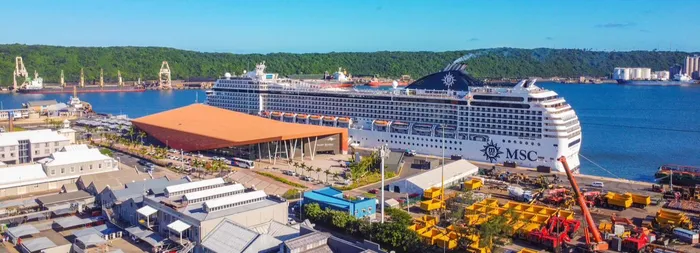
THE Advertising Regulatory Board has ruled against MSC Cruises' 'first guest pays R1' Black November promotion after a consumer complained that the total prices were misleading and inconsistent with the advertised offer.
Image: Supplied by eThekwini Municipality
THE Advertising Regulatory Board has ruled against MSC Cruises' 'first guest pays R1' Black November promotion after a consumer complained that the total prices were misleading and inconsistent with the advertised offer.
The promotion advertisement was posted on Facebook and on its website.
The complaint related to the Black November promotional offer, promising a limited-time opportunity to enjoy a cruise from Durban aboard the MSC Opera.
It offered options ranging from short two-night trips to festive 14-night voyages.
The promotional offer is, in particular, that the first guest would pay R1 for the cruise, with disclaimers noting that mandatory fees apply and terms and conditions were available via linked pages.
On the advertiser's booking interface, pricing options were depicted as ranging “from
R1 910 pp” for various cabin types (interior, ocean view and balcony) as well as “from R4 838 pp” for longer cruises with onboard credit.
It is also depicted that “total prices for two guests ranging from R7 019 to R49 676, depending on the selected cruise and cabin.”
The complainant submitted that when selecting the Black November offer and adding a second guest, the total price displayed was significantly higher than expected, in some cases exceeding the standard fare for two guests.
For instance, the complainant submitted, where the advertised per-person price was R4 838, the total shown was R49 676, and where the price was R1 910 per person, the total was actually R7 019 for two guests.
The complainant contended that this pricing structure was misleading and inconsistent with the promotional claims. The advertiser noted that it was not a member of the ARB and did not submit to the ARB's jurisdiction and that its response was provided without prejudice.
The cruise line company confirmed that the promotional material referenced by the complainant formed part of its “Black November” campaign, which ran in South Africa from November 5 to 17 last year.
The advertiser explained that the promotion allowed the first guest to pay R1, excluding mandatory fees, while the second guest paid the full fare plus mandatory fees.
Mandatory fees, it said, comprised port charges and hotel service charges, which applied to all passengers and could not be discounted or altered for promotional purposes.
MSC stated that these fees varied depending on the length and itinerary of the cruise.
In relation to the complainant's two examples, MSC provided a breakdown of the pricing, in which it explained that on the 14-night cruise priced “from R4 838 pp,” the first passenger paid only mandatory fees (R4 838), while the second passenger paid the full cruise fare (R40 000) plus mandatory fees (R4 838), resulting in a total of R49 676 for two passengers.
For the two-night themed cruise priced “from R1 910 p.p.,” the first passenger paid R1 plus mandatory fees and a third-party entertainment fee (totalling R1 910), while the second passenger paid the full fare plus the same mandatory and entertainment fees (totalling R5 109), resulting in a total of R7 019.
MSC submitted that these amounts aligned with the advertised offer and the applicable terms and conditions. It emphasised that all charges were displayed transparently in the booking summary before a customer proceeds to payment and that variations in cruise fares arise either from promotional discounts or from MSC's dynamic pricing model.
MSC denied that the advertisement was misleading or that any pricing irregularity occurred.
The ARB accepted that mandatory fees applied to all MSC cruises and that these fees varied depending on itinerary and duration. However, it said, the question was not whether the totals could be mathematically justified after the fact, but whether the advertisement, as presented to consumers, created a misleading impression about the nature of the prices quoted.
It found the advertisement misrepresented the actual price payable.