
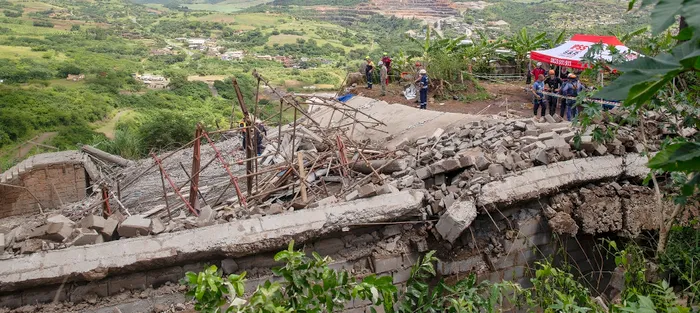
Temple Accident Day 3 HE South African Hindu Maha Sabha has issued a directive that all religious and cultural organisations must adhere to compliance and building regulations to ensure public safety following the collapse of a building under construction at River Range Ranch in Verulam in December.
Image: Leon Lestrade
THE South African Hindu Maha Sabha has issued a directive that all religious and cultural organisations must adhere to compliance and building regulations to ensure public safety following the collapse of a building under construction at River Range Ranch in Verulam in December.
It urged religious and cultural organisations to prioritise compliance with building regulations, bylaws, and engineering standards to avoid putting such organisations into disrepute with non-compliance and negligence.
Professor Brij Maharaj, the Sabha’s deputy president, said organisations were at grave risk of facing criminal charges and a decline in public trust should they be found to be non-compliant.
“In response to the recent tragic collapse of a building at a religious site and the consequent loss of life, we emphasise the critical importance of adhering to all legal and safety requirements.
“Temples, halls, and related venues are public facilities where the safety and well–being of devotees, guests, visitors, and all other persons who enter the premises must always be a top priority.
“We call on all religious and cultural organisations to prioritise compliance with building regulations, bylaws, and engineering standards, and to secure all necessary documentation and professional sign-offs before any construction activity.
“They must also monitor construction processes to ensure continued adherence to legal requirements. It is important that they ensure all contractors and their employees are registered with the Department of Employment and Labour and that they comply with all the provisions of the Occupational Health and Safety Act, like maintaining a safety file, conducting risk assessments, and ensuring the proper use of personal protective equipment,” Maharaj added.
He said organisations must make informed decisions by ensuring that the proper legal and regulatory advice was sought before allowing contractors to commence construction or maintenance work.
“It is the responsibility of the organisation to monitor and oversee construction processes to ensure continued adherence to legal requirements, even if the construction or renovation is undertaken solely by contractors appointed by devotees at their cost.
“The deliberate or negligent non-compliance is a grave risk exposing religious and cultural organisations to criminal charges, civil liability, irrecoverable losses, insurance invalidation, and irreparable harm to public trust and reputation. Let us reaffirm our commitment to maintaining our temples and cultural centres as safe, sacred, and secure spaces for all,” Maharaj said.
The sabha has issued the directives below.
Organisations are required to:
Legal penalties for non-compliance:
Non-adherence may lead to the following legal and regulatory consequences:
Consequences of legal action: