
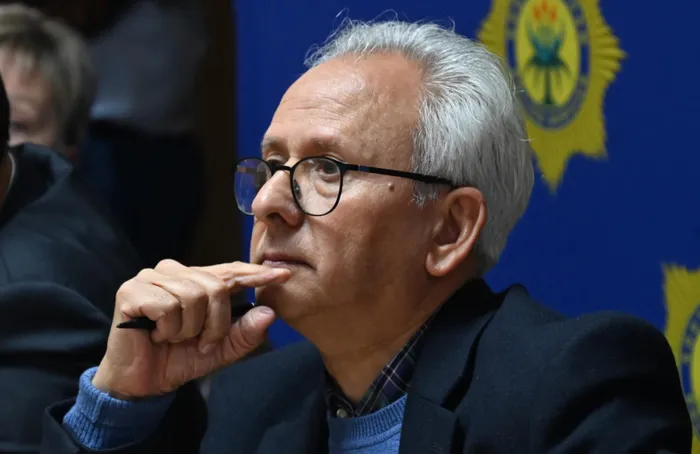
Acting Police Minister Firoz Cachalia has revealed that R3,7 billion was allocated for VIP protection services in 2024/25, a figure projected to rise, igniting debate on government spending priorities
Image: Ayanda Ndamane / Independent Newspapers
ACTING Minister of Police Firoz Cachalia revealed the South African government spent R3.7 billion on VIP protection services in 2024/25, with costs projected to exceed R4 billion by 2026/27.
ActionSA criticised the expenditure as prioritising political elites over essential public services, pointing out that VIP protection received R1.3 billion more than the Hawks' budget for fighting organised crime.
This amount, which includes R2,29 billion allocated for VIP protection and an additional R1,42 billion for static protection, was disclosed in response to a parliamentary question posed by ActionSA MP, Alan Beesley.
Beesley had asked for details about the financial allocations for protecting the President, Deputy President, Ministers, Deputy Ministers, and international dignitaries, specifically querying the actual, current, and projected expenditure on these services for the 2024/25, 2025/26, and 2026/27 financial years.
The figure, which represented a significant portion of the national budget, is projected to rise even further.
This ongoing rise in expenditure highlights what ActionSA describes as the "unchecked growth of executive perks."
By the 2026/27 financial year, total expenditure on protection services is expected to exceed R4 billion, which has prompted sharp criticism from ActionSA, who argued that the government was prioritising the protection of political elites over essential public services.
''This stark disparity lays bare the GNU’s skewed priorities, favouring executive protection and luxury over strengthening institutions tasked with holding the powerful to account,'' said Beesley.
He said that this spending far exceeds the R2,4 billion allocated to the Hawks, South Africa's Directorate for Priority Crime Investigation, tasked with fighting organised crime and corruption.
Cachalia’s breakdown of the 2024/25 spending reveals that the Protection and Security Services (PSS) received R1,21 billion for VIP protection, while the Presidential Protection Services (PPS) was allocated R1,08 billion. Static protection, which covers security for buildings and infrastructure, cost an additional R1,42 billion, with PSS receiving R1,30 billion and PPS R85 million.
A further R35 million was earmarked for the protection of traditional leaders in KwaZulu-Natal.
It also pointed to other instances of government spending that it argued reflected a disregard for the country’s financial realities.
The party recently disclosed that Ministers and Deputy Ministers had spent upwards of R500 million on travel and accommodation in the first 18 months of their tenure, with several departments surpassing the President’s own office in travel expenditures.
''Shockingly, but not surprisingly, four departments spent more on travel and accommodation than the President’s own office, further illustrating how executive excess has become entrenched across government. ''
The disproportionate spending on VIP protection, which exceeds R1,3 billion more each year than the Hawks' budget, has been described as a powerful indictment of the government's approach to governance.
Beesley condemned this prioritisation, saying, “That the GNU is willing to spend around R1,3 billion more each year on VIP protection than on the Hawks is a powerful indictment of its approach to governance.
''Instead of adequately funding the unit tasked with investigating, preventing and combating serious organised crime, corruption and priority offences, recovering stolen public funds and restoring public confidence in the criminal justice system, the GNU has chosen to prioritise the comfort and protection of political elites.”
In addition to the spending on protection and travel, President Cyril Ramaphosa had approved a salary increase for public office-bearers, which will take effect from April 2026.
Under the new adjustment, the Deputy President’s salary would rise to approximately R3,28 million annually, Cabinet Ministers would earn around R2,79 million, and Deputy Ministers would receive about R2,29 million, a 3,8% increase.
In response to what it calls a culture of waste, ActionSA has introduced the Enhanced Cut Cabinet Perks Bill, aimed at reducing the extravagant benefits enjoyed by ministers
Additionally, the party has proposed a Constitutional Amendment Bill to abolish the 32 Deputy Minister positions, a move they argue would save the country millions and streamline government operations.
"South Africans deserve a government that puts people before perks," Beesley said.