
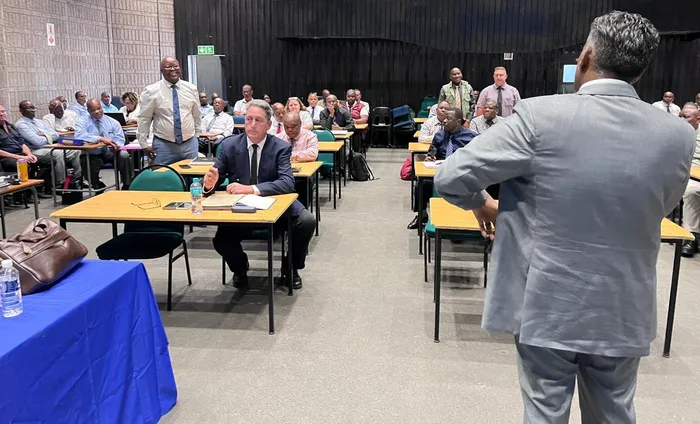
KZN acting deputy provincial commissioner for Crime Detection, Major General Anthony Gopaul formally welcomes the detectives on Friday
Image: Supplied
KWAZULU-NATAL (KZN) SAPS has re-enlisted 59 experienced retired detectives to address mounting case backlogs and combat violent crime.
While police leadership emphasises accountability and professionalism from the returnees, experts cautioned that long-term structural solutions were still needed to address the national detective shortage of over 2,300 officers.
The re-enlistment drive culminated in a formal welcome on Friday by the KZN acting deputy provincial commissioner for Crime Detection, Major General Anthony Gopaul, for the 59 detectives.
While some of the returning detectives had already begun working in November 2025, the ceremony served to formally reintegrate them into the service.
Addressing the cohort, Major General Gopaul underscored the seriousness of their task.
He said South Africans deserved justice that could be achieved when their cases were thoroughly investigated.
"You have been here before, you know what is expected of you. What I can tell you now is that accountability is non-negotiable, professionalism is a must, and no case must go cold under your watch," he stated.
The provincial police spokesperson, Colonel Robert Netshiunda, confirmed that all the re-enlisted detectives had retired from the Service in good standing.
The Minister of Police, Senzo Mchunu, disclosed in a Parliamentary response to Build One South Africa (BOSA) last year that SAPS faces a national shortage of 2,344 detectives.
Policing consultant with the Institute for Security Studies (ISS), David Bruce, said the assistance of experienced detectives can certainly help in the short term, but cautioned that the core problem requires a deeper fix.
"There is definitely a need for strengthening the detective service," noted Bruce.
"However, the main need is for a sustained programme focused on substantially strengthening the SAPS detective function. This should include a new approach to recruitment that is much more focused on ensuring that the SAPS brings on board people with the right kinds of skills," he said.
Bruce explained that the current recruitment framework, which often relies on recruiting matriculants, is inadequate for building a sufficiently skilled detective component capable of handling the increasing complexity of modern crime.
"There are many complex aspects of crime investigation," he added. "These start with taking witness statements effectively. But there also need to be detective personnel who are fully capable of investigating complex violent crime networks, financial crime, and working with digital evidence effectively."
Echoing the necessity of the move, the Independent Policing Union of South Africa (IPUSA) welcomed the re-enlistment, highlighting its importance "at a time when communities face high levels of violent crime and growing case backlogs".
In June last year, the Portfolio Committee on Police raised concern that a backlog of over 14,000 cases carried over to 2025.
IPUSA, however, stressed that the real impact hinges on logistical support.
"While we support this positive step, IPUSA emphasises that real impact will depend on proper resourcing, manageable caseloads, and strong supervisory support," the union stated.
The union stated that returning detectives must be equipped with the tools, vehicles, technology, and forensic backup required to deliver quality investigations.
IPUSA also aligned itself with Major General Gopaul’s directive: "No case should go cold, but this requires a system that empowers detectives, not one that overwhelms them," the union stated.
The Public Servants Association (PSA) also backed the initiative, with Claude Naiker, acting deputy general manager of Members' Affairs at the PSA, pointing out that the capacity shortfall is a nationwide issue, not just confined to KZN.
"Detectives have, over long periods, seen their case-loads increase tremendously, thus resulting in a lot of cases not being prosecuted timeously because they are unable to be investigated timeously," said Naiker.
He viewed the re-enlistment as a temporary, but necessary, measure. "Therefore, to consider previously employed detectives should be seen as an interim measure to bridge this gap. The government should pay serious attention to allocate more resources to the investigation unit if it wants to be serious about eradicating crime."
Professor Nirmala Gopal, a senior criminology lecturer at the University of KwaZulu-Natal (UKZN), described the re-enlistment as "a step in the right direction", saying it demonstrated the SAPS’s commitment to reintroducing efficiency and professionalism. Gopal stressed the need to protect the returning detectives from the systemic issues that led to the decline in standards.
"It is going to be very important that these 59 detectives are protected in a way that ensures they don't become contaminated by existing personnel, existing practices, and the institutional culture," she said.
Gopal suggested that the success of this initial cohort could pave the way for further re-enlistments.
"It might become critical for SAPS, then moving forward, to bring back retired personnel, especially those with a clean slate and an impeccable track record," she said.
Gopal said going back to the drawing board to re-enlist more of these high-calibre individuals could also "encourage existing members to improve the efficiency and effectiveness of their own service and to start holding themselves and each other accountable, as they will likely realise they are not indispensable".