
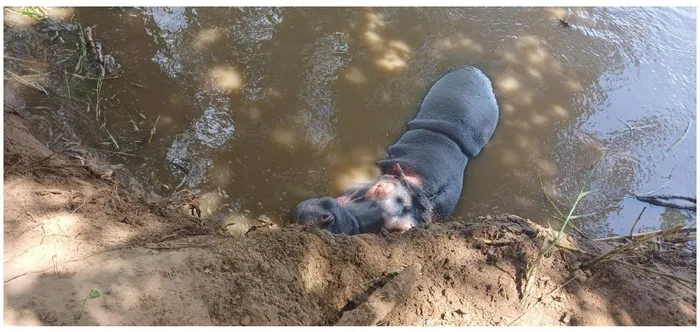
An image of the snared hippo while it was alive.
Image: Isimangaliso WetLand Park
TWO men tragically drowned in the Mfolozi River while attempting to harvest meat from a snared hippo that had been euthanised by Ezemvelo KZN Wildlife officials.
Authorities have issued an urgent warning to communities to avoid approaching wildlife carcasses due to significant safety risks
Ezemvelo KZN Wildlife, in a joint statement with iSimangaliso Wetland Park, confirmed that the incident occurred on Friday, after officials responded to reports of a hippo caught in a snare near a river in the area.
Upon arrival, conservation officials found a large number of community members gathered along the riverbank.
After assessing the situation, the Ezemvelo team determined that rescuing the hippo was impossible and extremely dangerous due to muddy terrain and high-risk conditions.
A local veterinary service was contacted and a decision was taken to euthanise the hippo to end its suffering.
Following this, Ezemvelo officials removed certain body parts, including the head and legs, in line with the organisation’s standard internal carcass management procedures.
However, due to the hazardous conditions, the remaining carcass could not be removed immediately and was left in the river while alternative options were being considered.
It was during this time that members of the community attempted to cut the carcass for meat, resulting in the tragic turn of events.
One man drowned while trying to reach the carcass, while a second drowned while searching for the first victim’s body.
Ezemvelo KZN Wildlife and iSimangaliso Wetland Park have since conveyed their condolences to the families of the deceased and issued a strong warning to communities.
“We convey our deepest condolences to the families of the two deceased individuals and strongly urge communities to refrain from approaching wildlife carcasses or entering swollen rivers, as this poses a serious danger to human life,” the statement read.
Authorities have reiterated that wildlife carcasses, particularly in rivers or remote areas, present significant risks and should only be handled by trained officials.