

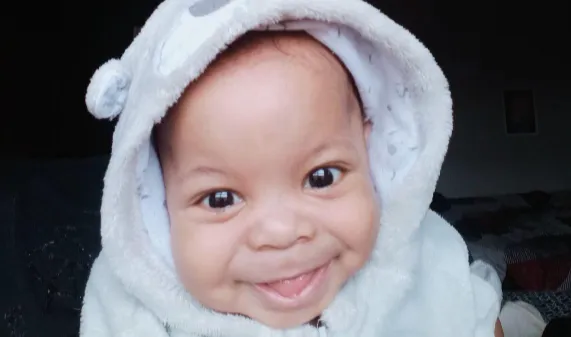
Little Kwandokuhle Ndlovu.
Image: Supplied
AFTER spending half his young life separated from his family and twin brother while on life support in Gauteng, nine-month-old Kwandokuhle Ndlovu has finally returned home to KwaZulu-Natal following a successful heart operation.
“We were excited when it was time to bring him home. Kwandokuhle came back strong," said dad, Andile Ndlovu, of Howick in KwaZulu-Natal.
"He was even smiling like a child should. Since the surgery, he has been doing well, and he is playful, healthy and gaining weight. We are so happy. It is the greatest gift to have our twins healthy at home and reunited.
"We celebrated our first Christmas together as a family at home. Kwandokuhle and his brother Kwenzokuhle play together so beautifully, and we are recording these memories for the twins when they grow up.”
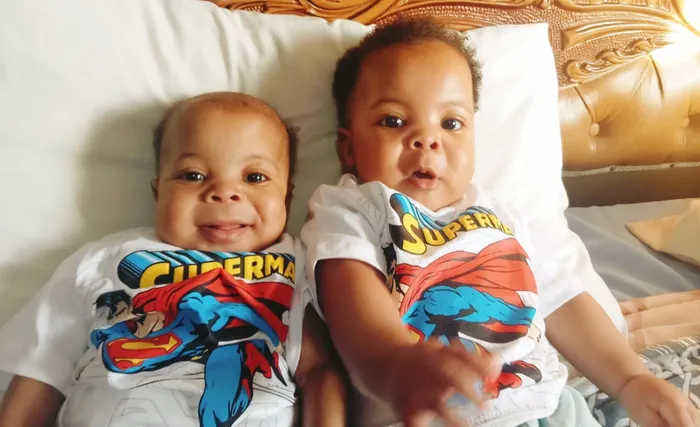
Kwandokuhle and Kwenzokuhle Ndovu.
Image: Supplied
Kwandokuhle and Kwenzokuhle - also referred to as Kwando and Kwenzo - were born in April.
At the end of May, they developed a flu-like illness. The twins were rushed to the hospital, and Kwenzo was placed in isolation while their parents awaited their blood test results.
The babies tested positive for respiratory syncytial virus (RSV) and doctors discovered a hole in Kwando’s heart that further complicated his situation.
While Kwenzo remained in hospital, Kwando’s condition deteriorated and doctors discussed the need to transfer him for specialised care to Netcare Waterfall City Hospital in Gauteng.
“We were so worried about him. The doctors explained that his life was in danger, but there was an option to take him to Johannesburg for specialised treatment called extracorporeal membrane oxygenation (ECMO), but this also came with risks that we had to be aware of,” said Ndlovu.
Netcare, together with specially trained advanced life support paramedics and cardiothoracic surgeon Dr Sharmel Bhika, operate an ECMO retrieval service specifically for children like Kwando, who are too critically ill to be transferred by conventional ambulance services. Their intervention enables transport to centres where patients can be continuously supported and receive escalated care for the best chance of eventual recovery.
At the referring hospital, Kwando required maximum mechanical ventilatory support, and yet he was not reaching adequate oxygenation.
“High pressure positive-pressure ventilation, lung overdistension and high inspired oxygen concentrations can all lead to secondary lung injury, which increases the risk for multiorgan injury and dysfunction,” said Dr Bhika.
She said ECMO was a form of life support in which specialised equipment artificially performed the functions of the heart and lungs, giving them a chance to heal.
"It was a clear indication in Kwandokuhle’s case as his rapid deterioration and increased demand on mechanical ventilatory support were possibly causing more harm to his body; and secondly, ECMO would be required for the safe long-distance transfer of our tiny patient."
ECMO is only considered in life-threatening circumstances for young children, and paediatric ECMO transfer is a highly specialised and complex service involving extensive teamwork and months of training and preparation, she said.
“It is not viable for every child in respiratory distress, and even for clinically-appropriate patients who receive this advanced heart and lung support as a last resort, the odds against survival remain significant. But for some, like baby Kwandokuhle, it offers a chance for recovery where there is otherwise very little hope."
Mande Toubkin, Netcare’s general manager of emergency, trauma, transplant and corporate social investment, said a long-distance ECMO retrieval for such a small patient required meticulous planning and coordination from many specialised team members.
"An undertaking of this magnitude required the team members to move equipment for the procedure in KwaZulu-Natal, and to transport little Kwandokuhle while on ECMO to Gauteng," said Toubkin.
Ndlovu said it was painful for them to see about 20 medical professionals around their baby.
"After a four-hour procedure to prepare Kwando for ECMO, we were glad to hear it went well and the next morning the doctors said they were confident he was ready for the journey on ECMO."
Kwando was put on veno-arterial ECMO life-support to allow his lungs to rest and recover, while supporting his heart throughout his ambulance journey from the local hospital to the airport in Pietermaritzburg, then on a medical evacuation flight to Lanseria and finally by ambulance to the receiving team at Netcare Waterfall City Hospital’s paediatric ICU.
"It was so hard for us not to be able to go with him. Our other twin first had to be discharged in KZN, so we had to wait to pick him up and get Kwenzo settled in with his grandparents before we could drive up to Gauteng early the next morning to be with Kwando," said Ndlvou.
Paediatric intensivist Dr Palesa Monyake recalled how desperately ill Kwando was when he arrived at the paediatric ICU.
“A baby so young hasn’t had the chance to develop a strong immune system, so his body was fighting this ravaging lung infection on the one hand, while his little heart was also struggling due to the congenital defect. We were all extremely concerned for him, but we were determined to give him the best possible chance of survival,” said Dr Monyake.
Although his condition on ECMO life support and medication remained serious, the Ndlovu family had to return to KZN and Kwenzo, visiting whenever possible. All the while Dr Monyake and the PICU team cared for Kwando as he remained sedated on ECMO.
“Eventually, after a difficult road, the day finally came when Kwandokuhle recovered sufficiently for us to take him off ECMO, but his lungs were still under strain because of his heart defect. He faced a last major hurdle – the time had come for the surgery to repair his heart,” added Dr Monyake.
Kwando's parents remained in close contact with Dr Monyake throughout.
“Kwando had so many ups and downs in the two and a half months that he was with us, and at times, we didn’t know if he was going to survive. For all our knowledge and experience, God shows us His will, and Kwandokuhle suddenly bounced back like a champion,” said Dr Monyake.
Dr Bhika said Kwando still had one more major hurdle to conquer: surgery to correct his congenital cardiac lesion patent ductus arteriosus (PDA).
Without surgery, a PDA can cause a significant increase in blood flow to the baby’s lungs, raising pulmonary arterial blood pressures, which in Kwando's case could result in difficulty weaning him off the ventilator and a more protracted ICU course.
“Fortunately, Kwandokuhle’s PDA ligation procedure was successful, and he returned to the PICU, where under the constant care of specially-trained PICU nurses and Dr Monyake, he was weaned off oxygen and began to gain weight healthily. This timely procedure likely prevented ICU complications and risks of further lung pathology,” said Dr Bhika.