
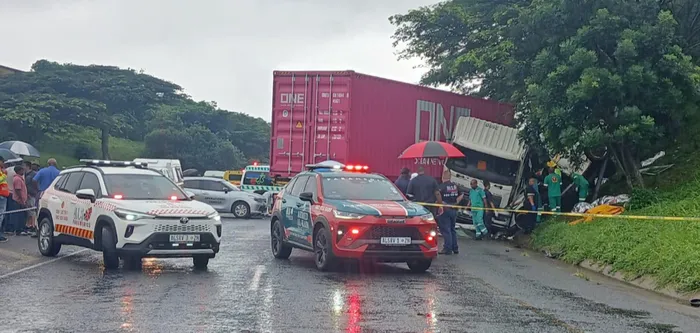
ADVANCED Life Support (ALS) Paramedics have issued a legal demand for retraction and public apology from KZN Transport MEC Siboniso Duma after he accused private ambulance services of 'bulldozing' accident scenes and refusing to treat patients without medical aid.
Image: Doctor Ngcobo / Independent Newspapers
ADVANCED Life Support (ALS) Paramedics have issued a legal demand for retraction and public apology from KZN Transport MEC Siboniso Duma after he accused private ambulance services of 'bulldozing' accident scenes and refusing to treat patients without medical aid.
ALS claimed these statements were 'false, vexatious and defamatory' and had presented evidence contradicting the MEC's claims, while other private emergency services have joined the debate highlighting their crucial role in the province's emergency response system
Duma made the comments on Thursday while addressing media at the scene of the crash in Isipingo which claimed 11 lives.
He was alleged unprofessional conduct and discriminatory practices by the ALS ambulance service.
“When they (ALS) enter the scene they tend to bulldoze. I am sure you know by now that they are also insensitive in some instances. If you don’t have a medical aid they are not going to assist you - if it means you are dying, if it means they could still save you. It is why we prefer you deal with the Department of Health
“I have always mentioned that the MEC of Health is always dispatching qualified and stronger teams on the scene, who are not saying you are going to be excluded,” said Duma.
The comments were broadcast in interviews with SABC, eNCA and Newzroom Afrika and later circulated widely on social media.
According to ALS Paramedics’ attorney, Wesley J. Rogers, the TikTok post alone attracted more than 96,000 views.
In a detailed legal letter addressed to the MEC, Rogers said the statements were “false, vexatious, malicious and defamatory” and had caused serious harm to his client’s professional reputation.
“At the scene in question, our client in fact transported two patients without medical aid to public hospitals (Albert Luthuli Hospital), and it does so on an ongoing basis where required,” Rogers said. He added that ALS assisted four patients at the scene and transported two to hospital, both of whom had no medical aid.
Rogers also challenged Duma’s assertion that the provincial Emergency Medical Rescue Services (EMRS) provided a “stronger” service, alleging that several EMRS vehicles at the scene were operating unlawfully.
He claimed that multiple ambulances and response vehicles did not display valid operating licences as required under the National Health Act and Emergency Medical Services Regulations.
“The EMRS ambulance vehicles which attended the scene were thus operating unlawfully at the time and potentially committing a criminal offence,” Rogers said, adding that EMRS personnel allegedly lacked basic pain medication and an ECG monitor and had requested equipment from ALS.
According to the letter, ALS arrived at the scene an hour before EMRS.
“The EMRS paramedics that attended the scene in question lacked even basic pain-medication and an ECG monitor and had requested the same from our client. By suggesting this service is stronger than our client's service is thus harmful to the public who may follow your misguided opinion and thus risk their own lives by relying on an emergency medical service which lacks the most basic of equipment and medication.”
Rogers further disputed claims that ALS had inflated casualty numbers at a separate accident two weeks earlier, stating that ALS held documentary proof showing assistance was provided to nine school-aged children, not 11 or 12 as alleged.
Beyond the factual disputes, Rogers argued that the MEC had acted outside his constitutional mandate.
“Your authority is strictly confined to transport and human settlements,” he said, adding that Duma’s comments on clinical conduct and billing practices amounted to executive overreach and breached the principle of legality.
The letter demands a full retraction and apology to be issued to all media outlets that carried the remarks, as well as a public apology via the MEC’s communications platforms. ALS has given Duma until 1pm on Monday, February 2, to comply, failing which legal action will follow.
The controversy has prompted broader responses from the private emergency medical sector.
KZN VIP Protection Services spokesperson Gareth Naidoo said the debate highlighted the realities faced by emergency responders on the ground.
“In emergencies, aid should never be delayed, and all patients should be accommodated regardless of circumstances. As emergency service providers, it is critical that leadership and decision makers fully understand what occurs on our roads daily before passing judgment on any service provider. All registered EMS providers undergo strict inspections, regulatory compliance, and continuous training. A core component of this training is medical ethics, which must be applied fairly and realistically. ” he said.
Naidoo emphasised that private EMS providers were not government-funded yet attended to the majority of serious motor vehicle collisions.
“Private EMS providers are not funded by the government, yet they carry a significant burden of emergency response. State ambulance services, due to resource constraints, primarily serve communities that cannot afford private care and often do not respond to the majority of motor vehicle collisions. In practice, private EMS attends to most accident victims across the province,” he said.
“Private EMS providers continue to operate in good faith, prioritising patient care and public safety. However, meaningful engagement, realistic policy, and sustainable funding solutions are essential to ensure that emergency medical services public and private can continue saving lives without compromise,” said Naidoo.
Samantha Meyrick from IPSS Medical Rescue said perceptions of insensitivity often misunderstood the pressures of mass casualty incidents.
“In a mass casualty situation, one has to realise that first responders have to separate their emotions from what they are handling on scene. This can come across as insensitive, but can be crucial for them to do their jobs efficiently.
“The biggest problem state ambulances face is that they are often under-resourced, covering vast areas and communities. This can delay their response time, in some areas where they have sufficient resources or ambulances available, their response time is quick and we all work as a team on scene.
“On a mass casualty scene, patients are triaged and will be provided treatment accordingly, initially there are often not sufficient resources on scene and it could be seen as some patients not receiving treatment when in fact there are those who are in more dire need,” said Meyrick.
Amawele Emergency Services owner Sivan Subramodey also rejected claims that private EMS discriminated based on the ability to pay.
“Amawele Emergency Services continues to render emergency medical care to all patients, irrespective of medical aid status or financial means. In line with emergency care ethics and professional duty, treatment is never delayed or denied based on a patient’s ability to pay. Unlike state services, Amawele Emergency Services does not receive any form of government subsidy or operational support.
“The cost of vehicles, medical equipment, staffing, fuel, and consumables is carried entirely by the organisation. Despite this, care is still provided in critical situations, even when there is no guarantee of reimbursement. This reality places significant financial strain on private emergency service providers, yet the commitment to saving lives remains unchanged. These challenges highlight the importance of collaboration and understanding between public authorities and private emergency services, particularly in a healthcare system where both sectors play a vital role,” said Subramodey.
When asked to comment, Duma's spokesperson Ndabezinhle Sibiya said "This is laughable and the MEC won't be retracting any statement."