

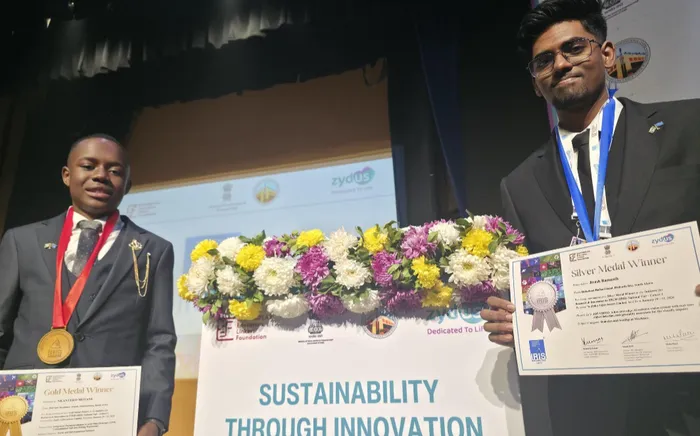
Nkanteko Moyane and Jivesh Ramnath garnered prestigious accolades at the Initiative for Research and Innovation in STEM (IRIS) Global Symposium in New Delhi, India.
Image: Facebook
IN A COMMENDABLE display of innovation and scientific brilliance, young South African scientists Nkanteko Moyane and Jivesh Ramnath garnered prestigious accolades at the Initiative for Research and Innovation in STEM (IRIS) Global Symposium in New Delhi, India.
Representing the nation with pride both pupils showcased their research projects that tackled pressing global challenges, reinforcing South Africa's commitment to fostering scientific talent.
Nkanteko Moyane, a 15-year-old from Daleview Secondary School in Gauteng, was awarded a gold medal for his project titled “Ecoharvest: Integrated Phytoremediation for contaminated soil and mining wastewater.”
His research demonstrated the efficacy of phytoremediation as a viable solution for environmental restoration.
“Winning an award at the IRIS Global Symposium felt great because it showed that my hard work and dedication have been recognised on such a big international platform. I am proud to represent my country and grateful to everyone who supported me along the way, especially Eskom Expo for Young Scientists. I would like to encourage aspiring young scientists to believe in themselves and their ideas. Every ‘failed’ experiment is a step closer to getting it right. With hard work, dedication, and persistence, you can achieve more than you can imagine,” said Nkanteko.
Another medal winner at the event was Jivesh, 18, from Hoërskool Richardsbaai in Richards Bay.
His research project “JØ7 Vireo: Development of a low-cost AI-powered navigation device for the blind and visually impaired”, enabled blind and visually-impaired persons to perceive their environment through real time object identification and distance awareness.
“Winning a silver medal in the computer science category felt exhilarating. It was completely unexpected. My hard work paid off, as the category was extremely competitive with numerous sophisticated projects. The judging was also rigorous and stressful. A highlight of the trip to India was learning about the country’s history and the wonders it holds. The level of technology was mind-boggling, especially among the youth. Meeting so many brilliant minds truly made the trip worthwhile,” Jivesh reportedly said.
Additionally, Melokuhle Khuzwayo and Simesihle Khuzwayo, both 17, from King Bhekuzulu High School in Nongoma, were awarded participation awards for their research project, “Double Trouble, Double Solution: Neutralising acids and plastics with nature’s help.”
“It was exciting and encouraging to be recognised at the IRIS Global Symposium. Being part of the team was a valuable experience, and it was rewarding to see our hard work and preparation pay off. The main highlight of our trip to India was visiting the Taj Mahal. It was an incredible experience because of its cultural and historical importance, as well as its impressive architecture. We learned that there are many similarities between Indian culture and some African cultures, which was fascinating because it shows how connected everyone is at the end of the day,” they said.
The IRIS Global Symposium is structured into two cohorts. This cohort featured 77 young scientists from 17 states and 23 cities, who presented 58 projects. The event served as a platform for top-performing pupils to present scientific solutions to real-world challenges, particularly in environmental sustainability and assistive technology.
Parthy Chetty, Eskom Expo Executive Director, said: “Congratulations to our learners on their outstanding achievements. Their success reflects the exceptional talent, dedication, and innovation that South Africa nurtures. Eskom Expo is proud to have supported these young scientists, as investing in their growth strengthens our country’s future by cultivating leaders who will drive technological advancement, sustainability, and positive social impact. Their achievements stand as an inspiration to learners across South Africa, to participate in the Eskom Expo and to explore the boundless opportunities in science, technology, engineering, mathematics and innovation (STEMI).”