

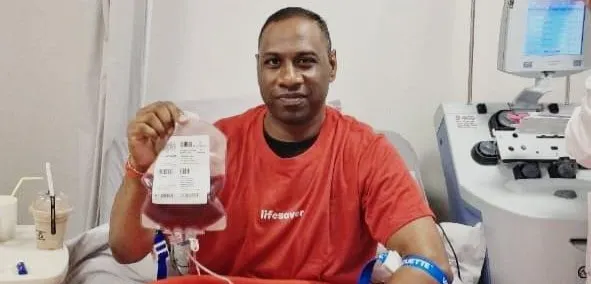
Krishan Shunmugam.
Image: Supplied
ALMOST four years ago, Krishan Shunmugam registered as a stem cell donor, with the hope of being a match for his then six-year-old nephew, who was battling Leukemia.
The 42-year-old of Centurion in Gauteng, said while he was not a match for his nephew, who passed away a year later, he was now able to help another person, by giving them a new lease on life as their perfect match.
On Monday, he underwent a nine-hour stem cell harvesting procedure which would help a person who is battling blood cancer.
Shunmugam, a technical writer, said his journey to becoming a donor started when his twin sister’s son was diagnosed in 2022.
“My sister was looking for a stem cell donor for my nephew, and while doing research found the Deutsche Knochenmarkspenderdatei (DKMS), which is an international nonprofit bone marrow donor center. Their aim is to provide blood cancer patients with a second chance at life. Some of our family members registered with DKMS.
“However, prior to my nephew’s diagnosis I did not know anything about being a stem cell donor or that there were such organisations. It was a very easy process, as it only required a cheek swab. But none of our family members or any other person registered with the DKMS were a match for my nephew. He sadly passed away in 2023,” he said.
Shunmugam said he received a call from DKMS in August last year.
“Once you register with DKMS, you remain on their system. So, when I received that call, I already knew what it meant; I was someone’s match. The person asked me a few questions, one of which was, if I was still interested in being a donor. I said absolutely yes. I was so excited as I had lost many loved ones over the years, and I could now possibly save someone’s loved one.
“In September I underwent blood testing, just to ensure that I was still a perfect match, and was in good health, which I was. Also, all the testing and even travelling costs are covered by DKMS. You are not placed under any financial strain. As we got closer to the donation time, I went for another round of blood tests in December. They again asked if I was still happy to proceed, which I was,” he said.
Shunmugam said he thereafter underwent a physical examination on January 21.
“During the examination, I had a chest X-ray, an ultrasound of my entire body, and more blood tests. The examination is done because of a five-day treatment you have to undergo prior to stem cell harvesting. The treatment is to boost your white blood cell and stem cell production in your body. I started the treatment on January 29. I was informed that there can be side effects, but I was lucky I didn’t experience any.”
Shunmugam said the South African National Blood Service (SANBS) were involved in the stem cell harvesting.
“The SANBS is responsible for all medical examinations and blood tests, and based on the results will advise DKMS if the potential donor can do a stem cell donation.
“On Monday, I arrived at the SANBS’ head office in Mayfair, where I met the nurses and doctor, who took me through to a consultation room for the stem cell harvesting. However, it is not an evasive procedure, it is a simple blood draw. It was initially scheduled for two-days, however, my stem cell count had increased due to the treatment. The doctor decided we would do nine-hours of harvesting, so I would not have to return the next day.
“During the harvesting, specifically in my case, a suction needle was put into my right arm, and a return needle in my left arm. In terms of the process, the blood is sucked out of your body, then goes through a machine which then removes the stem cells, and then returns the blood back to your body. During that process, it is also adding electrolytes and anticoagulants, which is to prevent or reduce blood clot formation. During the process there were two nurses present at all times, physically examining me to make sure there were no blood clots, blisters, or anything out of the ordinary,” he said.
Shunmugam said the process was a success.
“I was perfectly well after the procedure, there were no complications.”
Shunmugam said while he did not know who was the recipient, he wished them a speedy recovery.
“We are not informed of who the person actually is, but I do know it is someone from abroad. Furthermore, the patient's team was sitting in the next room, waiting for the harvest to be completed, so they could rush with the stem cell donation.
“Furthermore, the feeling of knowing I have been instrumental in saving a life is unexplainable. My only hope is that the person fully-recovers from cancer, and is able to lead a normal, happy life with their family. I also encourage others to register to become stem cell donors, as it may be your family member that may need help one day, and you can save them,” he said.