

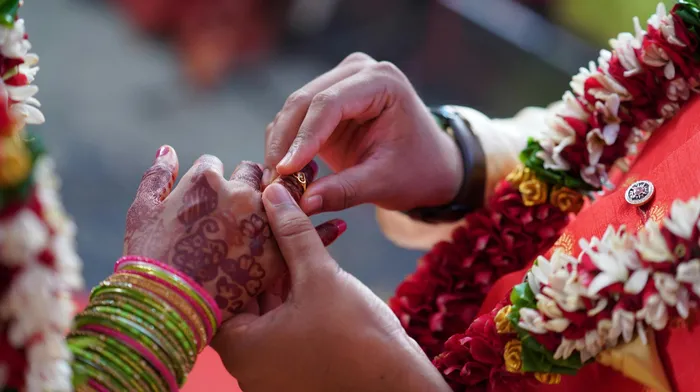
The case challenges the constitutionality of marriage and divorce legislation, arguing that Hindu marriages deserve the same legal protections as civil and Muslim marriages.
Image: Vinod puli/Pexels.com
FOR almost two years, an uMhlanga woman has continued in her court bid to claim what she believes she is entitled to after being left “empty-handed” following the dissolution of her Hindu marriage, which is not recognised under South African law.
The case challenges the constitutionality of marriage and divorce legislation, arguing that Hindu marriages deserve the same legal protections as civil and Muslim marriages.
The woman, who is represented by attorney Avir Maharaj and advocate Matthew Rudling, took her “former husband”, as well as the minister of home affairs, and minister of justice and constitutional development, to the Durban High Court.
According to the woman’s court papers, she and her former husband were married by Hindu rights in 2009. They had one child born in 2013. She said during this time, they lived together as husband and wife with their child, and both parties contributed money, resources, income, skills and labour for their joint benefit and profit. The woman said she tended to the household, her former husband and child. She said this was done at the behest of her former husband. Therefore she contributed her resources, skills, and time for the joint benefit of a profit of the partnership.
She said she periodically contributed income towards the household, but she was unable to continue doing so due to the time consuming nature of her duties. The woman said she believed she was entitled to a transfer of a half-share of the assets of her former husband’s marital estate. The woman further said in her court papers, that various sections of the Divorce Act 70 of 1979, and Section 11 of the Marriage Act 25 of 1971, were unconstitutional and invalid as they infringed on her rights as contained in the Constitution.
She said, among other things, that her rights in terms of Section 2 and Section 7(2) of the Constitution had been infringed as the State had failed to promote the rights of equality, dignity, rights of children, and access to courts for persons married in terms of an unregistered Hindu marriage. The woman said persons married in terms of civil marriage registered in terms of the Marriage Act or in an unregistered Muslim marriage, which was presided over by a registered or unregistered Imam, are afforded rights, but not those married under Hindu rites.
She said she did not enjoy the equal protection and benefit of the law as persons married in a Hindu marriage were deprived of the full and equal enjoyment of all rights and freedoms enjoyed by other persons married in terms of the Marriage Act. The woman said she required maintenance of R20 000 for herself and R11 700 for the child per month, and that a liquidator be appointed to determine and divide equally assets that stemmed from the partnership.
She asked that the various clauses on marriage and divorce be amended and publicised thereafter.
However, her former husband, through his legal representatives, submitted an exception (legal objection) in response to the woman’s particulars of claim. He said the woman relied on the case of the Women’s Legal Centre Trust vs President of South Africa and others, for the relief she sought.
The former husband’s court papers read: “However, the Women’s Legal Centre Trust case is distinguishable from the plaintiff’s (the woman) circumstance because that case relied on the premise that the Marriage Act is applicable to polygynous (Muslim) marriages, and therefore Muslim women are unable to avail themselves of the existing legislative protections. Applying this dictum to Hindu rights marriages, the plaintiff has to factually demonstrate that the relief she seeks does not contradict the religious tenets of the Hindu faith, and this she failed to do.”
In the court papers, the man stated the woman in her claims said the present law failed to recognise unregistered Hindu rites marriages, and did not provide mechanisms to safeguard the welfare of minor or dependent children. The man said in his court papers that the Children’s Act and Maintenance Act provided mechanisms for dependent children without discriminating as to the type of marriage that existed or whether a marriage existed at all.
“As such, the plaintiff’s allegations are bad in law …”
He said in his court papers that the woman’s claims that Section 11 of the Marriage Act was inconsistent with Sections 9 and 10 of the Constitution, as it failed to recognise the validity of Hindu marriage which was concluded by a priest who was not a registered marriage officer, but allowed for an exception for an Imam, was “vague and embarrassing”.
“Section 3 of the Marriage Act expressly provides that ‘any person holding a responsible position in any religious denomination or organisation to be a marriage officer including the rights of any Indian religion’. A Hindu priest is therefore capable of registering as a marriage officer and performing a civil marriage for a Hindu couple, in addition to a Hindu rites marriage.
“There were no lawful impediments to the solemnisation of the intended marriage between the plaintiff and defendant (the man), but they deliberately elected to not conclude a civil marriage in terms of the Marriage Act,” the court papers read.
On Tuesday (yesterday), Judge Murray Pitman ordered the exceptions be dismissed, and the costs were reserved for decision of the trial court. He further ordered that the former husband deliver his plea in compliance with the rules of the high court.